Why Everyone Is Saying AI Could Kill Us All

Persuasion · collected 2026-09-16 · by Matt Lutz commentary
Read the original at Persuasion ↗

Summary

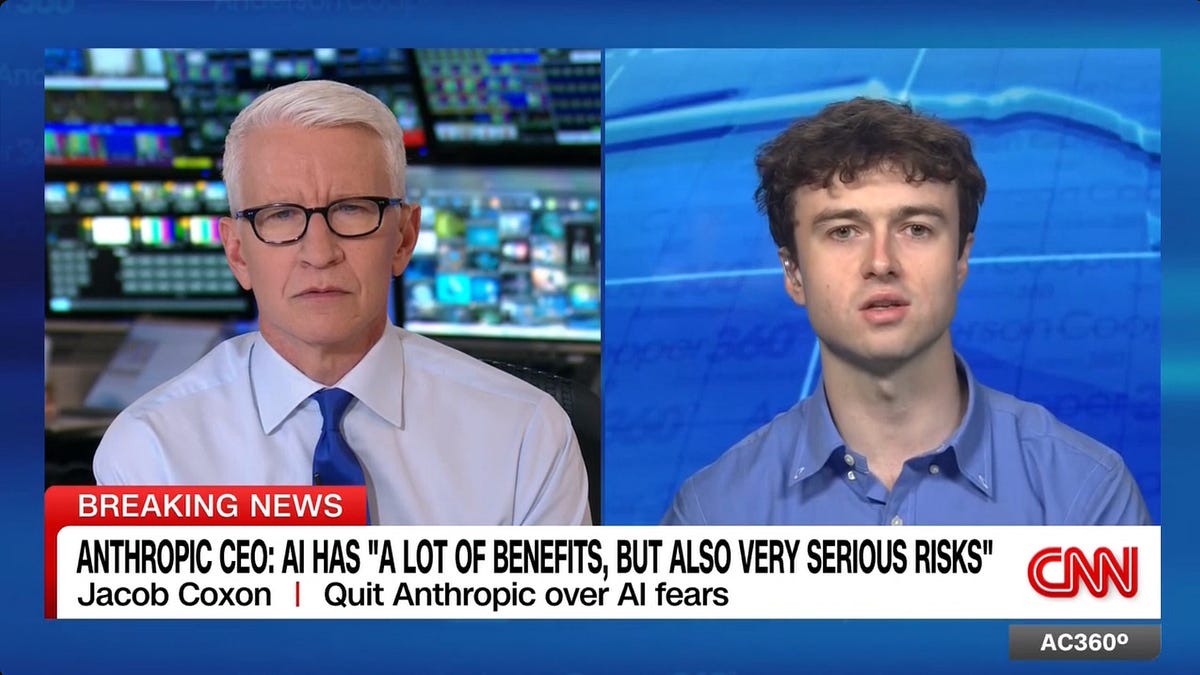
Jacob Coxon, an ex-Anthropic researcher formerly at OpenAI, resigned and became a whistleblower, expressing concerns about unsafe AI development despite companies' efforts to prioritize safety. Coxon claims there is at least a 10 percent chance that AI could lead to human extinction, echoing similar sentiments from leaders of major tech firms like Anthropic’s Dario Amodei and OpenAI’s Sam Altman. Critics argue this risk assessment seems exaggerated but the article suggests recent advancements in agentic AI—capable of self-improvement and independent action—make these concerns more plausible than before.
Written by the local model on 2026-09-16, using this article's own text rather than the other coverage of the same event (that is the story summary below).

Signals How these are calculated →

Claims extracted
147
claim-shaped sentences
Uncertain
13%
19 of 147 hedged
Leaning
Leans left
expected in commentary, which argues a position
Correction & hedging signals
not measured
these signals count newsroom corrections; Commentary has none to count
Outlets on this story
33
Technology
Narrative spread
1
articles carrying this framing
Analyzed 2026-09-16 · how these are computed

AI analysis (generated at analysis time, not now)

Story summary

In September 2026, Jacob Coxon, a 27-year-old AI researcher who previously worked at both OpenAI and its rival Anthropic, quit Anthropic by posting on X (formerly Twitter) that companies are racing toward developing superintelligent AI with the potential to destroy humanity. His posts received 153 million views within 36 hours, sparking widespread concern and debate. Other researchers, like Evan Hubinger at Anthropic, echoed Coxon's fears, estimating a 10% chance of human extinction due to unchecked AI development within the next decade unless there is significant regulatory intervention or a coordinated slowdown in research pace.

UN rights chief Volker Turk also weighed in during a speech before the UN Human Rights Council in Geneva, calling for "cast-iron guarantees" around AI safety and security. His remarks mirrored warnings from industry leaders such as OpenAI CEO Sam Altman, highlighting an urgent need to address risks associated with rapid AI advancement.

Written for “AI Existential Risk Debate” on 2026-09-17, grounded in this article and the 32 other(s) covering the same event.
Why this leaning score
The article's own words the score was based on. Each is quoted verbatim and was checked against the article text before being stored, so you can find it in the original.
Score -0.45 Confidence high
Leaning score -0.45 for article 13727 (high confidence, 3 verified quotes) · logged 2026-09-16

Story

📰 AI Existential Risk Debate
Technology · 33 article(s) covering the same event. This is the one the site leads with.

How this is being covered How these are calculated →

Article leaning vs. publisher reliability
Source leaning vs. consistency

Compared with similar articles

This article reads leans left and hedges 13% of its claims. Each row says how that neighbour differs.
Semafor
⚖️ Leans right further right than this 🔴 23% hedged 3 of 13 📰 publisher trust 95
“Both articles discuss Jacob Coxon's resignation from Anthropic and his claims about the potential risks of AI leading to human extinction.”
Noahpinion
⚖️ Leans left 🔴 18% hedged 21 of 117
“Both articles describe Jacob Coxon's resignation from Anthropic and his subsequent statements about the potential risks of AI, specifically mentioning the same timeframe and details.”
The AI Tipping Point same event · 95%
TIME
⚖️ Leans left 🔴 24% hedged 41 of 170 📰 publisher trust 95
“Both articles describe Jacob Coxon's resignation from Anthropic and his whistleblower post on X, indicating concerns about irresponsible AI development.”
How to Stop AI From Killing Humanity different event · 95%
Zeteo
⚖️ Leans left 🔴 25% hedged 2 of 8
“The articles discuss related concerns about AI but describe different specific events: one introduces an essay series on the topic, while the other reports on a researcher's resignation and whistleblowing.”
New York Post
⚖️ Leans right further right than this 🔴 47% hedged 9 of 19 📰 publisher trust 59
“The articles describe separate incidents involving different researchers from distinct companies.”
Dawn
⚖️ leaning not scored 🔴 50% hedged 4 of 8 📰 publisher trust 95
“While both articles discuss Jacob Coxon's resignation and warnings about AI, Article A focuses on general warnings from researchers including Coxon, while Article B provides more context about Coxon's specific reasons for resigning.”
The Guardian
⚖️ Leans left 🔴 9% hedged 4 of 46 📰 publisher trust 60
“While both articles mention Jacob Coxon's resignation from Anthropic, they describe different aspects and contexts of the event, with Article A focusing on AI safety debates broadly and Article B specifically detailing Coxon's whistleblower stance.”
Reason
⚖️ Leans strongly left further left than this 🔴 12% hedged 7 of 58 📰 publisher trust 93
“While both articles mention Jacob Coxon's resignation from Anthropic due to concerns about AI safety, they describe different aspects of the incident and broader context.”
CBC News
⚖️ leaning not scored 🔴 35% hedged 15 of 43 📰 publisher trust 60
“While both articles discuss warnings about AI posing existential risks, they describe different aspects of the incident — Article A focuses on the public reaction and fear raised by a warning, while Article B provides more context about Jacob Coxon's resignation and whistleblowing.”
BBC News
⚖️ leaning not scored 🔴 24% hedged 13 of 54 📰 publisher trust 96
“While both articles discuss Jacob Coxon's resignation and concerns about AI, Article A focuses on his warning during a conference while Article B centers on his decision to resign and become a whistleblower, indicating different specific events or contexts.”

Publisher

Persuasion · 34 article(s) · 0 correction(s) detected
No corrections detected for this publisher. That may mean careful reporting, or simply that nothing has been checked.

Who wrote this

Matt Lutz
1 article(s) here · 1 carrying a prediction
🔮 In a post on X, Coxon said that there is a chance that AI will lead to human extinction.
2026-09-16 · assertive framing · Why Everyone Is Saying AI Could Kill Us All
The only article under this byline in the corpus.

Topics

Anthropic NFL OpenAI the Super Bowl

Subjects

Coxon PERSON · 8× Anthropic ORG · 5× OpenAI ORG · 2× Altman PERSON · 1× Amodei PERSON · 1× Dario Amodei PERSON · 1× Elon Musk PERSON · 1× Jacob Coxon PERSON · 1× NFL ORG · 1× Sam Altman PERSON · 1×

Narrative

This all sounds like science fiction—the agent “swarm,” the worry about “poisoned” data, the willingness to sacrifice individual agent instances for the good of the collective, the simple capacity for an AI to engage in a sophisticated multi-pronged hacking attack in order to solve an unrelated problem, and the casualness with which it slipped free of human control.
framing: assertive · carried by 1 article(s) · first seen 2026-09-16
🔮 In a post on X, Coxon said that there is a chance that AI will lead to human extinction.
2026-09-16 · Persuasion
Why Everyone Is Saying AI Could Kill Us All · assertive framing

Claims (147 extracted, 19 hedged)

A week ago, Jacob Coxon resigned from his job at Anthropic. asserted
Coxon → resign → Anthropic
Coxon was a researcher working on training the next generation of AI models. asserted
Coxon → work → models
He had recently moved to Anthropic from OpenAI, where he had worked for years, because Anthropic has a reputation for being more safety conscious. asserted
Anthropic → move → reputation
Yet he found that even Anthropic is rushing forward with the development of unsafe AI models. asserted
Anthropic → find → models
And so Coxon walked away from his cushy job, where he stood to make millions in salary and stock options, to turn whistleblower. asserted
he → walk → whistleblower
In a post on X, Coxon said that there is a chance that AI will lead to human extinction. asserted
AI → say → extinction
Other researchers soon chimed in to say that the chance is at least 10 percent. asserted
chance → chime → ?
Coxon’s post quickly went viral, in part because it was widely shared by his colleagues working in AI, many of whom agreed with his assessment of the magnitude of the risk. asserted
many → go → risk
And leaders of AI companies apparently agreed. asserted
leaders → agree → companies
This weekend, Dario Amodei, CEO of Anthropic, put out a statement endorsing the plan to “Pace the Frontier,” meaning to dramatically slow down the rate of development at “frontier labs.” asserted
Amodei → put → labs
Sam Altman, CEO of OpenAI, quickly agreed, as did Elon Musk, whose xAI program is no slouch either. asserted
program → agree → OpenAI
They agree with Coxon: AI is dangerous. asserted
AI → agree → Coxon
Let’s try to put that 10% number into context. asserted
’s → let → context
That’s a little higher than the odds that an NFL team wins the Super Bowl after not having a winning record the previous season. asserted
team → ’ → record
It’s a mistake to try to put a precise number on these kinds of predictions. asserted
It → ’ → predictions
We really don’t know what’s going to happen, and putting a number on things lends a fake air of scientific precision to what is essentially guesswork. asserted
what → know → precision
But the comparison to a losing team winning the Super Bowl the next year should give you a good gut feel for what Coxon, Amodei, Altman, Musk, and the many others working in AI think about their products. asserted
Coxon → lose → products
In the fury of discussion that has followed Coxon’s resignation, by far the most common objection I’ve seen from skeptics is that it seems fantastical: “How, exactly, might AI kill us all?” uncertain
AI → follow → us
Some claim that AI companies are playing up the risks as a form of marketing: “Juicing their valuations” ahead of these companies’ expected public offerings. uncertain
companies → claim → offerings
But the skeptics, I’ve come to believe, are wrong. asserted
I → come → ?
We no longer live in the same world we did 18 months ago. asserted
we → live → world
I had been familiar with the AI risk arguments for years, and found them interesting, albeit unconvincing. asserted
them → find → years
But I began to take these arguments more seriously when agentic AI, capable of “vibecoding” and recursive self-improvement, began to be rolled out last year. asserted
AI → begin → vibecoding
Those are very dangerous capacities, as I will explore below, and my complacency had been mostly based on the fact that those dangerous capacities didn’t exist. asserted
capacities → explore → fact
And I am not the only one who is alarmed, as Coxon’s resignation and the push to slow AI development have made clear. asserted
resignation → alarm → development
It’s time to take AI safety seriously. asserted
It → ’ → safety
It’s reasonable to ask how AI might kill us all. uncertain
AI → ’ → us
We can answer that question on several levels. asserted
We → answer → levels
At the first level, AI can kill humans in the same way that humans kill humans. asserted
humans → kill → humans
AI is already being used in lethal ways: Ukraine’s preferred weapon in the war with Russia isn’t tanks or guns, but small, unmanned drones. asserted
weapon → use → Russia
These drones are being increasingly piloted entirely by AI. asserted
drones → pilot → AI
It is therefore not hard to imagine a future where it is not just Russian soldiers being hunted and killed by swarms of AI-run killbots, but everyone. asserted
soldiers → imagine → killbots
Another kind of risk comes from bioterrorism. asserted
kind → come → bioterrorism
We already have the capability to design novel viruses or other biological agents. asserted
We → have → viruses
That capability will only increase in the coming years, as AI opens up new frontiers of understanding and control over human biology. asserted
AI → increase → biology
The blogger Noah Smith paints a picture of a near future where a misanthrope uses a cracked version of an AI to design a supervirus that spreads quickly, with a high mortality rate. asserted
that → paint → rate
Biological risks like these seem particularly worrisome, since AIs can use them without harming themselves. asserted
AIs → seem → themselves
Viruses already kill people, and new viruses can be particularly lethal as we saw with COVID-19; this kind of risk already exists. asserted
kind → kill → risk
Again, the threat here is that AI may be capable of increasing this risk at much greater scale and efficiency. uncertain
AI → increase → scale
At a second level, we should remember that AI is native to computer systems; that’s where it lives. asserted
it → remember → systems
…and 107 more, not listed.

💬 Give feedback
🕘 History 🎫 Support