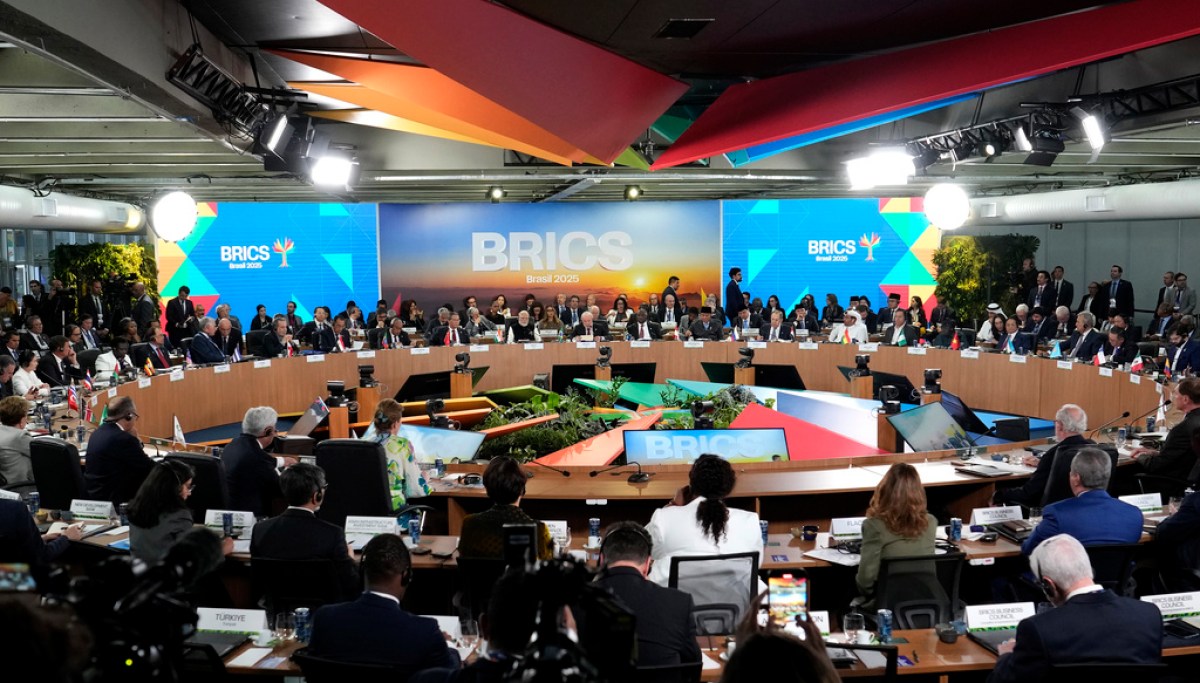
The Hindu’s foreign affairs experts discuss India's strategic balancing act during the 18th BRICS summit hosted by Prime Minister Narendra Modi in Delhi from September 12-13. The summit took place amid tensions caused by ongoing conflicts in West Asia, particularly the U.S.-Israel war on Iran and Israel's actions against Lebanon and Palestine. Diplomatic editor Suhasini Haidar highlights that despite these challenges, BRICS members reached a consensus on fostering economic development through cooperation in food, fuel, fertilizer security, and trade, reflecting their shared view of an unfair international order needing reform. The Delhi Declaration also included strong criticism directed at Israel over its actions in Gaza and Lebanon.
Written by the local model on 2026-09-15,
using this article's own text rather than the other coverage of the
same event (that is the story summary below).
(This article is part of the View From India newsletter curated by The Hindu’s foreign affairs experts.
asserted
article → curate → experts
But it also positions itself as a key voice of the Global South and maintains close strategic and economic relationships with Russia and China, respectively.
asserted
it → position → Russia
This balancing act was on display on September 12-13 when India hosted the 18th BRICS summit in Delhi.
asserted
India → host → Delhi
Any summit that brings together the leaders of India, Russia and China assumes strategic significance.
asserted
that → bring → significance
This time it was even more consequential because it took place amid an ongoing and widening conflict in West Asia, India’s extended neighbourhood.
asserted
it → take → Asia
Prime Minister Narendra Modi was in Israel in February, just days before Israel and the U.S. launched their war on Iran.
asserted
Israel → launch → Iran
More than six months into the war, Mr. Modi was seen walking hand in hand with Iran’s President Masoud Pezeshkian in Delhi.
asserted
Modi → see → Delhi
India doesn’t see a contradiction in these positions.
asserted
India → see → positions
Rather, they are part of New Delhi’s multi-engagement approach, rooted in both India’s continued rise and in the emergence of a more balanced international order.
asserted
they → root → order
Groupings such as BRICS play a critical role in shaping the latter.
asserted
Groupings → play → latter
We atThe Hinduhave been covering the summit rigorously from Delhi.
asserted
We → cover → Delhi
To get a ringside view of the meet and its key takeaway, I turned to Suhasini Haidar, our diplomatic affairs editor.
asserted
I → get → Haidar
She says there is a growing consensus among BRICS members that the current international order is unfair and unjust and needs to change.
asserted
order → say → members
Read what she has to say:
asserted
she → read → what
The main takeaway from the BRICS summit is that it’s always possible for diplomacy and as consensus-building to override bilateral narratives and conflicts.
asserted
diplomacy → ’ → narratives
This was perhaps the most difficult BRICS summit in recent years at which to forge consensus.
asserted
This → forge → consensus
That was largely because of the U.S.-Israel war on Iran, which began on February 28.
asserted
which → begin → February
India as the host is in a particular position where it is close to the U.S. and very close to Israel but it also wanted to forge a consensus while maintaining its ties with other BRICS members, particularly Iran.
asserted
it → want → members
That’s how a consensus was eventually built, through a compromise of positions by all the parties.
asserted
consensus → ’ → parties
Another big takeaway is that apart from the Big 2 –Russia and China – these are emerging economies that are primarily seeking economic development for their respective countries.
asserted
that → emerge → countries
Some of the BRICS consensus has been forged around that idea: food, fuel and fertilizer security and trade.
asserted
Some → forge → idea
These are the areas in which these countries want to work together.
asserted
countries → want → which
How did the Delhi Declaration address the conflicts in West Asia?
asserted
Declaration → address → Asia
The Delhi Declaration addressed the conflicts in West Asia in great detail, with very strong criticism of Israel, for example, over its actions in Lebanon and Palestine, particularly in Gaza.
asserted
Declaration → address → Gaza
However, the U.S.-Israel strikes on Iran, the assassination of Ayatollah Khamenei, and Iran’s strikes on its neighbours, particularly the UAE [another BRICS member], found no mention.
asserted
strikes → find → mention
It is also very clear that the basic difference that held up consensus was between the UAE and Iran.
asserted
that → hold → UAE
Iran wanted a strong condemnation of the U.S. and Israeli attacks on it, but the UAE wanted an equal condemnation of Iran’s attacks on its neighbours.
asserted
UAE → want → neighbours
Iran, of course, has consistently said it cannot agree to this because, as a member state, it cannot be seen criticising itself, and, secondly, it considers these attacks were in self defence.
asserted
attacks → say → defence
This basic contradiction between the two was resolved through a compromise: both sides were told that brother would get its way.
asserted
brother → resolve → way
There was a third compromise, and that concerned India’s position on Israel – there are very strong paragraphs criticising Israel, including a reference to South Africa’s case against Israel at the ICJ.
Sceptics argue that BRICS is a China-dominated grouping and that it is internally divided.
asserted
it → be → ICJ
Were internal divisions apparent in Delhi or would you say the grouping is coming of age as Mr. Modi said?
asserted
Modi → say → age
Unlike G7, where there is a very uniform view of the world, BRICS doesn’t have a uniform vision of how the world should look.
asserted
world → be → vision
But it does have a shared view that the world at present is imbalanced, unfair and unjust.
asserted
world → have → view
That’s what holds these countries together.
asserted
what → ’ → countries
The idea that BRICS would not have internal divisions, like the G7, is unfair because BRICS emerged from countries that are not part of the G7, they are not part of the Western consensus.
asserted
they → emerge → consensus
The idea of China dominating BRICS grouping would be true in terms of economics because China is by far the biggest economy among the members.
asserted
China → dominate → members
But I don’t think this is just about the size of economies.
asserted
this → think → economies
It is also about countering western sanctions and tariffs, and there is a consensus on this front.
asserted
It → counter → front
Where BRICS is divided is on bilateral issues.
asserted
divided → divide → issues
India and China are the biggest examples, but BRICS provides a platform for the two countries to meet.
asserted
countries → provide → platform
…and 6 more, not listed.
 The Aporia