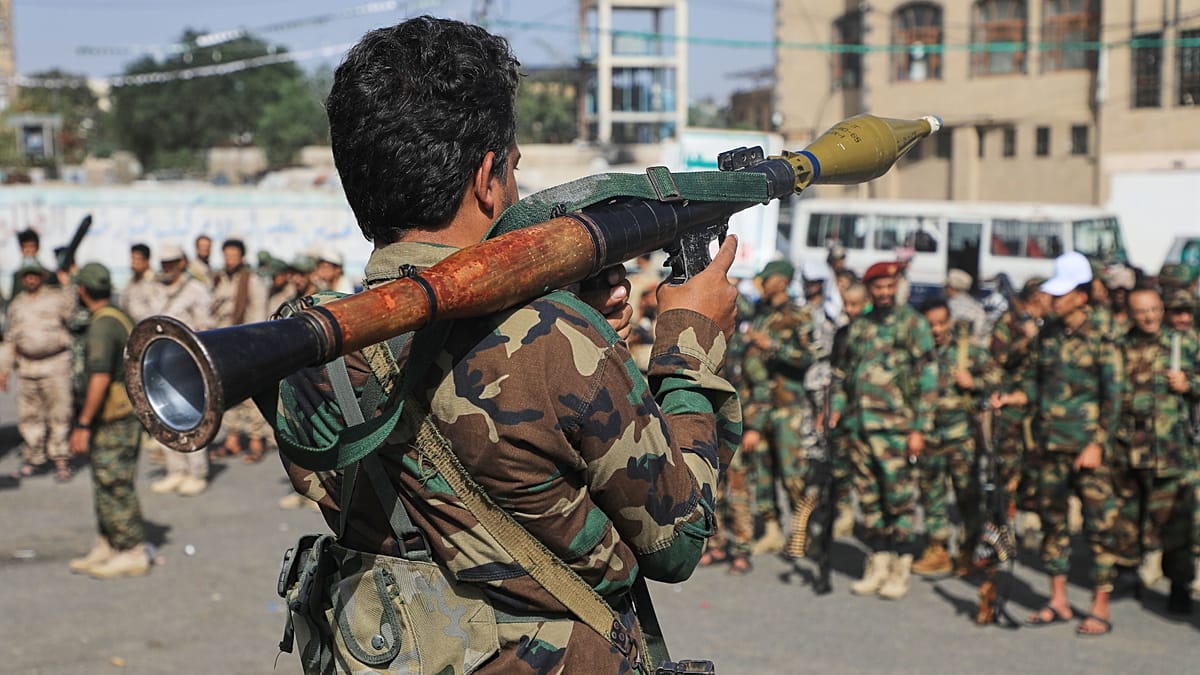
The rapid advance by Yemen’s Houthis down the country’s Red Sea coast has raised questions over whether the group could turn its territorial gains into new sources of revenue, adding to an already extensive war economy.
uncertain
group → raise → economy
But the Houthis already had control of large sections of the Red Sea coast, including the major port city of Hodeidah, and the financial benefits associated with that.
asserted
Houthis → have → that
Their military gains over the past week do not necessarily change the restrictions they have to deal with as an internationally unrecognised governing authority.
asserted
they → change → authority
Recommended Stories
list of 3 items- list 1 of 3Syria fuel price hikes test public patience with economic recovery
- list 2 of 3Why
asserted
hikes → test → recovery
the Houthi advance towards Yemen’s Marib, Taiz matters
- list 3 of 3Temporary Hormuz solution deferred as Iran-Arab summit falls through
asserted
summit → defer → matters
Ahmed al-Shalafi, Al Jazeera’s Yemeni affairs editor, said that the advance has been a “geographical and military gain” but not an economic one, as it doesn’t remove the international sanctions that have been placed on it, which severely restrict their ability to commercially exploit the new territory under its control through formal international channels.
asserted
which → say → channels
But the Houthis already enjoy significant financial benefits from their long-time control of northwestern Yemen, the most populous part of the country.
asserted
Houthis → enjoy → country
Since the Houthis’ capture of the capital Sanaa in September 2014, the group has developed a centralised financial system to collect revenues through taxes, customs duties, zakat (religious alms), and other levies.
asserted
group → develop → taxes
A July report by the Mokha Center for Strategic Studies described this as a “parallel economy”, estimating that the system generated direct and indirect financial resources and costs worth approximately $2.5bn annually.
asserted
system → describe → resources
Of that total, the report estimated that around $800m came from taxes and customs, $600m from additional feeds and levies, and $300m from cash and in-kind contributions to the war effort.
asserted
m → estimate → effort
It also counted about $100m linked to mobilisation events and another $700m in indirect costs borne by businesses through higher transport, service, and fee-related expenses.
asserted
It → count → transport
The Houthi authorities have also revoked the licenses of 4,225 established commercial agencies – the legal local representatives for foreign companies – according to a July report by Sana’a Center for Strategic Studies, which said the move could pave the way for businesses affiliated with the group to take their place.
uncertain
businesses → revoke → place
For their part, the Houthis defended the move, claiming that the agencies had not renewed their registrations for three years.
asserted
agencies → defend → years
But Houssam al-Saeedi, an economic researcher and the head of the Economic Studies Program at the Yemen and Gulf Center for Studies, told Al Jazeera that he viewed the restructuring as deliberate.
asserted
he → tell → restructuring
“It seizes companies belonging to existing merchants and manages them in favour of the [Houthis],” al-Saeedi noted.
asserted
Saeedi → seize → Houthis
“What is happening is a network aimed primarily at bringing about a change or replacement of capital; so that even in the event of reaching a political settlement or a military victory, this group retains financial sources in the future.
asserted
group → happen → future
The Houthis reject the characterisation of their economic policies as simply an effort to tighten control over the private sector, saying measures introduced in recent years are intended to encourage domestic production, investment and small businesses, and simplify commercial regulation.
asserted
measures → reject → regulation
Reshaping the private sector
Houthi commercial activity has increasingly shifted towards sectors that offer the greatest potential for revenue collection and control.
asserted
that → reshape → collection
The Mokha Center data showed that 26 percent of the nearly 68,000 commercial records analysed by the study were in general trade and imports, followed by food commodities at 18 percent.
asserted
percent → show → percent
“The Houthi group established a completely separate system, based on creating an internal economy parallel to the actual available economy first,” al-Saeedi explained to Al Jazeera.
asserted
Saeedi → establish → Jazeera
He said the group uses state mechanisms to collect official taxes while simultaneously extracting non-state levies.
asserted
group → say → levies
“There are various, long, and large collection operations under the name of ‘supporting the war effort’ and others, and these are not taken through government mechanisms.”
asserted
these → be → mechanisms
Beyond revenues raised inside Yemen, the US government says illicit oil trading has become one of the Houthis’ most important sources of external financing.
asserted
trading → raise → financing
The US Treasury Department alleged in January that the Houthis generate more than $2bn annually through illicit oil sales.
asserted
Houthis → allege → sales
It said Iran sells and provides oil to the group, including free monthly shipments, using Iranian-owned or affiliated companies based in Dubai.
asserted
Iran → say → Dubai
Al-Saeedi said that the group has long prioritised the energy sector.
asserted
group → say → sector
“These companies work primarily as a front for money laundering for the group,” he stated, adding that smuggled oil could provide direct income through domestic sales and monopoly pricing.
uncertain
oil → work → sales
Al-Saeedi said that the Houthis used a range of illicit channels to move weapons, oil, and money, including smuggling networks and financial laundering.
asserted
Houthis → say → networks
Another source of Houthi financing, he said, came from Iranian oil sold to third parties, with the proceeds transferred to the group through complex financial networks, including cryptocurrency transactions and local exchange houses.
asserted
proceeds → say → transactions
The networks operate under extensive international sanctions.
asserted
networks → operate → sanctions
The US designates the Houthis as both a “Foreign Terrorist Organisation” and a “Specially Designated Global Terrorist” group.
asserted
US → designate → Organisation
The United Nations Security Council separately lists the Houthis under its Yemen sanctions regime, subjecting the group to a targeted arms embargo.
asserted
Council → list → embargo
“Cutting off external funding to the Houthis may lead to suffocating them, but they have other sources of income, of course,” al-Shalafi said.
uncertain
Shalafi → cut → course
The Houthis have previously denied using Iranian fuel to finance their operations.
asserted
Houthis → deny → operations
A domestic economic crisis
The Houthis’ extensive revenue-raising network exists alongside a deepening economic and humanitarian crisis in the areas it controls and across Yemen more broadly.
asserted
it → raise → Yemen
The UN estimated in March that 22.3 million people in Yemen require humanitarian assistance and protection.
asserted
people → estimate → assistance
In Houthi-controlled areas the crisis is compounded by the fact that public sector employees have not received salary payments for years.
asserted
employees → control → years
The economic misery has led to increasing public criticism of the Houthis in the areas under their control, despite the group’s intolerance for dissent.
asserted
misery → lead → dissent
Al-Shalafi pointed out that the group’s regional actions are deeply tied to this domestic reality, seeking an escape from crises over unpaid salaries and high prices.
asserted
actions → point → salaries
“They transformed these economic crises into a combat priority, turning them into war, confrontation, and mobilisation,” al-Shalafi said.
asserted
Shalafi → transform → war
…and 8 more, not listed.
 The Aporia