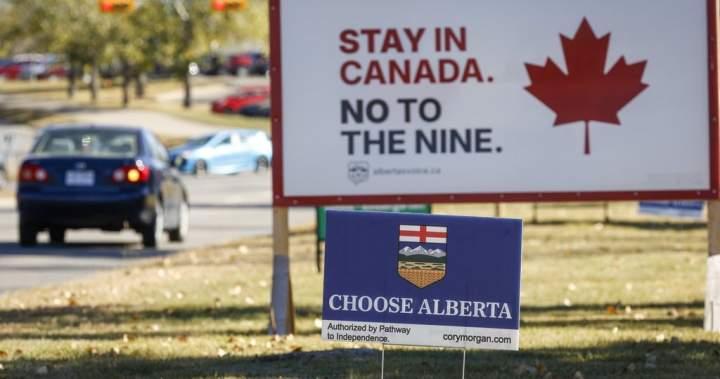
Why results of Alberta's immigration referendum might not mean what voters think

Read the original at Toronto Star ↗
Cite

Keung, N. (2026, October 21). Why results of Alberta's immigration referendum might not mean what voters think. Toronto Star. https://www.thestar.com/news/canada/alberta/why-results-of-alberta-s-immigration-referendum-might-not-mean-what-voters-think/article_7d125f23-acba-4c72-9e89-61bbcca8be0d.html

Dated from the outlet's own feed. Check the original for its byline.

Toronto Star · collected 2026-10-21 · by Nicholas Keung

Quick Summary

Albertans voted in a referendum on Monday where they supported giving the province more control over immigration and restricting access to provincial services for non-permanent residents. The majority favored measures such as prioritizing economic migration, imposing residency requirements, and charging fees for temporary residents' use of health care and education. However, experts suggest these results might not lead to significant practical changes, noting that immigration policy is federally controlled. Immigration advocates argue the referendum questions were misleadingly framed and see the close margins as a sign of Albertans' reasonable attitudes toward newcomers.
Written locally by qwen2.5:14b on 2026-10-21, using this article's own text rather than the other coverage of the same event (that is the story summary below).

AI analysis runs on qwen2.5:14b, locally

Story summary

Advance polling for Alberta's referendum on separation from Canada and other constitutional issues opened on July 19, 2026, with regular voting taking place until October 19. On October 21, results showed that about 75% of voters rejected starting a path toward separation, giving Prime Minister Mark Carney a boost in his push for national unity amid US President Donald Trump's trade war and annexation threats. The referendum included ten questions, with the last asking if Alberta should commence legal processes to hold a binding provincial referendum on separating from Canada; this question was overwhelmingly rejected. While many Albertans supported more control over immigration policies, the overall vote indicated strong support for remaining part of Canada.

Written for “Alberta Separation Referendum Voting Opens” on 2026-10-21, grounded in this article and the 93 other(s) covering the same event.
Why this leaning score
The article's own words the score was based on. Each is quoted verbatim and was checked against the article text before being stored, so you can find it in the original.
Reading Leans strongly left (beta estimate) Confidence high 1 quote(s) discarded as not found in the article
Leaning: leans strongly left for article 95776 (high confidence, 1 verified quote) · logged 2026-10-21

Story

📰 Alberta Separation Referendum Voting Opens
Politics · 94 article(s) covering the same event. Compare every outlet's account →

Compared with similar articles

This article reads leans strongly left and hedges 8% of its claims. Each row says how that neighbour differs.
The Globe and Mail · 0.88 cosine similarity
⚖️ Leans right further right than this 🔴 3% hedged 1 of 30 📰 publisher trust 53
“Both articles discuss the results of a single referendum held on October 20, 2026, in Alberta, focusing on immigration and constitutional reform.”
Alberta voters weigh future in Canada different event · 95%
NPR
⚖️ leaning not scored 🔴 9% hedged 5 of 54 📰 publisher trust 60
“Article A discusses a nonbinding referendum on Alberta's independence, while Article B focuses on the results of a different referendum concerning immigration and constitutional reform.”
Toronto Star
⚖️ Leans strongly left 🔴 12% hedged 4 of 32 📰 publisher trust 63
“Article A discusses potential implications of Alberta's sovereignty referendum, while Article B focuses on the results and interpretation of the actual referendum. They refer to related but distinct events.”
CBC News
⚖️ leaning not scored 🔴 6% hedged 3 of 48 📰 publisher trust 74
“Article A discusses economic perspectives on temporary residents' tax contributions versus benefits, while Article B reports on the results of an actual referendum regarding immigration and services for non-permanent residents.”
Toronto Star
⚖️ Leans strongly left 🔴 4% hedged 2 of 45 📰 publisher trust 63
“The articles describe different aspects of Alberta's political situation: one focuses on the upcoming referendum and its perceived deception, while the other discusses the results of a separate immigration-related referendum.”
The Globe and Mail
⚖️ Leans left further right than this 🔴 0% hedged 0 of 21 📰 publisher trust 53
“While both articles discuss results from Alberta's referendum, they focus on different aspects of the vote and do not describe the exact same incident or outcome.”
Global News
⚖️ Leans strongly right further right than this 🔴 23% hedged 12 of 52 📰 publisher trust 63
“While both articles discuss results from Alberta's referendum on Monday, October 20th, they focus on different aspects of the vote. Article A highlights the tenth question about remaining in Canada versus separation, while Article B focuses on immigration-related questions and their implications.”
Toronto Star
⚖️ Centre further right than this 🔴 0% hedged 0 of 1 📰 publisher trust 63
“The articles discuss different aspects of the Alberta referendum; Article A focuses on unity vs separation, while Article B discusses immigration-related questions.”
Global News · 0.91 cosine similarity
⚖️ Leans strongly right further right than this 🔴 26% hedged 9 of 34 📰 publisher trust 63
“Article A discusses an upcoming referendum while Article B reports on the results of a recent referendum, indicating different points in time.”
Toronto Star
⚖️ Leans right further right than this 🔴 13% hedged 5 of 38 📰 publisher trust 63
“Article A describes the questions being put to a referendum, while Article B discusses the results of the referendum.”
How this article was measured signals, leaning charts, publisher record, byline, topics and claims

Signals How these are calculated →

Claims extracted
40
sentences that state something as happening or true
Uncertain
8%
3 of 40 hedged ("reportedly", "may", "according to")
Leaning
Leans strongly left
of the writing, not the subject · beta estimate
Publisher signals
63/100
Toronto Star's corrections and hedging, across everything collected from it. Not a measure of accuracy.
Outlets on this story
94
Politics
Same framing elsewhere
1
articles that frame the event the way this one does
Analyzed 2026-10-21 · how these are computed

How this is being covered How these are calculated →

Article leaning vs. publisher reliability
Source leaning vs. consistency

Publisher

Toronto Star · 8778 article(s) · 23 correction(s) detected
Running correction rate · 23 correction(s)
2026-10-07
Correction
2026-09-24
Correction

Who wrote this

Nicholas Keung
5 article(s) here · 1 carrying a prediction
🔮 But experts say the results, while politically charged, tell a more nuanced story about how the province views newcomers, and may change very little in practice.
🔮 Ottawa is going to prioritize permanent residence for candidates in 186 high-wage occupations to mark the beginning of what’s expected to be a series of changes to Canada’s signature skilled immigration selection system.
🔮 “So that will happen, and we just want to make sure that we’ve got it under control.”
🔮 “I am not satisfied that a reasonable person apprised of the circumstances would conclude that the officer turned their mind to the evidence and the issues and rendered an impartial, independent decision.”
🔮 And official stamps used to process travellers and goods at ports of entry couldn’t be accounted for.
Also by Nicholas Keung
Nothing else under this byline is closely related to this article, so these are simply their most recent.

Topics

Alberta Albertan Albertans Edmonton Our Alberta Advantage

Subjects

Alberta GPE · 10× Albertans NORP · 4× Quebec GPE · 3× Albertan NORP · 2× Sharma PERSON · 2× Avnish Nanda PERSON · 1× Danielle Smith PERSON · 1× Edmonton GPE · 1× Nanda PERSON · 1× Our Alberta Advantage ORG · 1×

Narrative

• Fifty-eight per cent were in favour a residency requirement of at least 12 months before temporary residents with legal status qualify for any provincially funded social support programs; • Fifty-seven per cent supported imposing a fee or premium for temporary residents and their families to access health and education.
framing: assertive · carried by 1 article(s) · first seen 2026-10-21
🔮 But experts say the results, while politically charged, tell a more nuanced story about how the province views newcomers, and may change very little in practice.

Claims (40 extracted, 3 hedged)

A majority of Albertans have voted in favour of having more say in immigration and restricting access to health care, education and social services for non-permanent residents in the province. asserted
majority → vote → province
All four immigration-related questions on the ballot garnered more than 50 per cent of the “Yes” votes in Monday’s referendum dealing with potential Albertan independence and immigration and constitutional reform. asserted
questions → relate → independence
But experts say the results, while politically charged, tell a more nuanced story about how the province views newcomers, and may change very little in practice. uncertain
province → say → practice
• Fifty-four per cent supported Alberta to take more control over immigration “for the purposes of decreasing immigration to more sustainable levels, prioritizing economic migration and giving Albertans first priority on new employment opportunities”; • asserted
Alberta → support → opportunities
Fifty-four per cent said only citizens, permanent residents and “individuals with an Alberta approved immigration status” should be eligible for provincially funded programs such as health care, education and social services; asserted
citizens → say → care
• Fifty-eight per cent were in favour a residency requirement of at least 12 months before temporary residents with legal status qualify for any provincially funded social support programs; • Fifty-seven per cent supported imposing a fee or premium for temporary residents and their families to access health and education. asserted
residents → qualify → health
What will these results mean? asserted
results → mean → What
These margins were lower than what had been projected in earlier public polls, especially given Premier Danielle Smith’s campaign to rally for the mandate for change, said Avnish Nanda, a co-founder of Our Alberta Advantage. asserted
Nanda → project → Advantage
The group opposes the Alberta government’s immigration-related referendum questions and policies. asserted
group → oppose → questions
“She sent every Albertan home like a large pamphlet that contained (what) I think were false statements but made the case about why they should vote yes,” said Nanda, who is also an immigration lawyer in Edmonton. asserted
who → send → Edmonton
“She won by (a handful of points) on these questions. asserted
She → win → questions
She should be winning by 25, 30 points. asserted
She → win → points
She barely won this. asserted
She → win → this
A large portion of Albertans rejected it.” asserted
portion → reject → it
Raj Sharma, a Calgary-based immigration lawyer, also sees the result as a “victory” because he said the way the immigration questions were structured and written would lead many respondents to say yes. asserted
questions → base → respondents
“These were slam-dunk-level questions,” he said. asserted
he → say → ?
“They didn’t get that. asserted
They → get → that
It gives me great joy, great optimism that Alberta has been very decisive. asserted
Alberta → give → joy
At the end of the day, it looks like Albertans are quite reasonable, committed to the Canadian fabric, committed to working with their neighbours, whether newcomers or old, to a future together.” asserted
Albertans → look → future
Can Alberta actually curtail its immigration? asserted
Alberta → curtail → immigration
The referendum asked for more control over immigration but Sharma said the question was “disingenuous,” because immigration is exclusively within the jurisdiction of the federal government. asserted
immigration → ask → government
Not too long ago, the premier was asking to double the targets of Alberta’s provincial immigration nomination program and was warm to the idea of increased pathways for Ukrainians, he added. asserted
he → ask → Ukrainians
While Smith may hope to wrest as much control over how many people, and who, are let into Alberta as Quebec does in setting its intakes, Sharma said the conditions and circumstances are so different between the two provinces. uncertain
conditions → hope → provinces
“I’ll call it a febrile fever dream that Alberta can get the same position within the constitutional framework as Quebec,” he said. asserted
he → call → Quebec
“If you want sovereignty, you need to define and have a culture … asserted
you → want → culture
The starting point for sovereignty would be to define the culture. asserted
point → define → culture
We don’t have this separate language.” asserted
We → have → language
What will change for temporary residents in Alberta? asserted
What → change → Alberta
University of Alberta political science professor Yasmeen Abu-Laban said the immigration referendum questions were redundant given that Ottawa has already been prioritizing economic immigration and introduced measures to reduce newcomer admissions. asserted
Ottawa → say → admissions
Although the referendum results have clearer implications for people who are in the province on work or study permits around access to health care and social supports, she stressed that nothing has immediately changed. asserted
nothing → have → care
“In many ways, this referendum was the response of the (United Conservative Party) government and of the premier to a base” and a constituency within the UCP, said Abu-Laban. asserted
Laban → say → UCP
“There’s a constituency of people that were very supportive of the idea of Alberta separation,” which also “tends to support more populist ideas, and has been critical to immigration.” asserted
which → ’ → immigration
Calgary immigration lawyer Jatin Shory said health care, education and social services are run by provinces and Smith’s majority government does not need a mandate to change program eligibility. asserted
government → say → eligibility
The UCP is going to have a convention in November, and he believes members would likely review the referendum results and the party’s own objectives going into next year’s provincial election. asserted
members → go → election
“What we’re probably going to see is those who are motivated to push these conversations forward are going to have a heavy presence,” said Sharma. asserted
Sharma → go → presence
How might this affect immigrants’ perceptions of Alberta? uncertain
this → affect → Alberta
Mandeep Lidher, an immigration consultant in Calgary, noted the results are not binding, but the fact that the immigration questions were on the ballot sends a message to prospective newcomers. asserted
questions → note → newcomers
He has had clients asking him about where Alberta’s immigration is headed. asserted
immigration → have → him
“It definitely makes Alberta look less immigrant-friendly,” said Lidher. asserted
Lidher → make → ?
“It makes people anxious and question whether they want to move to Alberta, if they want to study and work in Alberta, and whether it’s worth pursuing.” asserted
it → make → Alberta

💬Give feedback
🕘History 🎫Support