Al Jazeera
· collected 2026-09-14 · by Federica Marsi, Mansur Mirovalev
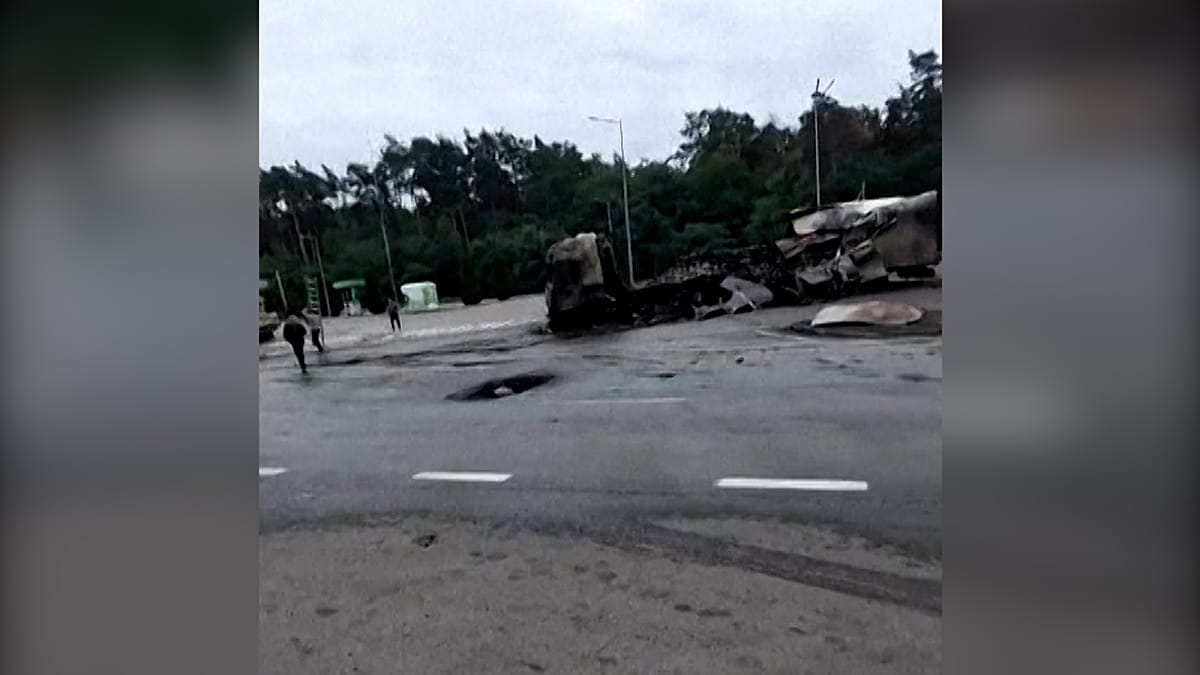
Tetiana Bubynets collapsed on the asphalt after a Russian drone exploded at a gas station in the southern Ukrainian city of Zaporizhzhia.
asserted
drone → collapse → Zaporizhzhia
Despite the violent shockwave and blast of drone shrapnel produced by the attack on July 6, the 18-year-old accounting student had no visible wounds except for a nosebleed.
asserted
student → produce → nosebleed
Recommended Stories
list of 3 items- list 1 of 3US envoys meet Putin: What’s behind latest diplomacy on Russia-Ukraine war?
- list 2 of 3US envoys hold ‘substantive’ talks with Zelenskyy in first visit to Kyiv
- list 3 of 3Witkoff
asserted
envoys → meet → Kyiv
says peace talks have been ‘very meaningful’ in Ukraine
asserted
talks → say → Ukraine
She was rushed to hospital and pronounced dead shortly after, alongside two other civilians, aged 41 and 48.
asserted
She → rush → civilians
One of her lecturers, Tetiana Melikhova of Zaporizhzhia National University, said Bubynets was an only child and that her mother “lost the meaning of life” after she died.
“She couldn’t speak.
asserted
She → say → life
At the funeral, she just lay on the coffin; she couldn’t let her child go,” Melikhova told Al Jazeera.
asserted
Melikhova → lie → Jazeera
The strike that killed Bubynets was the first recorded case of Russia’s use of a fully autonomous attack drone powered by artificial intelligence (AI), according to a New York Times analysis.
uncertain
that → kill → analysis
While drone strikes have hammered Ukraine since Russia launched its full-scale invasion in February 2022, Ukrainian officials who examined the wreckage found the unmanned vehicle to be unlike others.
asserted
vehicle → hammer → others
In place of an antenna, it featured an AI-powered minicomputer sold commercially by US technology company Nvidia, which rendered it capable of directing itself to the type of target it was programmed to spot – likely propane tanks in this case – lock on to it and proceed to strike.
asserted
it → feature → it
AI-powered drones are the tip of the iceberg as Russia and Ukraine race towards boosting tech infrastructure aimed at coordinating reconnaissance and attack, according to analysts.
uncertain
Russia → power → analysts
“It’s not about a drone having AI in it, and then seeing something and striking,” Marina Miron, researcher at the defence studies department at King’s College London, said.
asserted
Miron → ’ → London
“Rather, it’s the drone seeing something, communicating to a software complex which knows how to map the GPS coordinates on a live battlefield map, and notifying the closest artillery unit.”
asserted
which → ’ → unit
Referred to as reconnaissance-strike architecture, these unified battlefield management systems act like a central command.
asserted
systems → refer → command
They track the location of friendly forces and identify enemy positions.
asserted
They → track → positions
AI acts as the accelerator, instantly processing massive amounts of data collected through sensors in drones or any other military products, including interceptor missiles or artillery units.
asserted
AI → act → missiles
The tactical advantage on the battlefield is given by the system’s ability to compress the kill chain – meaning coordinating and distributing the intelligence to military assets on the ground to find, track and destroy targets in a matter of minutes.
asserted
advantage → give → minutes
In such an ecosystem, AI-powered automated drones are just pieces of a broader puzzle.
asserted
drones → power → puzzle
Ukraine is known to be developing its system, which it named DELTA.
asserted
it → know → which
Following operational trials in late 2025, Russia has been rolling out its version, the Svod Tactical Situational Awareness Complex, to front-line units.
asserted
Russia → follow → units
Both sides claim that once the battlefield data is processed, a decision support system (DSS) presents a military commander with options to choose from, keeping a human in the decision-making loop, said Miron.
uncertain
Miron → claim → loop
“In how far that is true is, of course, impossible to find out,” she added.
asserted
she → find → course
Acknowledging full AI autonomy would provoke ethical and legal questions.
asserted
Acknowledging → acknowledge → questions
Even if humans were to retain final decision-making authority, research has shown AI systems subtly shape choices, predetermining outcomes.
asserted
systems → retain → outcomes
“Under time and pressure, commanders often do as AI suggests,” said Miron, whose research focuses on military AI and remotely piloted and autonomous systems.
uncertain
research → do → AI
Towards full automation
Coordinated AI-powered military systems are the next frontier of modern warfare, said Serhiy Beskrestnov, a Ukrainian Ministry of Defence adviser on loitering munitions, known by his callsign Flash.
asserted
Beskrestnov → coordinate → Flash
“That’s what it will all come to,” he posted on his Telegram channel on July 1.
asserted
he → ’ → July
Drones with some autonomous capabilities are already being deployed at scale.
asserted
Drones → deploy → scale
Heorhii Volkov, commander of Ukraine’s Yasni Ochi drone strike unit, said this is currently mostly used in the final phase of long-distance strikes, where first-person view (FPV) drones are likely to lose radio connection due to electronic warfare or the curvature of the Earth.
asserted
drones → say → Earth
The use of AI in so-called last-mile operations solves this battlefield hitch.
asserted
use → call → hitch
If the signal is lost, an integrated AI-enabled onboard module takes full control of the unmanned vehicle, autonomously locks on the target and carries the strike to completion.
asserted
module → lose → completion
Yaroslav Azhnyuk, founder of Ukrainian technology company The Fourth Law, which develops AI-powered autonomy software for unmanned vehicles, said Russia and Ukraine were working to deploy a wider range of autonomous systems.
asserted
Russia → develop → systems
“This is not simply a race to demonstrate a fully autonomous drone.
asserted
This → demonstrate → drone
It is a race to make autonomy reliable, affordable and deployable at scale,” Azhnyuk told Al Jazeera.
asserted
Azhnyuk → make → Jazeera
“Electronic warfare, increasingly long engagement distances and the growing number of drones are making human-controlled systems less sufficient.
asserted
warfare → grow → systems
Autonomy solves exactly these constraints.”
asserted
Autonomy → solve → constraints
Azhnyuk believes autonomy will become a game-changer over the next six to 12 months.
asserted
autonomy → believe → months
“The decisive advantage will belong to the side that can deploy reliable autonomy across tens or hundreds of thousands of systems, not just demonstrate it in prototypes,” he said.
asserted
he → belong → prototypes
Kateryna Bondar, senior fellow at the Center for Strategic and International Studies (CSIS), noted the dangers of AI’s reliance on algorithms.
asserted
Bondar → note → algorithms
“The system doesn’t understand what it’s doing; it’s just following the algorithm and the rules which people created,” said Bondar, who works at the CSIS’s Wadhwani AI Center.
asserted
who → understand → Center
…and 4 more, not listed.