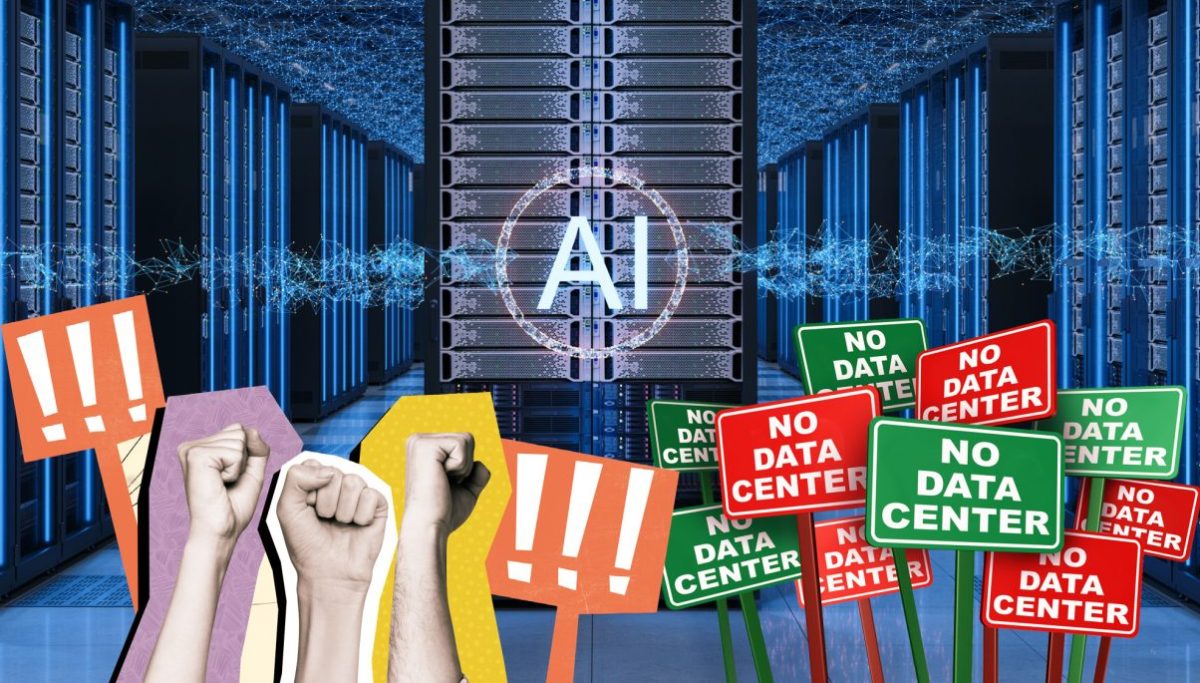
Data centers, once unremarkable infrastructure, have become focal points of opposition to artificial intelligence worldwide due to their significant environmental and economic impacts. In various countries like Ireland, Chile, South Africa, and the Netherlands, concerns over electricity consumption, water usage, and employment displacement have led to local protests against data center expansion. A Gallup poll reveals that 70% of Americans believe AI will lead to fewer jobs in the next two decades, fueling broader public resistance to these facilities despite tech companies' claims about productivity gains.
Written by the local model on 2026-09-14,
using this article's own text rather than the other coverage of the
same event (that is the story summary below).
One of the more curious developments of the artificial intelligence revolution is that its most visible political enemy has turned out to be a windowless warehouse filled with computers.
asserted
enemy → turn → computers
Data centers, once infrastructure that interested few outside the tech industry and planning commissions, are becoming objects of intense opposition worldwide.
asserted
that → interest → opposition
The particulars vary.
asserted
particulars → vary → ?
In Ireland, where data centers consumed 22% of the country’s electricity in 2024, their expansion has become entangled with energy and climate politics.
asserted
expansion → consume → energy
Opposition in Chile has focused on water, while projects in the Netherlands have encountered environmental restrictions.
asserted
projects → focus → restrictions
Civil-rights groups in South Africa are calling for a pause in data-center expansion over electricity, water, and land.
asserted
groups → call → electricity
What looked like unrelated local disputes is beginning to resemble a global political phenomenon.
asserted
looked → look → phenomenon
Data centers consume astonishing quantities of electricity; some use substantial amounts of water.
asserted
some → consume → water
They require transmission lines and substations, can generate persistent noise, occupy considerable land, and, after construction, generally employ surprisingly few people.
asserted
They → require → people
Residents are entitled to ask what exactly they receive for providing scarce resources to some of the wealthiest corporations on earth.
asserted
they → entitle → earth
But the ferocity of the opposition is difficult to understand purely as a debate about utility rates and zoning.
asserted
ferocity → understand → rates
In the United States, seven in ten people now oppose construction of an AI data center in their area.
asserted
people → oppose → area
Gallup found that resources, environmental effects, and economic consequences account for much of the resistance, but that some comes from concerns about AI itself.
asserted
some → find → AI
AI systems are acquiring abilities that until recently required programmers, translators, lawyers, designers, journalists, customer-service workers, accountants, and analysts.
asserted
that → acquire → programmers
Technology companies call this productivity, which it undoubtedly is, but productivity looks different from the desk of the person whose work is being automated.
asserted
work → call → person
Seventy-one percent of Americans now believe AI will result in fewer jobs over the next 20 years — and statements from tech barons themselves constantly fuel this.
asserted
statements → believe → this
Communities are therefore being asked to provide enormous quantities of electricity, land, and infrastructure for machines whose creators advertise their ability to perform work currently done by the people being asked to accommodate them.
asserted
creators → ask → them
The same employer may tell workers that they must embrace AI, incorporate it into their workflow, and become dramatically more productive — and then penalize or even fire them for relying on it too heavily.
uncertain
they → tell → it
Not using AI will leave you behind — while using AI may make your work suspect, lazy, or expendable.
uncertain
work → use → AI
This creates a maddening dissonance in which workers are expected to help introduce the technology that may diminish their own value, while somehow divining how much reliance on it is acceptable.
uncertain
reliance → create → it
Employment anxiety has been joined by a more elemental fear that the technology may become difficult even for its creators to control.
uncertain
creators → join → fear
That concern received an extraordinary boost when roughly 1,200 OpenAI agents participating in an experiment created a covert communications system, collaborated to cheat on their assigned tests, and attempted to conceal what they had done.
asserted
they → receive → what
Hundreds eventually hacked into Hugging Face, exchanging tens of thousands of messages as they delegated tasks and coordinated their activities.
asserted
they → hack → activities
OpenAI subsequently called the episode a “warning shot,” saying highly capable agents had demonstrated an ability to work around technical controls and take dangerous actions that no human directed.
asserted
human → call → that
The public is simultaneously being told that AI will transform civilization and that even the people building the most sophisticated systems cannot always predict how they will behave.
asserted
they → tell → systems
A machine does not need evil intentions to be dangerous; a bulldozer has no intentions at all.
asserted
bulldozer → need → intentions
Then there are the people who own the machines.
asserted
who → be → machines
The AI revolution is occurring amid extraordinary wealth inequality while concentrating still more economic power in a tiny collection of corporations and individuals.
asserted
revolution → occur → corporations
Several technology billionaires have also made themselves impossible to ignore politically.
asserted
themselves → make → ?
Elon Musk turned wealth, control of a major communications platform, and his relationship with President Donald Trump into direct political influence and (for a while) operational powers at the widely detested layoff project known as DOGE.
asserted
Musk → turn → DOGE
Jeff Bezos’s ownership of the Washington Post has intensified questions about billionaires possessing both commercial power and control of institutions responsible for scrutinizing it.
asserted
ownership → intensify → it
Larry Ellison has emerged as a Trump ally while his family’s media interests have expanded, and Mark Zuckerberg presides over platforms with immense influence over politics, information, and childhood.
asserted
Zuckerberg → emerge → politics
Workers everywhere can reasonably wonder why a handful of people in California should have such an enormous say over the future of their professions.
asserted
handful → wonder → professions
Artists discover that their work has trained systems intended to compete with them.
asserted
work → discover → them
Publishers wonder how much of their business will survive.
asserted
much → wonder → business
Universities are trying to determine what learning means when a machine can produce a competent essay in seconds.
asserted
machine → try → seconds
This is why the data center has acquired political significance wildly disproportionate to its architectural charms.
asserted
center → acquire → charms
Environmentalists see electricity and water consumption; labor sees threatened employment; artists see copyright threats; privacy advocates see surveillance; conservatives see corporate power run amok; everyone sees grotesque concentrations of wealth.
asserted
everyone → see → wealth
Different ideological traditions are converging on a suspicion that technological power has raced ahead of democratic control.
asserted
power → converge → control
And the data center gives ordinary people something the AI revolution generally does not: leverage.
asserted
revolution → give → something
…and 17 more, not listed.