Underground detector records unexplained particle interaction in dark matter hunt

Read the original at Times of India ↗
Cite

TOI Science Desk. (2026, October 14). Underground detector records unexplained particle interaction in dark matter hunt. Times of India. https://timesofindia.indiatimes.com/science/discovery/a-detector-buried-nearly-a-mile-underground-records-an-unexplained-particle-interaction-in-the-hunt-for-dark-matter/articleshow/134941967.cms

Dated from the outlet's own feed. Check the original for its byline.

Times of India · collected 2026-10-16 · by TOI Science Desk

Quick Summary

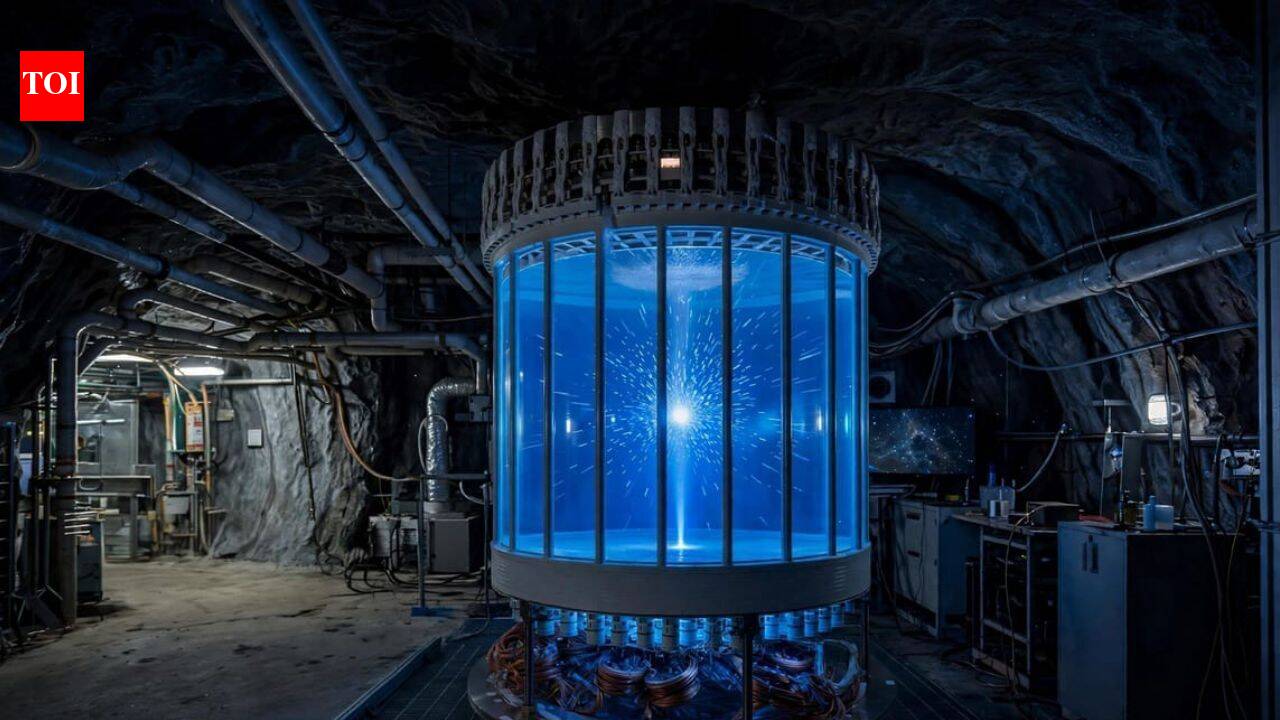
Scientists working on the LUX-ZEPLIN (LZ) experiment have detected a single particle interaction that remains unexplained by known background processes. Located nearly a mile underground at the Sanford Underground Research Facility in South Dakota, the LZ detector uses 10 tonnes of ultrapure liquid xenon to search for weakly interacting massive particles (WIMPs). This finding is the most significant hint of dark matter reported so far by the experiment but falls short of confirming its presence, with a statistical significance of only 2.6 sigma—well below the 5 sigma standard required for a discovery claim. The analysis was led by the University of Bristol and presented at a conference in Japan.
Written locally by qwen2.5:14b on 2026-10-16, using this article's own text rather than the other coverage of the same event (that is the story summary below).

AI analysis runs on qwen2.5:14b, locally

Story summary

Scientists working on the LUX-ZEPLIN (LZ) dark matter experiment have detected a single particle interaction that they cannot fully explain using any known background process. This discovery was made at the Sanford Underground Research Facility in South Dakota, where the LZ detector operates nearly a mile underground to search for signs of dark matter. The event is the most compelling hint of dark matter reported by the LZ team so far but does not meet the statistical threshold required for a confirmed discovery; it has a significance level of 2.6 sigma, indicating a roughly 0.5% chance that background processes could explain it.

The analysis was led by the University of Bristol and presented at the 2026 TeV Particle Astrophysics conference in Japan, with support from UK Research and Innovation (UKRI). Dark matter is believed to compose around 85% of all matter in the universe but has yet to be directly detected. The LZ collaboration plans to continue collecting data to determine if this signal strengthens, weakens, or disappears as more observations become available.

Written for “Dark Matter Particle Interaction Detected” on 2026-10-16, grounded in this article and the 0 other(s) covering the same event.

Story

📰 Dark Matter Particle Interaction Detected
Science · 1 article(s) covering the same event.

Compared with similar articles

Nothing to compare against. No article is close enough to this one for the pipeline to have linked or judged the pair.
How this article was measured signals, leaning charts, publisher record, byline, topics and claims

Signals How these are calculated →

Claims extracted
28
sentences that state something as happening or true
Uncertain
18%
5 of 28 hedged ("reportedly", "may", "according to")
Leaning
not political
takes no side on a contested political question
Publisher signals
59/100
Times of India's corrections and hedging, across everything collected from it. Not a measure of accuracy.
Outlets on this story
1
Science
Same framing elsewhere
1
articles that frame the event the way this one does
Analyzed 2026-10-16 · how these are computed

How this is being covered How these are calculated →

Article leaning vs. publisher reliability
Source leaning vs. consistency

Publisher

Times of India · 2646 article(s) · 2 correction(s) detected
Running correction rate · 2 correction(s)

Who wrote this

TOI Science Desk
263 article(s) here · 1 carrying a prediction
🔮 The result has a statistical significance of 2.6 sigma, indicating a roughly 0.5% chance that known background processes alone could explain the event.
🔮 The report says it is so small that many resonators could be packed onto a chip to perform complex functions.
🔮 The dataset also includes environmental observations and three-dimensional digital reconstructions, which the field note says will help researchers track change over time while documenting the fragile site without disturbing it.
🔮 Future studies tracing the particles to their sources and testing for biological effects could reveal whether microplastic ingestion actually threatens sea snake health, and whether limiting laundry wastewater pollution might reduce exposure along the Gulf coasts.
🔮 The researchers could connect enzyme motion, iron chemistry, and water-mediated proton transfer by capturing structural snapshots over milliseconds to seconds of reaction time.
🔮 The findings, published in the journal Aging Cell in 2026, could help researchers understand how age-related changes occur and whether some of them can be reversed.
🔮 She also developed a Michaelis-Menten computational model to identify an optimal aragonite dose, an important step towards exploring how such a system could eventually be adapted for practical use, the report adds.
🔮 A sandwich Gabriella Rothberg was making for her father when she was 15 led to an unusual question- Could a tomato be made to taste like meat?
🔮 According to Archaeology magazine, researchers believe the token may have been deliberately buried at the site by protesters.
🔮 Among all the animals and birds that have gone extinct, the dodo remains unforgettable, not due to some special characteristic, but because, before its human-driven extinction, many thought that nature was inexhaustible and none of god's creations would ever disappear.
Wire or desk byline, not an individual reporter.
Also by TOI Science Desk
Nothing else under this byline is closely related to this article, so these are simply their most recent.
All 263 articles by TOI Science Desk →

Topics

Japan South Dakota UK Research and Innovation UKRI the University of Bristol

Subjects

South Dakota GPE · 2× Brown University ORG · 1× Japan GPE · 1× Lawrence Berkeley National Laboratory ORG · 1× Rick Gaitskell PERSON · 1× UK Research and Innovation ORG · 1× UKRI ORG · 1× UKRI Infrastructure Fund ORG · 1× the US Department of Energy ORG · 1× the University of Bristol ORG · 1×

Narrative

How the LZ team plans to investigate the signal and advance dark matter research The LZ collaboration will continue collecting data at the Sanford Underground Research Facility to determine whether the signal grows stronger, weakens or disappears as more observations become available.
framing: assertive · carried by 1 article(s) · first seen 2026-10-16
🔮 The result has a statistical significance of 2.6 sigma, indicating a roughly 0.5% chance that known background processes alone could explain the event.

Claims (28 extracted, 5 hedged)

Scientists working on the LUX-ZEPLIN (LZ) dark matter experiment have identified a single particle interaction that they have struggled to explain using any known background process. asserted
they → work → process
The detector operates nearly a mile underground at the Sanford Underground Research Facility in South Dakota, US, where it searches for signs of dark matter. asserted
it → operate → matter
The result is the most compelling hint of dark matter reported by the experiment so far, although it does not meet the statistical threshold required to claim a discovery. uncertain
it → report → discovery
Dark matter is thought to make up around 85% of all matter in the universe, yet it has never been directly detected. asserted
it → think → universe
According to UK Research and Innovation (UKRI), the analysis was led by the University of Bristol and presented at the 2026 TeV Particle Astrophysics conference in Japan. uncertain
analysis → accord → Japan
What did the underground detector discover in its search for dark matter The LZ experiment identified a single particle interaction in a region of its dataset that researchers had not previously explored. asserted
researchers → discover → that
The team spent months investigating possible causes, including known background processes that can produce signals inside the detector. asserted
that → spend → detector
The event stands out because researchers understand the detector and its background signals well, making an unexplained interaction important to investigate. asserted
interaction → stand → detector
However, the finding does not confirm the presence of dark matter. asserted
finding → confirm → matter
The result has a statistical significance of 2.6 sigma, indicating a roughly 0.5% chance that known background processes alone could explain the event. uncertain
processes → have → event
Physics requires a significance of 5 sigma before a result can be declared a discovery. asserted
result → require → sigma
How the LZ detector searches for dark matter deep underground The LZ experiment uses 10 tonnes of ultrapure liquid xenon to search for weakly interacting massive particles, known as WIMPs. asserted
experiment → search → WIMPs
These hypothetical particles are among the candidates researchers investigate in the search for dark matter. asserted
researchers → investigate → matter
The detector operates nearly a mile underground at the Sanford Underground Research Facility in South Dakota, US. asserted
detector → operate → Dakota
The experiment is managed by the US Department of Energy’s Lawrence Berkeley National Laboratory and brings together around 250 scientists and engineers from 39 institutions worldwide. asserted
experiment → manage → institutions
Researchers look for rare interactions that might provide evidence of dark matter. uncertain
that → look → matter
What could the unexplained particle interaction tell scientists about dark matter If the event was the result of a dark matter interaction, it would point to a WIMP with a mass of at least 200 GeV/c² (gigaelectron volts), making it more than 200 times the mass of a proton. uncertain
it → tell → proton
Its interaction with ordinary matter would fall outside the simplest theoretical models. asserted
interaction → fall → models
However, researchers have not confirmed that the signal came from dark matter. asserted
signal → confirm → matter
Rick Gaitskell, a professor at Brown University and the LZ spokesperson, said, “We’re very intrigued to see this event in the data, in the region where we expect dark matter to show up and the competing backgrounds are very low”. asserted
backgrounds → say → region
“With only one event, we don’t want to get ahead of ourselves. asserted
we → want → ourselves
We are not claiming to have seen dark matter. asserted
We → claim → matter
But we have seen something interesting that we want to share with the scientific community for their input”. asserted
we → see → input
How the LZ team plans to investigate the signal and advance dark matter research The LZ collaboration will continue collecting data at the Sanford Underground Research Facility to determine whether the signal grows stronger, weakens or disappears as more observations become available. asserted
observations → plan → Facility
The UK has played a central role in the experiment, with 10 teams contributing to its construction and operations and around 50 UK researchers involved in operations, data analysis and collaboration leadership since commissioning in 2021. asserted
teams → play → 2021
The UK team is also working with international partners on XENON-LUX-ZEPLIN-DARWIN, a next-generation rare-event observatory designed for dark matter detection and neutrino physics. asserted
team → work → detection
The project currently receives support through a UKRI Infrastructure Fund preliminary activity. asserted
project → receive → activity
The UK is also exploring the possibility of hosting the experiment at the Boulby Underground Laboratory, supporting plans for further research into rare particle interactions. asserted
UK → explore → interactions

💬Give feedback
🕘History 🎫Support