WASHINGTON (AP) — Canada might seem an unlikely target for a U.S. trade war.
uncertain
Canada → seem → war
No country on Earth buys as much from the United States as its northern neighbor.
asserted
country → buy → neighbor
A North American trade pact — negotiated by President Donald Trump in his first term — means that most American products enter Canada duty-free.
asserted
products → negotiate → Canada
Rankings of the world’s most open economies usually put Canada near the top.
asserted
Rankings → put → top
But when Trump looks at Canada, he says, he sees a predator out to cheat the United States and strangle its industries.
asserted
he → look → industries
“One of the Worst Abusers is Canada,’’ the president declared on social media last month.
asserted
president → declare → media
“They’ve been ripping us off for decades, and it’s going to stop.’’
asserted
it → rip → decades
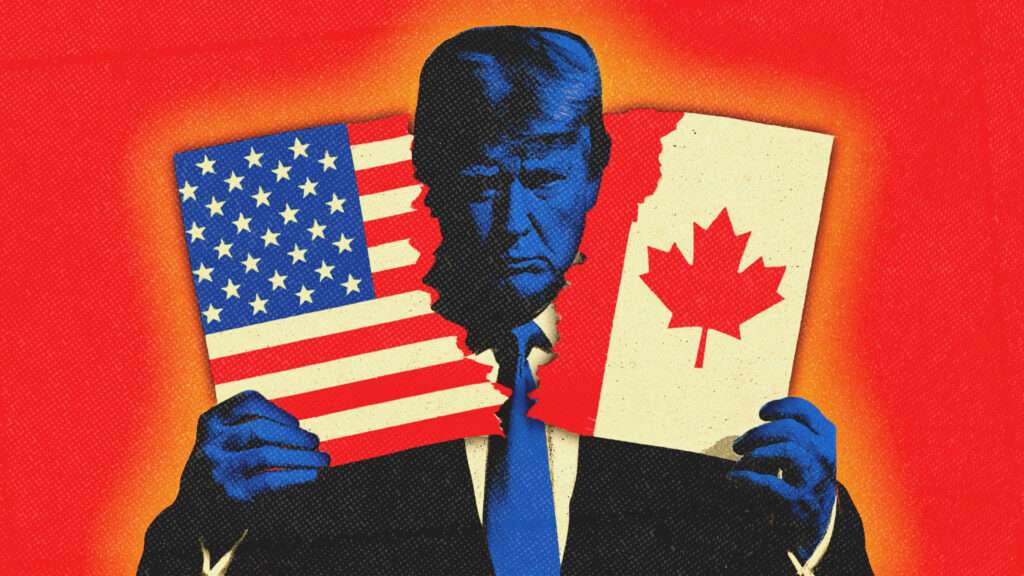
Since trade talks collapsed Aug. 21, relations between the longtime allies have deteriorated as Trump has goaded Canada’s leaders with personal attacks and portrayed the country as weak.
asserted
Trump → collapse → country
Trump has also enraged the Canadian public by repeatedly floating the idea of making Canada the 51st state and signed an executive order directing the federal government to change Lake Ontario’s name to “Lake America.”
asserted
Canada → enrage → America
Last month, Trump slapped 50% tariffs on $20 billion worth of Canadian products to protest what he calls discrimination against U.S. auto, dairy and alcoholic beverage exports.
asserted
he → slap → exports
When Ottawa retaliated Tuesday with tariffs of its own, Trump escalated, vowing to cut off Canadian companies from government contracts in the United States and even outright banning some Canadian products, including motorcycles, some dairy products and most alcoholic beverages.
asserted
Trump → retaliate → motorcycles
It’s a jarring turn of events for Canada, a country that has built its economy around international commerce.
asserted
that → ’ → commerce
Canada’s trade is equal to 64% of its economic output, the World Bank says, versus 25% for America.
asserted
Bank → say → America
The conservative Heritage Foundation in Washington ranked Canada No. 14 (out of 184 economies) on its Index of Economic Freedom; the United States landed eight spots lower at No. 22.
asserted
States → rank → .
The libertarian Fraser Institute in Vancouver likewise ranked Canada No. 11 (out of 165 countries and territories) on its Economic Freedom of the World report.
asserted
Institute → rank → report
Before the latest tariff blowup, Canada’s effective tariff rate on U.S. imports was about 2.4%, less than half the 5% that the United States imposed on Canada, according to calculations by Oxford Economics.
uncertain
States → impose → Economics
Most U.S. exports enter Canada duty-free under the US-Mexico-Canada Agreement that Trump negotiated in his first term.
asserted
Trump → enter → term
Canada protects its dairy industry from competition
Despite keeping its economy open to trade overall, Canada does protect several domestic industries.
asserted
Canada → protect → industries
Barry Appleton, co-director of New York Law School’s Center for International Law, calls Canada “a modestly protected economy with two or three genuinely closed sectors.’’
asserted
Appleton → call → sectors
The U.S. has complained for decades, for instance, about what it calls unfair subsidies for Canadian softwood lumber producers — though Canada disputes those allegations.
asserted
Canada → complain → allegations
In his 2023 memoir, Robert Lighthizer, U.S. trade representative in Trump’s first term, argued that Canada was only “outwardly supportive of free trade. ...
asserted
Canada → argue → trade
The system Canada set up to protect its dairy industry, Lighthizer wrote, “would make a Soviet commissar blush.’’
asserted
commissar → set → industry
Canada shields its dairy producers through a convoluted system that imposes tariffs of more than 200% on most dairy products — nearly 300% on some items, such as butter — once they’ve exceeded a quota, according to Leonard Polzin, a specialist in dairy markets at the University of Wisconsin.
uncertain
they → shield → Wisconsin
Polzin said the Canadians have a strong incentive to protect their politically sensitive dairy industry from competition with America.
asserted
Canadians → say → America
Wisconsin alone produces more milk than all of Canada.
asserted
Wisconsin → produce → Canada
American dairy producers are so adept at producing large quantities of low-cost milk, Polzin said, that if Canada opened its market completely “we would dump so much product there’s no way they could remain as a viable industry.
uncertain
they → produce → industry
Trump claimed falsely on social media Tuesday that “Canada doesn’t let our Great Dairy Farmers sell into the Canadian Market.’’
In fact, the United States agreed in the USMCA to allow Canada to continue the supply management system in return for giving American dairy farmers more access to the Canadian market.
asserted
Canada → claim → market
And American dairy producers have been making headway: U.S. dairy exports to Canada rose more than 11% last year on top of an 8% increase in 2024, according to the U.S. Department of Agriculture.
uncertain
exports → make → Agriculture
“We gradually get more and more expansion of dairy product into Canada,’’ Polzin said.
asserted
Polzin → get → Canada
“It’s not always pretty.
asserted
It → ’ → ?
It’s not always easy, but over time it has been increasing.’’
asserted
it → ’ → time
The United States already runs a hefty trade surplus in dairy with its northern neighbor, exporting $1.3 billion worth of dairy products to Canada last year while importing just $585 million, according to the USDA.
uncertain
States → run → USDA
US runs a trade deficit with Canada – because it needs Alberta’s oil
Overall, the United States runs a trade deficit with Canada — $27.3 billion last year — and Trump isn’t happy about it.
asserted
Trump → run → it
But the gap between what the U.S. sells to Canada and what it buys can be explained by one industry: oil.
asserted
it → sell → industry
Canada exported more than $85 billion worth of crude oil to the United States in 2025.
asserted
Canada → export → 2025
Refineries in the U.S. Midwest need heavy sour crude oil from Alberta’s oil sands deposits.
asserted
Refineries → need → deposits
“It’s the only oil they can use,” Appleton said.
asserted
Appleton → ’ → ?
“They can’t use Texas crude.
asserted
They → use → crude
They can’t use Venezuelan crude.
asserted
They → use → crude
They’re not set up for it.
asserted
They → set → it
…and 19 more, not listed.
 The Aporia