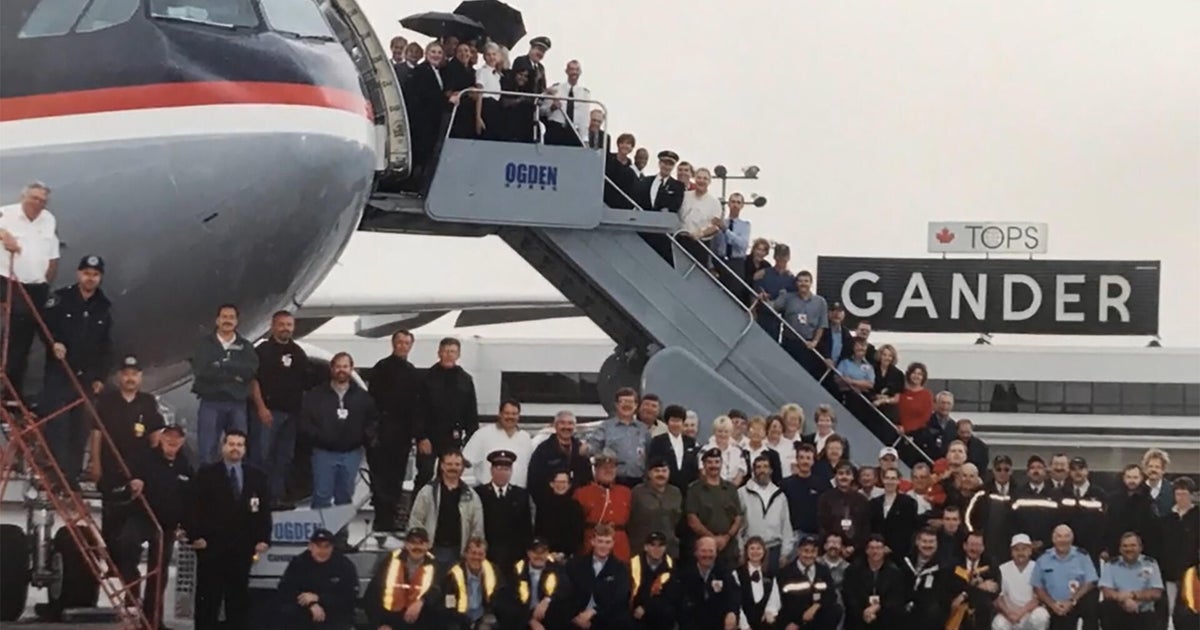
But Canadians know it for its citizens’ famous acts of kindness and hospitality, caring for 6,700+ stranded airline strangers in the days after the 9/11 attacks.
asserted
Canadians → know → attacks
Now retired as principal at the Gander Campus of the College of the North Atlantic, he and his team at the school helped 438 people who suddenly found themselves grounded in Canada after U.S. airspace was closed.
asserted
airspace → retire → Canada
“Our college year just started …
asserted
year → start → ?
Everybody was in class, or wherever they were supposed to be,” he recalled in an interview.
asserted
he → suppose → interview
Moss learned about the attack in a phone call from one of his staff.
asserted
Moss → learn → staff
“She said: ‘We’re listening to the radio up here.
asserted
We → say → radio
And a plane just flew into one of the World Trade Center Towers.’
asserted
plane → fly → Towers
”
The effect on campus, at first, was paralyzing, Moss said.
asserted
Moss → say → campus
“Everybody started crowding around the television, some radio.
asserted
Everybody → crowd → television
And the campus virtually came to a standstill.”
asserted
campus → come → standstill
At 1 p.m., the Town of Gander’s emergency services called Moss, asking if the campus could accommodate incoming planeloads of passengers by providing shelter, first aid and food.
uncertain
campus → call → shelter
“I knew the size of the campus, the space we had available, and I said yes,” Moss said.
asserted
Moss → know → campus
At 7 p.m., town manager Jake Turner told him he’d be getting a jumbo jet-load of people.
asserted
he → tell → people
That plane, carrying 234 passengers according to Moss’ recollection, was the first of two whose passengers the college hosted.
uncertain
college → carry → passengers
It was a stroke of luck that the college had commercial cooking and electronics classes running that day; it allowed students and staff to prepare hot food, set up additional television feeds with microphones in the cafeteria, and gather supplies.
asserted
students → have → supplies
Many people in Gander, including Moss’s wife, the college’s employees and their spouses, volunteered everything from bedding to food for their “guests,” as Ganderites endearingly call the plane people.
asserted
Ganderites → include → people
Gander provided free medical treatment, such as free prescription renewals, for the passengers as needed.
asserted
Gander → provide → passengers
Gander Campus also had a few student nurses available to assist.
asserted
nurses → have → ?
“We had them set up serving a little triage area,” Moss recalled.
asserted
Moss → have → area
As the “guests” trickled in, many did not even know where they were; they needed to see the news, make calls, or send emails.
asserted
they → trickle → emails
The passengers had tight living conditions:
asserted
passengers → have → conditions
“20 or 30 people to a room, and … they were lying on a tile floor, with just a blanket or a sheet underneath them,” Moss recalled.
asserted
Moss → lie → them
“If they didn’t have a pillow, we give them an extra sheet to put over the shoes for pillows.”
asserted
we → have → pillows
“When the passengers came down to their breakfast, it was like walking into a first-class hotel.
asserted
it → come → hotel
I mean, everything in the world that you wanted for breakfast was available,” said Moss.
asserted
Moss → mean → breakfast
“The big problem our cooks had, after the first day, was the stores were running out of food,” he said.
asserted
he → have → food
But “Our cooks had managed to secure, you know, 250 or 300 chicken breasts in their raid of the stores the night before.”
asserted
you → manage → stores
To meet the needs of guests, everyone pitched in.
asserted
everyone → meet → guests
“The Salvation Army took control of the local hockey rink, and … turned that into a walk-in cooler,” Moss recalled.
asserted
Moss → take → cooler
Nearby towns also volunteered supplies.
asserted
towns → volunteer → supplies
He felt exhausted after the passengers left, having slept only two hours in the three days his campus hosted the passengers.
asserted
campus → feel → passengers
“I did over 300 interviews, and I always asked them the same question: ‘How did you feel after the passengers left?’”
asserted
passengers → do → question
“What they remembered most was the total exhaustion.”
asserted
remembered → remember → What
The former principal had trouble sleeping too.
asserted
principal → have → trouble
“After the passengers left, I don’t think I had a good night’s sleep for two or three months,” he said.
asserted
he → leave → months
He relived every detail of those few days in his mind.
asserted
He → relive → mind
Moss continues to stay connected with some of the guests, such as Kevin Tuerff, a passenger who is portrayed in the musical Come From Away.
asserted
who → continue → Away
“Kevin has been a frequent visitor to our house,” said Moss.
asserted
Moss → say → house
Moss has also visited the 9/11 site in New York City.
asserted
Moss → visit → City
Twenty-five years after the plane people’s arrival, he says the big takeaway for him is “how well our towns — plural, our towns — were prepared to handle such an event, and they didn’t know it, because they had never experienced (this) before.”
asserted
they → say → this
…and 2 more, not listed.
 The Aporia