Pollsters and Republican operatives doubt Democrats' current polling advantages for the 2026 elections, despite polls showing Democrats leading Republicans by more than eight points nationally. In key states like Alaska, Michigan, New Hampshire, Ohio, and Texas, Democrats hold slight leads in Senate races. However, factors such as historical overstatement of Democratic performance in midterms, potential non-response bias from disgruntled Republican voters, and the likelihood that undecided voters will lean towards Republicans could narrow these margins significantly.
Written locally by qwen2.5:14b on 2026-10-10,
using this article's own text rather than the other coverage of the
same event (that is the story summary below).
Pollsters and Republican political operatives aren’t fully buying the Democratic polling leads that project the minority party to flip the House and possibly win back the Senate, a task considered herculean at the start of the 2026 election cycle.
uncertain
party → buy → cycle
Heading into the weekend, polls showed Democrats holding an advantage of more than 8 points over Republicans on generic House ballots, leading most analysts to believe that the chamber will flip majorities in November.
asserted
chamber → head → November
Races are tighter in the Senate, but Democrats still hold slight leads in polls tracking races in Alaska, Michigan, New Hampshire, Ohio, and Texas.
asserted
Democrats → hold → Alaska
Iowa and Kansas, both traditionally viewed as Republican strongholds, are virtually tied.
asserted
Iowa → view → strongholds
Democrats need to win four of those races to take over the Senate majority.
asserted
Democrats → need → majority
President Donald Trump won the popular vote in 2024 and enjoyed greater success among minority voters than any other Republican presidential candidate in history.
asserted
Trump → win → history
But heading into 2026, many view the president as a drag on the GOP, with polls indicating that Republican voters have been turned off by the war with Iran and the elevated prices at home that have come with the conflict.
asserted
that → head → conflict
But Republicans still hope Democratic margins may evaporate, based on recent historical precedent, and are pointing to several factors that could suggest closer-than-projected results on Election Day.
uncertain
that → hope → Day
Republican pollster Patrick Ruffini wrote on X this week that pre-election polls in the 2018-2024 cycles have overstated Democratic performance by more than six points in Iowa, Michigan, and Ohio.
asserted
polls → write → Iowa
Ruffini added that, in the 2026 cycle, polls commissioned by Democratic campaigns are giving Democrats a 6.2 point advantage over Republicans, but with nonpartisan polls, the advantage shrinks to 2.6 points and is “consistent with cooking the books to show tight races and juice fundraising across the map.”
asserted
advantage → add → map
Furthermore, there is a chance that Republicans, dissatisfied with Trump’s job in office, are simply not responding to surveys but still plan to cast ballots for the GOP.
asserted
Republicans → be → GOP
Chaz Nuttycombe, the executive director of the nonpartisan State Navigate, noted that the group’s recent poll in Iowa, which gave Democrats a 3-5 point advantage in the state, had trouble reaching rural Republicans to gauge their opinions.
asserted
which → note → opinions
“Rural Iowa R’s ignored our survey,” he wrote.
asserted
he → ignore → survey
“We think this could be a Canary in the Cornfields for Iowa polling this year.”
uncertain
this → think → polling
Sean Trende, the senior elections analyst for RealClearPolitics and a lecturer at Ohio State University’s department of political science, noted that Democratic leads in traditionally Republican states fail to factor in that currently undecided voters are “probably triple Trump voters” which likely means “reversion [to voting Republican] in the end.”
asserted
which → note → end
“Of course the steelman case for a Democratic Senate is just [waves hands around] all this,” he said.
asserted
he → wave → hands
Ultimately, Republican operatives working with the president’s outside political operation generally agree with Trende’s analysis.
asserted
operatives → work → analysis
Those people concede that reliable Trump voters may be turned off by a number of issues, not to mention the fact that the party in power typically fares poorly in midterm cycles, but remain confident that the president’s final-month midterm push will sufficiently drive turnout to hold on to at least one congressional majority.
uncertain
push → concede → majority
“It’s not a secret that, like, the trick for us is convincing MAGA voters to turnout when there might be things that they don’t love that the president is doing right now.
uncertain
president → ’ → that
It’s not rocket science,” one veteran Trump campaign aide told the Washington Examiner.
asserted
aide → ’ → Examiner
“Luckily, many of these voters aren’t necessarily super locked in on the actual policies.
asserted
many → lock → policies
That’s why POTUS is going to be campaigning his ass off until Election Day.
asserted
POTUS → ’ → Day
That’s why he’s doing those rallies.
asserted
he → ’ → rallies
Remind them why they voted for him in the first place.
asserted
they → remind → place
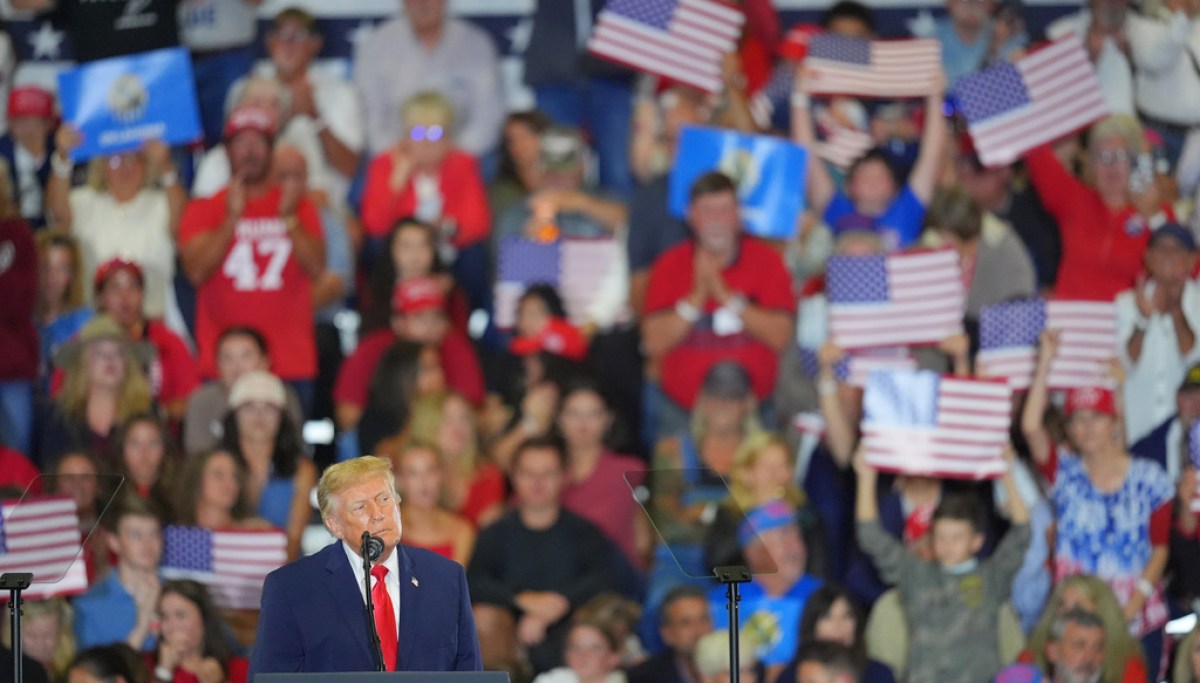
The president spent the first five days of October campaigning in reliably red states: Alabama, Nebraska, Ohio, Oklahoma, and Texas.
asserted
president → spend → states
On Saturday, he’ll hold a rally in Tennessee.
asserted
he → hold → Tennessee
But Trump isn’t exclusively campaigning in MAGA country.
asserted
Trump → campaign → country
On Friday, he traveled to Syracuse, New York, a trip ostensibly touting his economic and manufacturing agenda in support of Republican New York gubernatorial nominee Bruce Blakeman, which followed a speech to Baltimore County, Maryland, earlier in the week to announce a billion-dollar shipbuilding initiative.
asserted
which → travel → initiative
A former senior Trump aide told the Washington Examiner that the president’s team believes that those types of trips may help to drive Republican turnout in other parts of the state, where there are more competitive contests.
uncertain
types → tell → state
 The Aporia