The Sydney Morning Herald
· collected 2026-10-07 · by Brittany Busch, Matt Wade
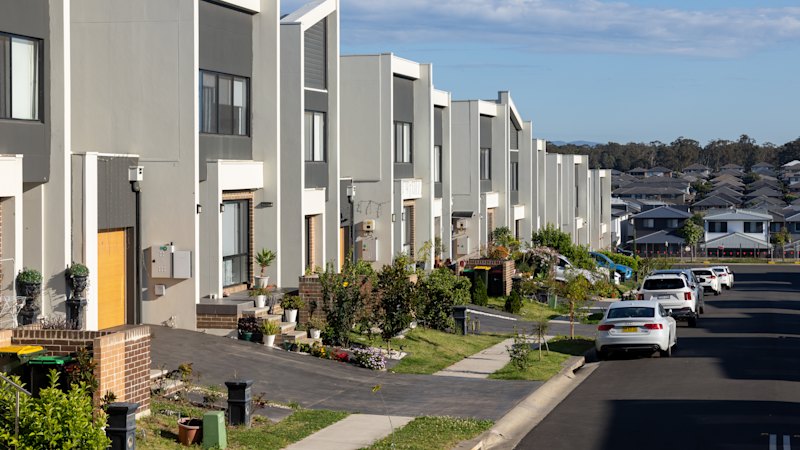
The Australian Bureau of Statistics reported a 7% rise in homes starting construction and a 5.8% increase in completed homes for the June quarter, reaching 52,201 and 47,168 respectively. However, this surge still falls short of the government's target to build 1.2 million homes over five years by nearly 100,000 units. Economic challenges like rising interest rates, higher construction costs due to increased oil prices from the Middle East conflict, and housing tax changes are expected to slow future progress, according to experts.
Written locally by qwen2.5:14b on 2026-10-07,
using this article's own text rather than the other coverage of the
same event (that is the story summary below).
Story summary
The Australian Bureau of Statistics reported an increase in home construction for the June quarter, with 52,201 homes beginning construction and 47,168 being completed. Despite this growth, Labor remains nearly 100,000 homes short of its goal to build a record number of dwellings over five years. The housing sector faces challenges from rising interest rates, increased construction costs due to the Middle East war, and uncertainty caused by recent budget changes. The Housing Industry Association estimates that missing these targets has created an $11 billion financial gap for state governments due to lower stamp duty and GST collections, potentially stunting economic activity worth $45 billion and leaving up to 242,160 Australians without housing.
Written for “Home Construction Shortfall” on 2026-10-07,
grounded in this article and the 0 other(s) covering the same event.
A surge in homes built last quarter has failed to get the government back on track for its 1.2 million homes target as experts warn the deteriorating economic conditions threaten to slow down future housing projects.
asserted
conditions → build → projects
The Australian Bureau of Statistics released its quarterly building activity data on Wednesday, showing a boost to the number of homes that began construction and the number of projects finished in the June quarter.
asserted
that → release → quarter
But it also showed Labor remained almost 100,000 short of the homes needed to reach its target of building a record number of dwellings over five years – a key plank in its plan to tackle the housing crisis and get more first home buyers into the market.
asserted
Labor → show → market
The number of homes, including houses and apartments, that began construction in the June quarter rose 7 per cent to 52,201.
asserted
that → include → 52,201
Homes that were completed rose 5.8 per cent to 47,168.
asserted
that → complete → 47,168
But the home building sector has this year been hit by a series of interest rate hikes, higher construction prices due to the Middle East war and uncertainty prompted by the May budget’s housing tax changes which are yet to properly flow through to the figures.
uncertain
which → hit → figures
KPMG urban economist Terry Rawnsley said the uptick in commencements and completions showed Australia was trending in the right direction, and a record number of more than 240,000 houses under construction would enter the market over the next year or so.
asserted
number → say → year
“Developers are seeing that prices are softening, their holding costs are increasing... so they’re probably on the bike pedalling as fast as they can to complete projects and get them into the market,” he said.
asserted
he → see → market
But projects starting today would be more expensive because they break ground after the start of the US’s war on Iran, which has increased oil costs, he said.
asserted
he → start → costs
“This is probably as good as it’s going to get for the foreseeable future,” he said.
asserted
he → go → future
Housing Industry Association chief economist Tim Reardon said the 52,000 commencements in the quarter would not be enough to keep up with demand.
asserted
commencements → say → demand
“There hasn’t been a material increase in the volume of new home building over the past decade, we’re still building a similar volume … despite the pick-up that we can see in today’s data, it’s about average for recent decades,” he said.
asserted
he → build → decades
“We have not built enough homes in the past year to meet growth and demand, and we don’t anticipate that in the next 12 months we’ll build enough homes to meet the growth in demand.
asserted
we → build → demand
Reardon said the number of houses would probably continue to rise in the September quarter because of the strength of the market coming into 2026, but they could start to fall by early 2027.
uncertain
they → say → 2027
“What today’s data shows us is just how much momentum there was in the housing market coming into this year,” he said.
asserted
he → show → year
“That growth isn’t going to be sustained, and that we won’t see an increase in home building activity in 2027.”
The association estimates the failure to hit the government’s housing targets has left an $11 billion “black hole” in the finances of state and territory governments because not enough stamp duty and GST was collected over the two years since the target was set.
Had the target been on track, the construction would have generated $45 billion in economic activity and potentially housed 242,160 Australians based on average household sizes, the housing association said.
asserted
association → go → sizes
Treasurer Jim Chalmers and Housing Minister Clare O’Neil released a statement on Wednesday welcoming the June quarter increase in dwelling starts and completions.
asserted
Chalmers → release → starts
“These are encouraging numbers, but we know they can bounce around from quarter to quarter and that there’s more work to do,” it said.
asserted
it → know → quarter
“We are tackling housing supply from all angles, including funding enabling infrastructure, building 55,000 social and affordable homes and working with states and territories to streamline approvals.”
asserted
We → tackle → approvals
Master Builders Australia chief executive Denita Wawn said the outlook for new projects was increasingly challenging.
asserted
outlook → say → projects
“The cumulative impact of the federal budget, continued interest rate increases and an ongoing global uncertainty have deteriorated the environment.”
asserted
impact → continue → environment
She said the “flat result” for higher density housing revealed by the latest figures was concerning because strong growth in that type of residential construction was needed it Australia is meet its housing targets.
asserted
Australia → say → targets
Subscribers can sign up to our weekly Inside Politics newsletter.
asserted
Subscribers → sign → newsletter
 The Aporia