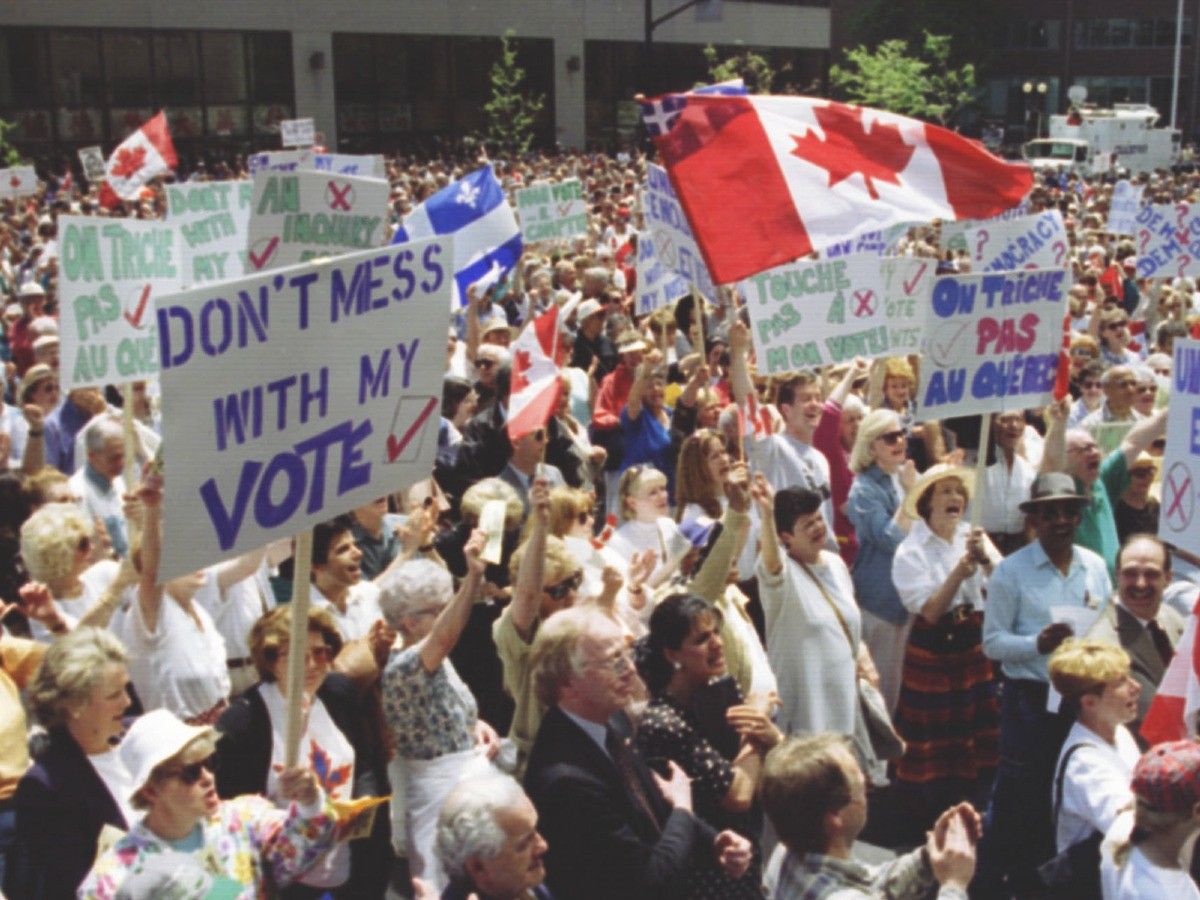
How did Quebec separatists win if most Quebecers oppose separation? | About That

Read the original at CBC News ↗
CBC News · collected 2026-10-07

Quick Summary

In Quebec's recent provincial elections, the Parti Québécois won despite polls showing that most Quebecers do not support separation from Canada. Andrew Chang analyzes how the fall of the incumbent Coalition Avenir Québec paved the way for this outcome, focusing on the shift in voter priorities that allowed sovereignty to become a less critical issue during these elections.
Written locally by qwen2.5:14b on 2026-10-07, using this article's own text rather than the other coverage of the same event (that is the story summary below).

AI analysis runs on qwen2.5:14b, locally

Story summary

Quebec's five main parties, including the separatist Parti Québécois (PQ) and the ruling Coalition Avenir Québec (CAQ), are making their final pitches to undecided voters over this weekend, ahead of Monday’s provincial election on October 5, 2026. The PQ, which has led polls throughout the campaign, promises a referendum on independence by 2029. Despite concerns raised by opponents that this could destabilize Quebec's economy and politics, PQ leader Paul St-Pierre Plamondon insists his rivals are merely trying to win votes through fear tactics. About 25% of eligible voters have already cast ballots in advance polls.

Written for “Quebec Election Vote” on 2026-10-07, grounded in this article and the 37 other(s) covering the same event.
Why this leaning score
The model judged this article politically coded and scored it -0.35, but every quote it verified points right, so the score is not published.
Written under an earlier scoring contract, which gave a paragraph rather than checkable quotes. Re-analysing this article replaces it.
Leaning score withheld for article 61608: score contradicts its own evidence · logged 2026-10-07

Signals How these are calculated →

Claims extracted
3
claim-shaped sentences
Uncertain
0%
0 of 3 hedged
Leaning
withheld
no quote in the article backed the model's score
Correction & hedging signals
76.8
corrections and hedging in what we collected; not a measure of accuracy
Outlets on this story
38
Politics
Narrative spread
1
articles carrying this framing
Analyzed 2026-10-07 · how these are computed

Story

📰 Quebec Election Vote
Politics · 38 article(s) covering the same event. See how they differ ↓

How this is being covered How these are calculated →

Article leaning vs. publisher reliability
Source leaning vs. consistency

Compared with similar articles

This article reads unscored and hedges 0% of its claims. Each row says how that neighbour differs.
National Post
⚖️ Leans left 🔴 8% hedged 7 of 92 📰 publisher trust 60
“Both articles describe the election of the Parti Québécois as the governing party in Quebec on the same date.”
The Hindu
⚖️ Leans right 🔴 9% hedged 2 of 23 📰 publisher trust 60
“Both articles describe the same provincial election result in Quebec on October 5, 2026, where separatists won despite most Quebecers opposing separation.”
The Globe and Mail
⚖️ Leans left 🔴 17% hedged 7 of 42 📰 publisher trust 51
“Both articles discuss the recent Quebec election results where the separatist Parti Québécois won after a long absence from power, indicating they cover the same specific electoral outcome.”
The Globe and Mail
⚖️ Leans left 🔴 7% hedged 3 of 41 📰 publisher trust 51
“Both articles discuss the election of Paul St-Pierre Plamondon's Parti Québécois as the governing party in Quebec on the same date.”
CBC News
⚖️ Leans left 🔴 3% hedged 1 of 31 📰 publisher trust 77
“Both articles discuss the same provincial election result in Quebec where a sovereignist party won despite most voters opposing separation.”
Al Jazeera · 0.85 cosine similarity
⚖️ Leans left 🔴 13% hedged 2 of 15 📰 publisher trust 60
“Both articles describe the Parti Quebecois winning the election in Quebec on October 6, 2026.”
BBC News
⚖️ Leans left 🔴 14% hedged 4 of 29 📰 publisher trust 72
“Both articles discuss the election of the separatist Parti Québécois as the provincial government in Quebec on a specific date, marking Paul St-Pierre Plamondon as the incoming premier.”
National Post
⚖️ Leans left 🔴 0% hedged 0 of 37 📰 publisher trust 60
“Article A describes an individual meeting between a young sovereigntist and the PQ leader to sign a book, while Article B discusses the broader political context of Quebec's provincial election results.”
The Straits Times
⚖️ Leans right 🔴 8% hedged 2 of 26 📰 publisher trust 59
“While both articles discuss the election of Quebec separatists, Article A describes the expectation before the election on October 5th, while Article B discusses the outcome and aftermath after the election on October 7th.”
South China Morning Post
⚖️ Leans left 🔴 20% hedged 1 of 5 📰 publisher trust 67
“While both articles discuss Quebec's provincial election where separatists won, they describe different aspects of the event: Article A is about the voting day and PM Carney's stance, while Article B analyzes how separatists won despite most Quebecers opposing separation.”

Publisher

CBC News · 1004 article(s) · 4 correction(s) detected
Running correction rate · 4 correction(s)
2026-09-28
Alleged drug trafficker denied bail again in Toronto police corruption case
2026-09-19
She pressed charges against a Mountie for sex assault, but says court delays robbed her of justice
2026-09-17
Toronto cop charged in Project South allegedly didn't care if selling information harmed people
2026-09-15
Edmonton mayor calls for province to address release protocols after detainees dropped off in Chinatown

Who wrote this

No reporter is named on this article.

Topics

Canada Coalition Avenir Québec Quebec Quebecers the Parti Québécois

Subjects

Quebec GPE · 2× Quebecers NORP · 2× Adobe Stock ORG · 1× Andrew Chang PERSON · 1× Canada GPE · 1× Coalition Avenir Québec ORG · 1× Paul St-Pierre Plamondon PERSON · 1× Reuters ORG · 1× The Canadian Press ORG · 1× the Parti Québécois ORG · 1×

Narrative

Andrew Chang explains how the fall of the incumbent Coalition Avenir Québec led to the rise of the Parti Québécois and its leader, Paul St-Pierre Plamondon, and why sovereignty became a separate issue for voters.
framing: assertive · carried by 1 article(s) · first seen 2026-10-07

Claims (3 extracted, 0 hedged)

How did Quebec separatists win if most Quebecers oppose separation? | asserted
Quebecers → win → separation
For the first time in over a decade, Quebec has elected a separatist party in its provincial elections, even though most Quebecers don’t want to secede from Canada. asserted
Quebecers → elect → Canada
Andrew Chang explains how the fall of the incumbent Coalition Avenir Québec led to the rise of the Parti Québécois and its leader, Paul St-Pierre Plamondon, and why sovereignty became a separate issue for voters. asserted
sovereignty → explain → voters
💬Give feedback
🕘History 🎫Support