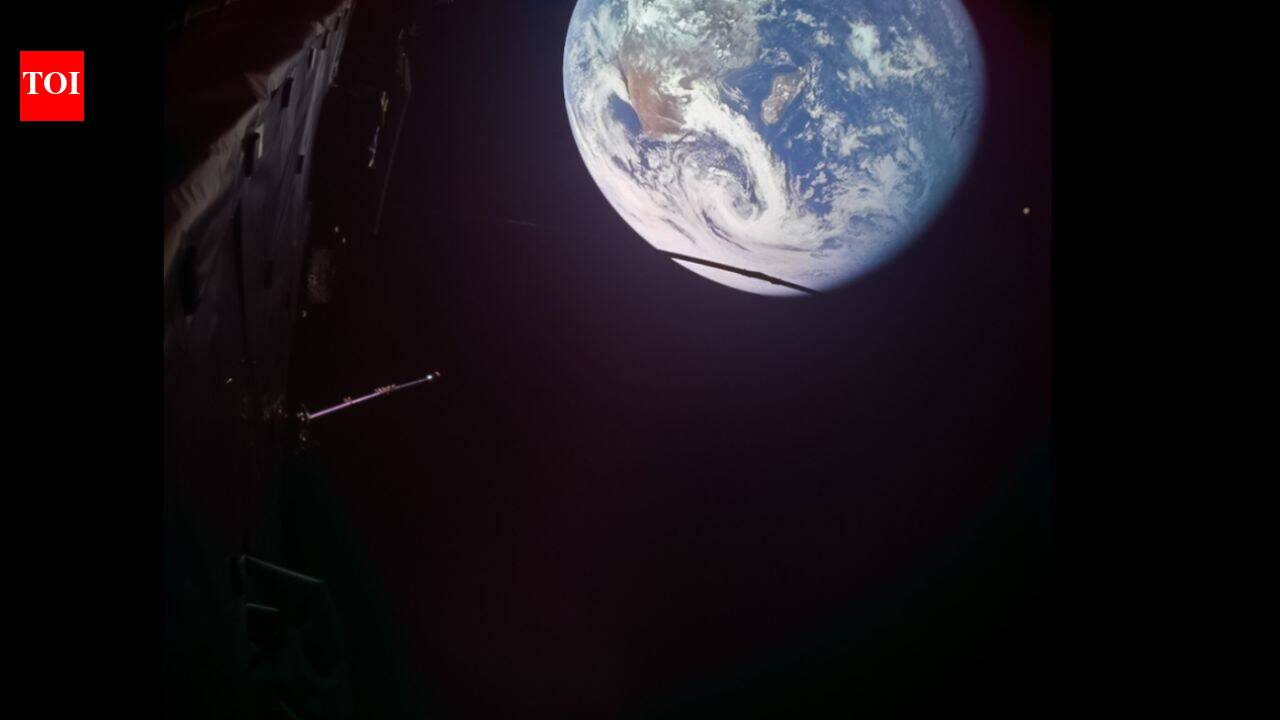
ESA’s Jupiter Icy Moons Explorer, known as Juice, used Earth’s gravity as a cosmic slingshot on September 28, 2026, reshaping its route to Jupiter while conserving precious fuel.
asserted
Explorer → know → fuel
Flying just 8,640 km above the Indian Ocean, the spacecraft had its trajectory deflected by 20 degrees and its speed increased by 3.5 km/s, all without a major engine burn.
asserted
speed → fly → burn
According to ESA and ScienceDaily, mission controllers needed only one small course correction in the four weeks before the encounter to keep Juice on the precise path needed for the gravity assist.
uncertain
controllers → accord → assist
Juice’s closest approach came at 13:45 CEST, or 11:45 UTC, on September 28.
asserted
approach → come → September
At that moment, the spacecraft passed 8,640 km above the Indian Ocean, skimming the very outer edge of Earth’s atmosphere.
asserted
spacecraft → pass → atmosphere
The manoeuvre was designed to bend Juice’s path by 20 degrees and add 3.5 km/s to its velocity, setting it on a better course toward Jupiter, as per the reports.
asserted
manoeuvre → design → reports
ESA had scheduled six opportunities for tiny trajectory corrections in the weeks leading up to the flyby, including windows at four weeks, two weeks, one week and three days before closest approach.
asserted
ESA → schedule → approach
In the end, controllers only had to use one of those six opportunities, a sign that the navigation planning was highly accurate.
asserted
planning → have → sign
Angela Dietz, Juice’s Spacecraft Operations Manager, said the flyby required ultra-precise navigation in real time and that careful planning allowed the team to use only a small amount of the propellant reserved for the event.
asserted
team → say → event
How a gravity assist works
JUICE flies by Earth: The spacecraft’s complete pathPhoto: ESA.int
asserted
JUICE → work → Earth
A gravity assist, sometimes called a gravity slingshot, uses the gravitational pull of a planet or moon to change a spacecraft’s speed and direction.
asserted
assist → call → speed
As Juice flew past Earth, our planet’s gravity pulled on the spacecraft, altering its trajectory without requiring Juice to fire its engines for an extended burn.
asserted
gravity → fly → burn
The energy for the speed increase comes from the planet’s orbital motion around the Sun, which is why the effect can be so powerful without consuming onboard fuel, as per Space Daily.
asserted
effect → come → Daily
For a mission heading to Jupiter, this kind of manoeuvre is essential.
asserted
kind → head → manoeuvre
Reaching the outer solar system requires enormous amounts of energy, and using engines alone would demand a much larger rocket and far more propellant than is practical.
asserted
using → reach → rocket
By using Earth, the Moon and Venus at different points in its journey, Juice can gradually build up the speed and direction it needs while keeping fuel in reserve for the critical operations at Jupiter.
asserted
it → use → Jupiter
ESA notes that without these gravity assists, Juice would need immense amounts of fuel to reach the speeds necessary to arrive at Jupiter, not to mention the fuel required to slow down and enter orbit around the planet.
asserted
Juice → note → planet
The gravity-assist strategy allows the spacecraft to arrive with enough fuel left to enter orbit around Jupiter in 2031 and later move into orbit around the moon Ganymede in 2034.
asserted
spacecraft → allow → 2034
Juice’s journey so far
Juice launched in April 2023 and has already used gravity assists at several points in its mission.
asserted
Juice → launch → mission
In August 2024, it performed the first-ever lunar-Earth flyby, passing the Moon at just 465 miles before sweeping past Earth the next day.
asserted
it → perform → Earth
That manoeuvre actually acted as a brake, deflecting Juice’s trajectory by 100 degrees and redirecting it toward Venus.
asserted
manoeuvre → act → Venus
In August 2025, Juice used a Venus flyby to pick up additional speed and adjust its course.
asserted
Juice → use → course
The September 2026 Earth flyby was the third major gravity assist of the mission, and it provided a significant boost in both speed and directional change.
asserted
it → provide → speed
ESA describes the overall strategy as using the gravity of Earth, the Moon and Venus to pick up speed and adjust the path almost entirely for free, as per the reports.
asserted
ESA → describe → reports
That encounter will put Juice on the optimum path to intercept Jupiter in July 2031.
asserted
encounter → put → July
The spacecraft is expected to enter orbit around Jupiter that year and then move into orbit around Ganymede in 2034, becoming the first spacecraft to orbit a moon other than Earth’s.
asserted
spacecraft → expect → Earth
A chance to test instruments
While the main goal of the flyby was to alter Juice’s trajectory, the encounter also gave scientists a valuable opportunity to test the spacecraft’s instruments on a real planetary surface.
asserted
encounter → test → surface
This was the third such opportunity during the mission, following the 2024 lunar-Earth gravity assist and the 2025 observations of Comet 3I/ATLAS.
asserted
This → follow → ATLAS
As Juice passed over the Indian Ocean, its onboard monitoring cameras captured a series of images of Earth, offering what ESA calls a unique Juice eye view of our home planet.
asserted
ESA → pass → planet
The spacecraft also photographed Africa, Madagascar and the Moon during the approach.
asserted
spacecraft → photograph → approach
These images serve both a scientific and public engagement purpose, giving researchers a chance to calibrate instruments while providing striking visuals for audiences on the ground.
asserted
images → serve → ground
ESA notes that testing instruments on real surfaces in space is an important part of preparing for the mission’s main science phase at Jupiter.
asserted
testing → note → Jupiter
The flyby allowed the team to verify that the instruments are functioning correctly and to gather data that can be used to refine their performance before the spacecraft reaches the Jovian system.
asserted
spacecraft → allow → system
Why this matters for the Jupiter mission
Juice’s mission is focused on studying Jupiter and its icy moons, particularly Ganymede, Europa and Callisto.
asserted
mission → matter → Jupiter
These moons are thought to hold vast amounts of water beneath their icy surfaces, making them key targets in the search for conditions that could support life.
uncertain
that → think → life
To study them in detail, Juice needs to enter orbit around Jupiter and then move into orbit around Ganymede, both of which require significant fuel.
asserted
both → study → fuel
By using gravity assists to build up speed and adjust its path, Juice preserves fuel for those critical operations.
asserted
Juice → use → operations
ESA says this means the spacecraft will have plenty left in its tanks to enter orbit around Jupiter in 2031 and then hop to an orbit around Ganymede in 2034.
asserted
spacecraft → say → 2034
The September 2026 Earth flyby was a key step in that long journey, providing a major boost without a major engine burn.
asserted
flyby → provide → burn
The success of the manoeuvre also reflects the precision of modern space navigation.
asserted
success → reflect → navigation
…and 2 more, not listed.
 The Aporia