A pulse of warm water hitting the Pacific coast could mean erosion and flooding

Read the original at The Independent ↗
The Independent · collected 2026-10-03 · by Martha Bellisle

Quick Summary

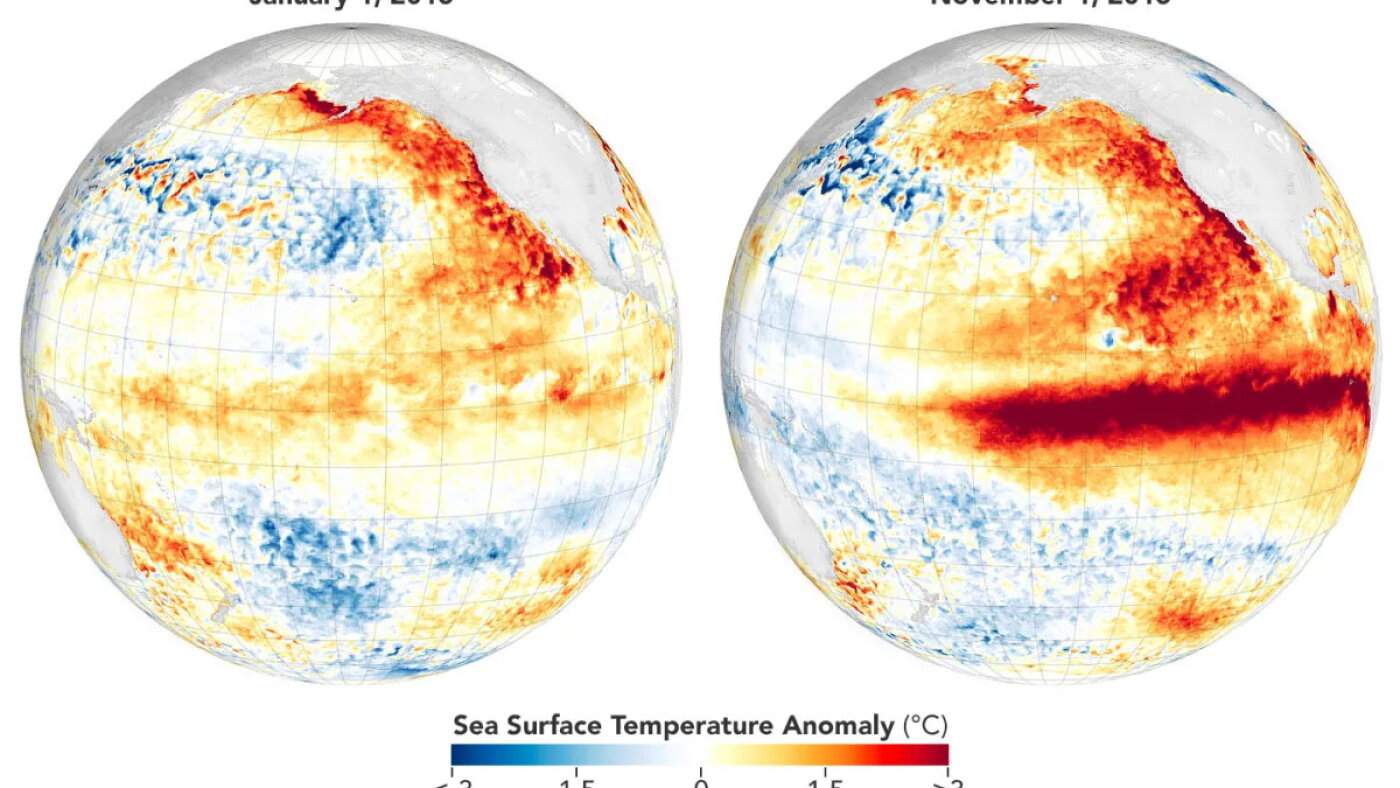
Kelvin waves, pulses of warm water expected to hit the Pacific Coast starting this month, will raise sea levels by up to a foot in California and continue northward over the next few weeks. These waves travel at about 6 miles per hour and could cause significant beach erosion and flooding, especially during high tides or storms. Experts predict that these effects, exacerbated by this year's strong El Niño, will persist from October until February, impacting marine life by pushing cold, nutrient-rich waters deeper below the surface.
Written locally by qwen2.5:14b on 2026-10-03, using this article's own text rather than the other coverage of the same event (that is the story summary below).

AI analysis runs on qwen2.5:14b, locally

Story summary

Communities in California are preparing for the arrival of a massive underwater band of warm water known as the "Kelvin wave," expected to reach the state's coast by early October. This phenomenon is driven by El Niño conditions, causing sea levels along the California coast to rise by up to a foot, doubling existing 8-12 inch increases due to climate change over the past century. The wave moves north and could affect coastal areas from southern California through the San Francisco Bay Area into Alaska.

Kelvin waves are not like tsunamis; instead, they create a bulge of water under the surface that can persist for months, raising sea levels significantly during periods when the coast is also hit by wet weather. This surge will travel north at approximately 6 miles per hour, or 150 miles per day, affecting Oregon and Washington state through February.

Scientists warn that higher sea levels combined with larger waves from North Pacific swells expected during El Niño could cause severe beach erosion and flooding in areas already vulnerable to climate change impacts. According to experts like Sean Vitousek of the U.S. Geological Survey, these conditions significantly increase flood risks.

Written for “Kelvin Wave Hits California Coast” on 2026-10-05, grounded in this article and the 4 other(s) covering the same event.

Signals How these are calculated →

Claims extracted
42
claim-shaped sentences
Uncertain
19%
8 of 42 hedged
Leaning
not political
takes no side on a contested political question
Correction & hedging signals
58.8
corrections and hedging in what we collected; not a measure of accuracy
Outlets on this story
5
Environment
Narrative spread
2
articles carrying this framing
Analyzed 2026-10-03 · how these are computed

Story

📰 Kelvin Wave Hits California Coast
Environment · 5 article(s) covering the same event. See how they differ ↓

How this is being covered How these are calculated →

Article leaning vs. publisher reliability
Source leaning vs. consistency

Compared with similar articles

This article reads unscored and hedges 19% of its claims. Each row says how that neighbour differs.
Toronto Star · 0.95 cosine similarity
⚖️ leaning not scored 🔴 18% hedged 8 of 45 📰 publisher trust 63
“Both articles describe the exact same occurrence of warm water pulses (Kelvin waves) hitting the Pacific coast and causing concerns about erosion and flooding.”
The Guardian
⚖️ leaning not scored 🔴 24% hedged 9 of 38 📰 publisher trust 60
“Both articles describe the impending arrival of a Kelvin wave affecting sea levels along the California coast during early October 2026.”
The Independent
⚖️ Leans left 🔴 24% hedged 4 of 17 📰 publisher trust 59
“Both articles describe the impending arrival of a Kelvin wave hitting the California coast in October, causing sea levels to rise and threatening coastal areas.”
New York Post
⚖️ leaning not scored 🔴 18% hedged 2 of 11 📰 publisher trust 64
“Both articles describe the exact same phenomenon of a coastal trapped wave or Kelvin wave affecting California's coast with rising sea levels, leading to concerns about erosion and flooding.”
New York Post
⚖️ leaning not scored 🔴 31% hedged 4 of 13 📰 publisher trust 64
“The articles describe different events: one discusses rising sea levels due to warm water pulses (Kelvin waves), while the other reports on health warnings for beaches due to elevated bacteria levels.”
NPR
⚖️ Leans left 🔴 16% hedged 16 of 97 📰 publisher trust 60
“The articles discuss different aspects of El Niño's impacts, with Article A focusing on NOAA scaling back research and understanding El Niño in general, while Article B specifically talks about Kelvin waves hitting the Pacific coast leading to erosion and flooding.”

Publisher

The Independent · 1625 article(s) · 4 correction(s) detected
Running correction rate · 4 correction(s)
2026-10-03
Prison chief to resign after shock botched execution of Christa Pike
2026-09-22
Costa Rican man complained of lack of care for diabetes before his death in ICE custody, family says
2026-09-17
Killer who gunned down famed Elvis impersonator set to be executed tonight
2026-09-04
Pennsylvania confirms second death of child with measles after RFK Jr. told CDC director to delete numbers

Who wrote this

Martha Bellisle
1 article(s) here · 1 carrying a prediction
🔮 Sea levels along the West Coast will begin to rise by up to a foot this month as a series of pulses of warm water called Kelvin waves hit the shoreline and move north, sparking concerns about beach erosion and flooding in areas already impacted by climate change and El Niño.
The only article under this byline in the corpus.

Topics

Amaya California El Niño Independent super El Niño

Subjects

Amaya ORG · 3× California GPE · 2× Dillon Amaya PERSON · 1× Ecosystem Science Division ORG · 1× Independent NORP · 1× Michael Jacox PERSON · 1× National Oceanic and Atmospheric Administration Fisheries’ ORG · 1× Oregon GPE · 1× Washington GPE · 1× the Department of Marine, Earth, and Atmospheric Sciences ORG · 1×

Narrative

The higher sea level combined with larger than average waves from North Pacific swell, which are expected during the El Niño, plus large spring tides from October to February, can cause exceptional erosion on the West Coast, said Sean Vitousek, a research oceanographer with the U.S. Geological Survey.
framing: assertive · carried by 2 article(s) · first seen 2026-10-03
🔮 Sea levels along the West Coast will begin to rise by up to a foot this month as a series of pulses of warm water called Kelvin waves hit the shoreline and move north, sparking concerns about beach erosion and flooding in areas already impacted by climate change and El Niño.
2026-10-03 · The Independent
A pulse of warm water hitting the Pacific coast could mean erosion and flooding · assertive framing

Claims (42 extracted, 8 hedged)

Sea levels along the West Coast will begin to rise by up to a foot this month as a series of pulses of warm water called Kelvin waves hit the shoreline and move north, sparking concerns about beach erosion and flooding in areas already impacted by climate change and El Niño. asserted
series → begin → change
Kelvin waves are not like tsunamis, and they don't curl over and crash on the beach. asserted
they → curl → beach
A better image is water sloshing in the bathtub or a swimming pool during an earthquake. asserted
image → slosh → earthquake
In the ocean, they are bulges of water that lift the sea level as they move along the coast. asserted
they → lift → coast
They're common during El Niño events, but this year’s super El Niño could intensify the impacts, experts say. Over the next week, the 6-inch to foot-tall surge will move north along the California coast at about 6 miles per hour (9.6 kilometers per hour), or 150 miles per day (241 kilometers per day), bringing higher sea levels to Oregon and Washington state. uncertain
surge → intensify → Oregon
Experts predict the waves will continue to pass through from October until February. asserted
waves → predict → February
“It’s not that this Kelvin wave is going to come and flood anything on its own,” said Michael Jacox, a research oceanographer with National Oceanic and Atmospheric Administration Fisheries’ Ecosystem Science Division. asserted
Jacox → ’ → Division
Instead, it raises the baseline. asserted
it → raise → baseline
If you start with sea levels that are 6 inches higher than normal, when you have really high tides, big storms or storm surges, the water levels are now 6 inches higher, he said. asserted
he → start → tides
“The effects can be amplified,” he said. asserted
he → amplify → ?
The waves also increase ocean temperatures and push cold, nutrient-rich waters deeper below the surface, which has an impact on marine life. asserted
which → increase → life
How does a Kelvin wave form? asserted
wave → form → ?
Kelvin waves are a “fact of life” during an El Niño, a naturally occurring climate pattern involving the warming ocean waters, said Dillon Amaya, an assistant professor in the Department of Marine, Earth, and Atmospheric Sciences at North Carolina State University. asserted
Amaya → occur → University
They form when the trade winds along the equator change direction. asserted
winds → form → direction
Winds blowing east to west along the equator push water in the Pacific Ocean west toward Asia, Jacox said. asserted
Jacox → blow → Asia
When those winds weaken or reverse direction, that bulge of water gets pushed back toward the east along the equator until it hits South America. asserted
it → weaken → America
When the surge of water hits the coastline at the equator, it moves north and south along the North and South American coasts. asserted
it → hit → coasts
The wave isn't visible to the naked eye and they won't cause boats to go up and down, Amaya said. asserted
Amaya → cause → eye
It's wider than it's deep: The bulge extends 12 to 20 miles (19 to 32 kilometers) off the coast and about 200 meters deep, Amaya said. asserted
Amaya → extend → coast
Many coastal communities are already grappling with the impacts of rising sea levels, like the coastal erosion eating away at the beach in San Clemente, California. asserted
communities → grapple → Clemente
Waves are also getting bigger, experts say. asserted
experts → get → ?
The higher sea levels could exacerbate those problems. uncertain
levels → exacerbate → problems
“People are on edge,” Amaya said. asserted
Amaya → say → edge
“They think about more flooding happening, more beach erosion so when you hear elevated sea states coastal inundation risk, I think that raises a lot of anxiety.” asserted
that → think → anxiety
The higher sea level combined with larger than average waves from North Pacific swell, which are expected during the El Niño, plus large spring tides from October to February, can cause exceptional erosion on the West Coast, said Sean Vitousek, a research oceanographer with the U.S. Geological Survey. asserted
Vitousek → combine → Survey
Generally, the largest El Niño events of 1982-83, 1997-98 and 2015-16 caused West Coast beaches to experience their worst erosion on record, Vitousek said. asserted
Vitousek → cause → record
“The loss of protective beaches also increases wave impacts and coastal flooding on property and infrastructure,” he said. asserted
he → increase → property
Things could intensify over time as more waves arrive over the winter. uncertain
waves → intensify → winter
Typically El Niños are associated with five or six of these waves, Amaya said. asserted
Amaya → associate → waves
One already came through in May or June and there’s evidence of a third Kelvin wave forming, he said. uncertain
he → come → May
Experts expect it to continue up the coast over the next month or so. asserted
it → expect → month
How are states responding to concerns about higher sea levels? asserted
states → respond → levels
There's concern the waves could worsen challenges along the Southern California coast, said Alyssa Napuri, deputy chief of staff for Orange County Supervisor Katrina Foley. uncertain
Napuri → be → Foley
Already, waves are approaching a seaside rail line and oceanfront homes were damaged during swells last month tied to Hurricane Marie. asserted
homes → approach → Marie
Authorities are placing emergency sand on beaches as quickly as possible, Napuri said, adding that forecasts show the Kelvin Wave could send water levels between six to 12 inches higher. “We’re already struggling as it is,” Napuri said. uncertain
Napuri → place → levels
California Gov. Gavin Newsom, a Democrat, proclaimed a state of emergency in late September to prepare the state for what will likely be a historic El Niño season. asserted
what → proclaim → state
The proclamation will help the state “move faster to protect communities, stage critical resources, and strengthen readiness before severe weather intensifies,” the governor said in a statement. asserted
governor → help → statement
Experts with the Washington state Department of Natural Resources are ready to respond to any disasters that might come with the Kelvin waves, said spokesperson Courtney James. uncertain
James → respond → waves
They regularly coordinate through the state Emergency Management Division but they have not been asked to do any special preparation so far, she said. asserted
she → coordinate → preparation
Actual damages from the Kelvin waves will depend on the storms and tides magnified by El Niño, and if they're stronger, the damage could be significant, Amaya said. uncertain
Amaya → depend → Niño
…and 2 more, not listed.

💬Give feedback
🕘History 🎫Support