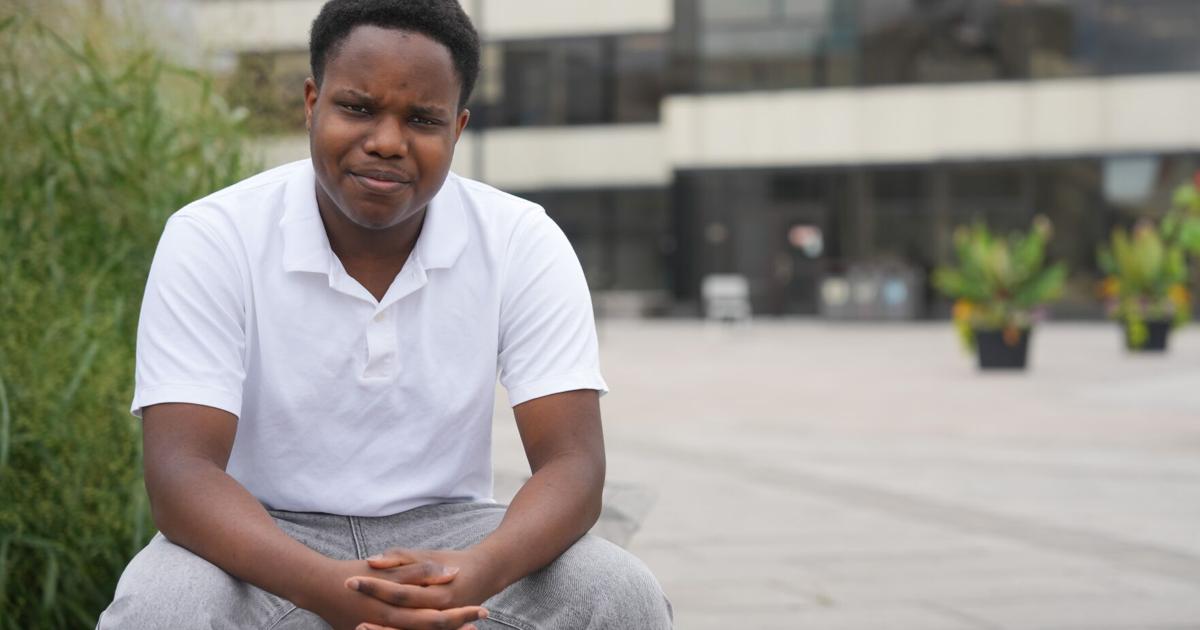
If you asked Jonathan Ogboru what he wanted to be when he grew up, the answer was usually the same: he wanted to be like his mother.
asserted
he → ask → mother
The now 18-year-old student remembers looking up to his mom, a principled and hard-working engineer who built a career in cybersecurity at a financial technology company.
asserted
who → remember → company
When Ogboru was six, she gave him a book on programming and as he grew older, he spent hours teaching himself to code.
asserted
he → give → himself
Sometimes she brought him to work, where he would watch the IT and cybersecurity teams sit around computers, solving problems.
asserted
teams → bring → problems
He remembers looking at them and thinking: I want to do that.
asserted
I → remember → that
But now, after years of chasing his passion, Ogboru sits in his dorm at the University of Ottawa, preparing to start his honours biology program instead of computer science like he had always dreamed.
asserted
he → chase → program
He pivoted his plans to medical school in his senior year, not because he had lost interest in computers, but because he had started to wonder whether there would still be a place for him in the industry by the time he got there.
asserted
he → pivot → time
“I had to ask myself ‘if I want an actual job, a house, a life, do I want to gamble on a dream?’
asserted
I → ask → dream
I want to bet on reality,” said Ogboru, who grew up in Whitby.
asserted
who → want → Whitby
But, it feels like I’ve missed out on something I wanted more than anything.”
asserted
I → feel → anything
For high school students, choosing a post-secondary program has always meant making a daunting bet on the future, but as artificial intelligence reshapes the job market and raises questions about which skills and careers will still be valuable by the time today’s teenagers graduate, that gamble can start to feel riskier.
asserted
gamble → choose → time
For students and their parents, the question is no longer simply what they want to study, but whether the career waiting for them on the other side will still exist in the way they imagined it.
asserted
they → want → it
Canadians are rethinking how to plan for education and careers
A new survey from Embark and Angus Reid suggests Ogboru is hardly alone in wondering.
uncertain
Ogboru → rethink → wondering
Nearly 84 per cent of Ontarians said they were concerned AI could make degrees less valuable, while 86 per cent believe the skills employers value will change significantly over the next 25 years.
uncertain
employers → say → years
Roughly nine in 10 were also concerned graduates wouldn’t have the skills needed for the jobs of the future.
asserted
graduates → have → future
With nearly half of all Canadians identifying as AI skeptics — 10 points above the global
The findings, from an online survey of 1,514 Canadian adults conducted July 20 to 22, also point to a growing appetite for alternatives to the traditional university route: nationally, 50 per cent of respondents said trade school or an apprenticeship would best prepare a child for a successful career in 2050, compared with 37 per cent who chose university.
asserted
who → identify → university
In Ontario, 36 per cent favoured the trades, compared with 27 per cent who chose a university, graduate or professional program.
asserted
who → favour → program
Sandra Tenus, a psychotherapist who previously worked as a guidance counsellor and was head of guidance with the Toronto Board of Education, spends roughly a fifth of her private practice on career counselling, with a particular focus on Grade 11 and 12 students.
asserted
who → work → students
After assessing a student’s interests, aptitudes, personality and working style, Tenus considers not just whether a career is a good fit, but whether it is likely to remain a viable one.
asserted
it → assess → interests
If she expects a role is at risk of being largely eliminated by AI within the next five to 10 years, she leaves it out of her recommendations.
asserted
she → expect → recommendations
For careers more likely to be transformed than replaced — including law, architecture and medicine — she talks students through what that transition might look like.
uncertain
transition → transform → what
She also highlights skilled trades and professions that depend heavily on empathy, human connection and moral judgment.
asserted
that → highlight → empathy
“I emphasize to students that evaluating the impact of AI on their potential career path is no longer optional, it is essential,” she said.
asserted
she → emphasize → path
“Virtually every job will be touched by AI in some capacity.”
asserted
job → touch → capacity
Her advice is to stop trying to identify a single “safe” career and instead ask better questions about whatever field they are considering: How will AI change the day-to-day work? Is the field expanding or shrinking? And what human skills can they develop alongside the technical ones?
Some students are preparing for a future they can’t predict
One student has turned the question of life after high school into something of a soundtrack.
asserted
student → stop → soundtrack
Justin Miranda-Radbord, a Grade 12 student in Toronto, has posted songs online about his experience preparing to transition to university, giving them names borrowed from some of Ontario’s most competitive university programs, like McMaster health science or Queen’s commerce.
asserted
Radbord → post → science
His answer to the perennial question — what are you going to do with your life? — is to build a career around the things he believes AI cannot easily replicate.
asserted
AI → go → things
Ottawa native Matt Milton, who cut his tech teeth at IBM before joining Microsoft last summer,
Like Ogboru, Miranda-Radbord had toyed with the idea of following in his mother’s footsteps and pursuing family law.
asserted
Radbord → cut → law
By the time he started thinking seriously about what he wanted to study though, ChatGPT had already been released and the future was shifting in front of his eyes.
asserted
future → start → eyes
Miranda-Radbord still expects to go to university, but he is less interested in collecting a credential than in what happens around it.
asserted
what → expect → it
He wants to learn how to build his own data-analysis business, interact with customers and develop the social skills that cannot be picked up as easily from a textbook.
asserted
that → want → textbook
“I can get all the skills required from one of those sordid $100 courses people find online,” he laughed.
asserted
he → get → courses
“Instead, I wish to go to university to learn about those ‘soft’ skills and expand my life’s horizons.”
asserted
I → wish → horizons
Rather than trying to find a profession AI is unlikely to touch, Miranda-Radbord is thinking about how to make himself useful in a world where the definition of a useful worker may be changing.
uncertain
definition → try → worker
It is a different response to the same uncertainty that sent Ogboru away from computer science.
asserted
that → send → science
He loved computers, but AI made him rethink his future
Ogboru had been interested in computers for most of his life, but sometime between Grade 11 and Grade 12, as he began researching university programs and career prospects, he encountered stories of computer science and engineering graduates struggling to find work in their fields.
He settled on medicine, at least for now, after working in a clinic and concluding that although AI may become increasingly useful in health care, he believes people will still want a human being to make the final call.
uncertain
being → love → call
Though he’s excited to begin his studies, Ogboru is now entering some of the most defining years of his future feeling like he has lost out on the life he wanted.
asserted
he → ’ → life
Instead of spending four years studying the subject he had loved since childhood, Ogboru is embarking on a path that could require a decade or more of university, medical school and training before he is fully established in his career.
uncertain
he → spend → career
His mother initially questioned the decision because she knew how much he loved technology and had thought he would, at least in part, follow her into the field.
asserted
he → question → field
She also told him that the frenzy around AI could eventually subside and the job market could change again, but Ogboru wasn’t convinced.
uncertain
Ogboru → tell → AI
…and 9 more, not listed.
 The Aporia