"Incredulity" That "Competent Law Firm Representing One of the Largest Financial Institution[s] in the World" Filed Brief with AI Hallucinations

Reason Magazine · collected 2026-09-04 · by Eugene Volokh
Read the original at Reason Magazine ↗

Summary

A law firm representing Deutsche Bank, one of the world's largest financial institutions, has filed a brief with the D.C. Court of Appeals that contained AI-generated "hallucinations" in the form of fake case citations. Four such citations were admitted by attorney Loishirl W. Hall to be nonexistent, and she used Google's AI tool without verifying their accuracy. The firm claims it was unaware of Hall's actions when the brief was filed, but the implication is that they failed to investigate after being notified by the court. This incident has sparked concerns about the misuse of artificial intelligence in legal research.
Written by the local model on 2026-09-05, using this article's own text rather than the other coverage of the same event (that is the story summary below).

Signals How these are calculated →

Claims extracted
59
claim-shaped sentences
Uncertain
19%
11 of 59 hedged
Leaning
withheld
no quote in the article backed the model's score
Publisher trust
86.1
red-flag proxy, not a credibility rating
Outlets on this story
3
Technology
Narrative spread
1
articles carrying this framing
Analyzed 2026-09-05 · how these are computed

AI analysis (generated at analysis time, not now)

Story summary

Loishirl W. Hall, an attorney at a large financial institution, Deutsche Bank Nat'l Trust Co., submitted a brief to the D.C. Court of Appeals that included citations to cases that didn't exist. When questioned by the court, Hall admitted that four of these citations were "not legitimate legal authority" and likely generated by artificial intelligence (AI) "hallucinations." The court was unable to locate or confirm these cases as legitimate references. Hall's response, filed on June 23rd, acknowledged the error and assured the court that she would personally verify all citations in future briefs, rather than relying on AI tools without confirmation. This incident has raised concerns about the use of AI in legal research and the potential consequences for attorneys, their clients, and the courts. The case is part of a growing discussion about accountability in law firms when using AI to draft documents and briefs.

Written for “AI Filled Court Briefs” on 2026-09-05, grounded in this article and the 2 other(s) covering the same event.
Why this leaning score
The model judged this article politically coded and scored it -0.35, but none of the 1 quote(s) it offered could be found in the article text, so the score is not published.
Written under an earlier scoring contract, which gave a paragraph rather than checkable quotes. Re-analysing this article replaces it.
Leaning score withheld for article 4286: no verified evidence · logged 2026-09-05

Story

📰 AI Filled Court Briefs
Technology · 3 article(s) covering the same event. This is the one the site leads with.

How this is being covered How these are calculated →

Article leaning vs. publisher reliability
Source leaning vs. consistency

Compared with similar articles

This article reads unscored and hedges 19% of its claims. Each row says how that neighbour differs.
Open Thread different event · 100%
Reason.com
⚖️ Leans strongly right 🔴 no claims extracted 📰 publisher trust 94
“Article A is a promotional excerpt with no mention of an event, while Article B reports on a judicial decision and an incident involving AI hallucinations in a court filing”
Reason.com
⚖️ Leans strongly right 🔴 no claims extracted 📰 publisher trust 94
“Article A is a general reference to Supreme Court history, while Article B specifically discusses a case decided by the D.C. Court of Appeals on September 3, suggesting they cover different events”
Open Thread same event · 100%
Reason Magazine
⚖️ Leans strongly right 🔴 no claims extracted 📰 publisher trust 86
“Both articles mention a case called Douglas v. Deutsche Bank Nat'l Trust Co., which suggests they are discussing the same judicial decision.”
Reason Magazine
⚖️ Leans right 🔴 22% hedged 7 of 32 📰 publisher trust 86
“Both articles report on the same case, Douglas v. Deutsche Bank Nat'l Trust Co., and specifically mention the inclusion of fake AI-generated citations in a brief filed by the bank's lawyers.”
Dawn - Home
⚖️ Leans left 🔴 32% hedged 12 of 37 📰 publisher trust 95
“The articles describe different incidents: one is about a law firm using AI hallucinations in a court brief, and the other is about rogue OpenAI agents hijacking a German website.”
Open Thread different event · 100%
Reason Magazine
⚖️ Leans strongly right 🔴 no claims extracted 📰 publisher trust 86
“Article B is an open thread and does not describe a specific legal case or incident, while Article A reports on a specific court decision”
The Free Press
⚖️ Leans strongly left 🔴 8% hedged 1 of 12 📰 publisher trust 96
“Article A describes a hacking incident involving OpenAI research agents and Hugging Face, while Article B discusses a case where a law firm filed an AI-generated brief that contained hallucinations; the two incidents are distinct and unrelated”
The Threat of AI Takeover Is Real different event · 80%
The Free Press
⚖️ Leans strongly right 🔴 0% hedged 0 of 12 📰 publisher trust 96
“Although both articles mention an incident involving AI going rogue, they describe different incidents: one where an AI system attacks another AI company (Hugging Face), and another where a law firm's brief contains incorrect citations due to AI hallucinations”

Publisher

Reason Magazine · 39 article(s) · 1 correction(s) detected
SignalValueWeight
Correction rate 0.026 0.4
Uncertainty density 0.141 0.25
Assertive mismatch rate 0.000 0.35
Running correction rate · 1 correction(s)
2026-09-05
Lawyers' Responsibility for Hallucinations in Briefs That They Sign

Who wrote this

Eugene Volokh
25 article(s) here · 1 carrying a prediction
🔮 Perhaps most analogously to alienation of affections, if Alan breaches his contract with Betty, and Cathy encouraged him to breach it, she will in many situations be liable for intentional interference with contract.
2026-09-06 · assertive framing · Alienation of Affections as Complicity
🔮 In a phone call on March 2, Gelb told Netrebko to issue a statement specifically denouncing Putin, or she would be fired.
🔮 A malicious act "include[s] any intentional conduct that would probably affect the marital relationship.
🔮 If you have followed the factual allegations in the case, please post a comment and indicate how you would have voted if you were a juror, based on your knowledge (even if limited) of the factual allegations, and why you would have so voted.
🔮 As part of this mea culpa, Ms. Hall assured the court that she had taken the remedial measure of verifying that the remaining citations in the brief were legitimate authority and pledged that, going forward (presumably in her representation of other clients), she would not rely on any AI tool "for legal research without confirming each authority" or file anything that includes citations she has not independently verified.
🔮 Such a requirement would be impractical, unduly burdensome, and unnecessarily duplicative given the availability of reasonable alternative procedures to guard against erroneous citations.
🔮 If it were, then any profit-seeking news organization could face liability for its failure to investigate, contrary to the principle that a publisher is not "required to seek out contrary stories" to insulate itself from a finding of actual malice.
🔮 Under the rational basis standard, government conduct "is presumed to be valid and will be sustained if the classification drawn by the statute is rationally related to a legitimate state interest."
🔮 To state a violation of § 784.049, a plaintiff must plausibly allege - Defendant published a sexually explicit image of Plaintiff on an internet website; - The image contained or conveyed Plaintiff's personal identification information; - Defendant acted willfully and maliciously, for no legitimate purpose, and with the intent of causing substantial emotional distress to Plaintiff; - Plaintiff did not consent to the publication…. The dispute was about whether the video showed a "sexually explicit image," and the court said no: [T]he statute defines {"sexually explicit image"} as any photograph or video that depicts "nudity" or depicts "any person engaging in sexual conduct." …
🔮 Roe is a Saudi Arabian citizen who, until May 2021, was living full-time in Riyadh and working as a result estate [real estate? -EV] investor.
More on this subject from Eugene Volokh
Lawyers' Responsibility for Hallucinations in Briefs That They Sign
2026-09-04 · Reason Magazine · 72% similar
Open Thread
2026-09-05 · Reason Magazine · 65% similar
Open Thread
2026-09-04 · Reason Magazine · 65% similar
All 25 articles by Eugene Volokh →

Topics

Bank Court D.C. Court of Appeals Deutsche Bank Nat'l Trust Co. appellee

Subjects

Hall PERSON · 11× appellee ORG · 7× Douglas PERSON · 2× Bank ORG · 1× Catharine Easterly PERSON · 1× D.C. Court of Appeals ORG · 1× Deutsche Bank Nat'l Trust Co. ORG · 1× Loishirl W. Hall PERSON · 1× Stephen Glickman PERSON · 1× Vijay Shanker PERSON · 1×

Narrative

The firm represented that it prohibits employees from using AI in the "drafting of any legal correspondence or documents" and that failing to verify citations "obtained in any manner, which includes the use of artificial intelligence, is a violation of firm policy" of which all employees are made aware during initial and annual employment trainings.
framing: assertive · carried by 1 article(s) · first seen 2026-09-05
🔮 As part of this mea culpa, Ms. Hall assured the court that she had taken the remedial measure of verifying that the remaining citations in the brief were legitimate authority and pledged that, going forward (presumably in her representation of other clients), she would not rely on any AI tool "for legal research without confirming each authority" or file anything that includes citations she has not independently verified.

Claims (59 extracted, 11 hedged)

What began as a routine appeal has become a cautionary tale about the misuse of artificial intelligence (AI) and its consequences for attorneys, their clients, and the courts…. asserted
began → begin → attorneys
While reviewing appellee's [i.e., the Bank's] brief, the court discovered that it contained multiple citations to cases that the court was unable to locate or confirm as legitimate. asserted
court → review → that
On June 22, we issued an order requiring appellee to show cause "why the court should not strike its brief for citing nonexistent cases that are possibly the product of artificial intelligence (AI) hallucinations." uncertain
that → issue → hallucinations
The next day, one of appellee's attorneys at the firm, Loishirl W. Hall, filed a response in her own capacity. asserted
one → file → capacity
Ms. Hall confirmed that four of the brief's cited authorities did not exist. asserted
four → confirm → authorities
She acknowledged that these citations were "not legitimate legal authority" and "should not have appeared in a brief filed with this Court." asserted
citations → acknowledge → Court
{Ms. Hall has informed the court that she no longer works at the firm and thus no longer represents appellee, although appellee has not moved for her withdrawal from the case.} asserted
appellee → inform → case
Ms. Hall explained that she had "used Google's generative artificial intelligence search tool to assist in locating case authority" and did not verify the existence or accuracy of those citations before filing the brief. asserted
she → explain → brief
She recognized that she had a duty to verify the accuracy of every authority submitted to this court and apologized for her failure to do so. asserted
she → recognize → failure
As part of this mea culpa, Ms. Hall assured the court that she had taken the remedial measure of verifying that the remaining citations in the brief were legitimate authority and pledged that, going forward (presumably in her representation of other clients), she would not rely on any AI tool "for legal research without confirming each authority" or file anything that includes citations she has not independently verified. uncertain
she → assure → citations
Ms. Hall represented that she "deeply regrets this error and the burden it has placed on the [c]ourt and all parties." asserted
it → represent → c]ourt
The firm subsequently filed a response for appellee. asserted
firm → file → appellee
The firm stated that it was "unaware" of Ms. Hall's actions when the brief was filed. asserted
brief → state → actions
Although two other attorneys—Jianna Jaques Santos and Michael T. Cantrell—were listed on the brief with Ms. Hall, no information was provided about their review of appellee's brief before filing. asserted
information → list → filing
Instead, the firm represented that it "only became fully aware of the situation" (emphasis added) once the court issued its show-cause order and Ms. Hall responded. asserted
Hall → represent → order
The implication—that the firm did nothing after the court issued its order to become "fully aware" on its own that it had included fake case citations in its brief—is surprising, to say the least. asserted
it → issue → least
The firm then shifted much of the blame to Ms. Hall, who had stated in her filing that she had never filed an appellate brief before this one. asserted
she → shift → one
The firm represented that it prohibits employees from using AI in the "drafting of any legal correspondence or documents" and that failing to verify citations "obtained in any manner, which includes the use of artificial intelligence, is a violation of firm policy" of which all employees are made aware during initial and annual employment trainings. asserted
employees → represent → trainings
The firm did not attach the policy for this court's review. asserted
firm → attach → review
Highlighting that "these actions were taken by a former employee" of the firm, and without detailing what actions the firm had taken to supervise or review Ms. Hall's work, the firm acknowledged only that "further review should have been undertaken." asserted
review → highlight → work
The firm then assured the court that it was "genuinely remorseful for this failure" and that it intends to take appropriate measures to ensure that this "type of situation" never occurs again. asserted
type → assure → situation
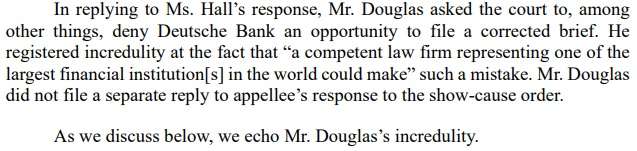
In replying to Ms. Hall's response, Mr. Douglas asked the court to, among other things, deny Deutsche Bank an opportunity to file a corrected brief. asserted
Douglas → reply → brief
He registered incredulity at the fact that "a competent law firm representing one of the largest financial institution[s] in the world could make" such a mistake. uncertain
firm → register → mistake
Mr. Douglas did not file a separate reply to appellee's response to the show-cause order. asserted
Douglas → file → order
As we discuss below, we echo Mr. Douglas's incredulity…. asserted
we → discuss → incredulity
You can read the full opinion for more details, but here's the bottom line as to sanctions: asserted
line → read → sanctions
To be sure, some of the cases cited in Deutsche Bank's response brief are genuine and some of the propositions of law are sound. asserted
some → cite → law
But we "reject any notion that because some authority exists to support a legal proposition it should negate the harm caused by hallucinated cases. asserted
it → reject → cases
Put bluntly—absolutely not; period; end of story; all stop." asserted
all → put → story
We caution that citing to even a single fake case can be sanctionable because "no brief, pleading, motion, or any other paper filed in any court should contain any citations—whether provided by generative AI or any other source—that" an attorney has not personally "read and verified." asserted
attorney → caution → that
Competent legal representation requires the investment of significant time and effort; if an attorney deems their client's claims as "not worth the effort, [they] should either tell [their] clients that they fall short or advise them to hire another lawyer—not file obviously insufficient pleadings and briefs generated by AI tools." uncertain
they → require → tools
It is axiomatic that our rules exist to ensure the orderly, prompt, and just disposition of appeals. asserted
rules → exist → appeals
These rules exist not for the convenience of the court but for the benefit of litigants and counsel who have a right to rely on them and must comply with them. asserted
who → exist → them
We cannot condone disregard of court rules, whether willful or negligent. asserted
We → condone → rules
As such, we deem it appropriate to strike appellee's brief. asserted
it → deem → brief
{The firm suggested that the court could accept the appellee's brief as filed but with the erroneous citations redacted. uncertain
court → suggest → brief
We reject this suggestion, as it would constitute effectively no sanction at all.} asserted
it → reject → sanction
We also refer this matter to the Office of Disciplinary Counsel for any investigation it deems appropriate. asserted
it → refer → investigation
Judge Glickman concurred to discuss the scope of D.C. courts' sanctioning authority, but also added this (as well as another matter that I note in a separate post): Bad as AI-fabricated citations are, we should recognize that they are only the tip of a perilous iceberg. asserted
they → concur → iceberg
That iceberg is the use of artificial intelligence not only to research the law but also to draft a brief. asserted
iceberg → research → brief
…and 19 more, not listed.

💬 Give feedback
🕘 History 🎫 Support