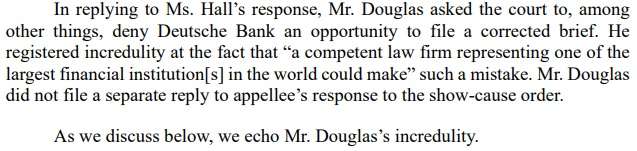
An interesting perspective from D.C. Court of Appeals Judge Stephen Glickman concurring in Douglas v. Deutsche Bank Nat'l Trust Co. (more on that case here):
The panel opinion, which I join, states that "every attorney who signed the brief bears some responsibility" for inclusion of fake citations.
asserted
who → concur → citations
I agree with that general principle, subject to a clarification as to what I think it must entail.
asserted
it → agree → what
The opinion also quotes, with evident approval, the Ninth Circuit's declaration that "[a] competent and diligent attorney cannot decline to 'vet' citations, in a brief he signs, for substantive validity—in other words, to read the cited authorities and ensure that they are on point."
asserted
they → quote → point
In the appeal that the Ninth Circuit had before it, there was only one signatory on the brief in question.
asserted
Circuit → have → question
If the quoted statement is understood to mean that every signatory on any brief with multiple signatories must personally check every citation in the brief for accuracy, I demur….
asserted
I → quote → accuracy
Appellate briefs commonly list the names of multiple attorneys for the party on whose behalf the briefs are submitted.
asserted
briefs → list → party
Ordinarily, only one of those attorneys actually signs the brief.
asserted
one → sign → brief
For present purposes, though, all the named attorneys are deemed to be "signatories" who stand behind and who (usually, but not always) contributed to the brief.
asserted
who → name → brief
(It is not unreasonable for a brief to list the attorneys who represent the party in the appeal even if they did not personally contribute to the brief or were not its principal drafter(s).)
asserted
they → list → brief
This does not mean, however, that all these "signatories" necessarily have exactly the same responsibilities for ensuring that the brief comports with ethical and other requirements.
asserted
brief → mean → requirements
Fulfilling the duty to guard against AI-hallucinated (or otherwise invalid) citations can be a group effort that does not require every signatory to personally cite check every brief.
asserted
that → fulfil → brief
Such a requirement would be impractical, unduly burdensome, and unnecessarily duplicative given the availability of reasonable alternative procedures to guard against erroneous citations.
asserted
requirement → give → citations
{See Lake v. Gates, 130 F.4th 1054, 1062 (9th Cir. 2025) (Bumatay, J., concurring in the judgment only) (Disagreeing with the majority's conclusion that federal Rule 11 allowed the trial court to sanction an attorney who participated on a brief as "of counsel" and only contributed a discrete portion to the offending brief, because "[a]s a textual matter…, Rule 11 permits different levels of accountability for different attorneys in a case….
asserted
Rule → see → case
To encourage the participation of specialized attorneys and to improve the quality of advocacy in our courts, we should have adopted a rule that recognizes the circumscribed role that some attorneys with subject-matter expertise may play in litigation.").}
uncertain
attorneys → encourage → litigation
.
Suppose, for example, that a law firm assigns different sections of a complex brief to different associates for initial drafting.
asserted
firm → suppose → drafting
Each associate is certainly responsible for the accuracy of the citations in his own assigned section; in general, this cite checking is a task that the principal drafter (or drafters) of a brief must perform.
asserted
drafter → assign → brief
But that hardly means each associate must also be charged with double-checking a section assigned to and drafted by another associate.
asserted
associate → mean → associate
Or consider the typical brief this court receives from the United States Attorney's Office in criminal appeals.
asserted
court → consider → appeals
Every one of those many briefs lists not only the author (who is also the designated counsel for oral argument) but also the Assistant United States Attorneys who represented the government at trial (who may have been consulted by appellate counsel but who have nothing to do with the drafting of the legal arguments in the brief); the Chief of the Criminal Appellate Section (who oversees the production of a multitude of briefs and can hardly be expected to spend all her time checking all the citations in that multitude); and the United States Attorney herself (ditto).
uncertain
who → list → multitude
It surely would be unrealistic, as well as unnecessary overkill, to require each of those attorneys to cite check any given brief.
asserted
It → require → brief
Other, far more practical procedures can be followed to ensure that AI-generated hallucinations do not result in the inclusion of fake citations in briefs and other filings.
asserted
hallucinations → follow → briefs
I suspect that the problem of fake citations (along with other AI-generated errors that I describe below) arises primarily when lawyers unwisely ask AI to draft a brief from scratch for them, a practice that supervisors can (and, I think, should) ban outright.
asserted
I → suspect → that
(I will say more about this below.
asserted
I → say → this
That said, law firms and law departments may institute supplemental measures to guard against AI-hallucinated citations and other AI-generated errors in their briefs.
uncertain
firms → say → briefs
Such measures include training (and retraining) attorneys in the proper use of AI; adopting clear policies governing such use and providing for discipline when appropriate; and requiring attorneys to confirm that they have complied with those policies.
asserted
they → include → policies
The likelihood that any fake citations will eventually come to light, and that the consequences for the offender will be drastic, should be made very clear.
asserted
consequences → come → offender
In addition, to the extent it is desirable to double check the citations and case descriptions in all briefs before they are filed, such "vetting" may be done cost-effectively by a trained paralegal.
uncertain
vetting → check → paralegal
{I should not be understood as suggesting that only a lawyer who did the actual drafting of a brief containing fake citations (or other AI-generated errors, see infra) may be subject to sanction.
uncertain
who → understand → sanction
For example, if training and oversight have been neglected, I think supervisory lawyers may be accountable as well.}
uncertain
lawyers → neglect → example
As the opinion itself suggests, other judges may disagree (see, e.g., this post), and lawyers certainly shouldn't feel comfortable that they'll get off the hook for hallucinations so long as they weren't the person drafting that part of the brief.
uncertain
they → suggest → brief
And of course, regardless of whether there are any formal sanctions on the lawyer, such hallucinations risk losing the case for the client, risk damaging the firm's reputation, risk a malpractice lawsuit for the firm, are likely to undermine the client's relationship with all the lawyers at the firm, and more.
asserted
hallucinations → be → firm
Still, the judge's point that it's not reasonable to expect every signing lawyer to personally check each citation seems sound to me.
asserted
lawyer → expect → me
 The Aporia