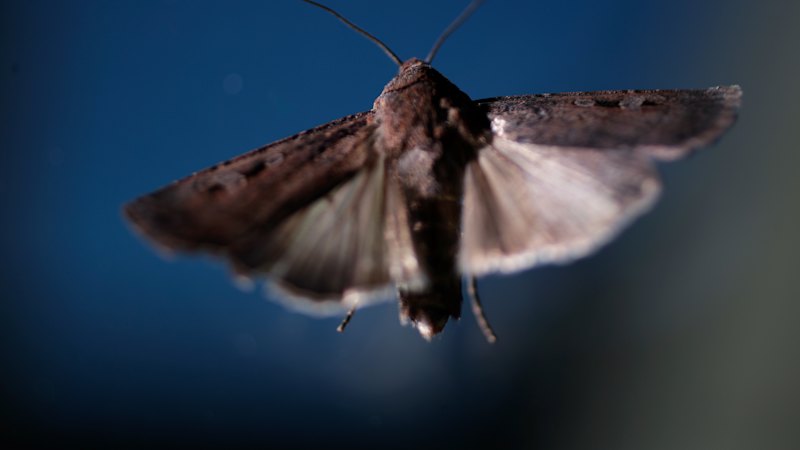
Photo via The Sydney Morning Herald

After a catastrophic decline bogong moths are back, and naturalists are celebrating

Read the original at The Sydney Morning Herald ↗
Cite

O'Malley, N. (2026, September 28). After a catastrophic decline bogong moths are back, and naturalists are celebrating. The Sydney Morning Herald. https://www.smh.com.au/environment/conservation/after-a-catastrophic-decline-bogong-moths-are-back-and-naturalists-are-celebrating-20260928-p610z7.html?ref=rss&utm_medium=rss&utm_source=rss_feed

Dated when The Aporia collected the article, usually within hours of publication. Check the original for its exact date and byline.

The Sydney Morning Herald · collected 2026-09-28 · by Nick O'Malley

Quick Summary

Bogong moths, after a significant population decline from over eight billion in the 1980s to less than four billion by 2017 and near undetectable levels since then, are now showing unexpected abundance. This resurgence is attributed to improved conditions and increased rainfall but remains somewhat mysterious. Scientists like Dr. Marissa Parrott of Zoos Victoria are excited about this development, noting a substantial increase in moth sightings recorded through citizen science projects like Moth Tracker and iNaturalist.
Written by AI on 2026-09-28, from this article's own text only (the story summary below draws on all the coverage).
See how they differ ↓

AI analysis

Story summary

Bogong moths, which had seen their numbers plummet by over 99% between 2017 and 2019 due to severe drought in their lowland breeding areas, are making a surprising comeback this spring in New South Wales (NSW), Australia. Listed as endangered since 2021, the moths are now being spotted in large numbers, delighting naturalists and researchers who track them using citizen science platforms like iNaturalist. Master's student Ayesha Kelly from the University of Western Sydney has reported a significant increase in moth activity at her light traps near Sydney. The insects, each weighing about as much as a Tic Tac, migrate up to 1,000 kilometers for their annual journey to cool caves in the Snowy Mountains to escape summer heat. Researchers speculate that increased rainfall and warmer winter conditions have contributed to this resurgence, with hundreds of sightings logged on iNaturalist recently. The moths' return is seen as a positive sign for conservation efforts despite them not being listed under federal laws.

Written for “Bogong Moth Recovery” on 2026-11-18, grounded in this article and the 3 other(s) covering the same event.

How they differ

4 outlets covered “Bogong Moth Recovery”.

What each outlet says

One AI summary per outlet of its latest article on this story, written from that article alone and checked against it. Open the article for the outlet's own words.

Sydney Morning HeraldThis outlet28 Sep

Bogong moths, after a significant population decline from over eight billion in the 1980s to less than four billion by 2017 and near undetectable levels since then, are now showing unexpected abundance. This resurgence is attributed to improved conditions and increased rainfall but remains somewhat mysterious. Scientists like Dr. Marissa Parrott of Zoos Victoria are excited about this development, noting a…

After a catastrophic decline bogong moths are back, and naturalists are celebrating (this article)
The Guardian28 Sep

Residents in New South Wales have been surprised by large swarms of bogong moths over recent days. The Bogong Watch initiative, run by Invertebrates Australia, has recorded numerous sightings through its citizen science program. Project manager Linnea Emneby reports that some households spotted dozens of moths, with one sentinel sighting more than 200 on a single night. Dr Marissa Parrott from Zoos Victoria’s Moth…

‘Thrilled’: huge swarms of bogong moths surprise NSW residents and may point to species’ recovery →
ABC News (AU)28 Sep

Bogong moths are swarming across New South Wales as part of their annual migration to the Snowy Mountains. Over 800 sightings have been logged on iNaturalist since Friday, with many homes seeing millions of moths. Researchers suggest increased rainfall and warmer winter temperatures may be contributing to this year's dramatic influx, offering hope for the endangered species.

Homes invaded by 'millions' of migrating bogong moths →
BBC1 Oct

Bogong moths, an endangered species, have unexpectedly swarmed along Australia’s east coast, entering homes and vehicles in cities such as Sydney and Canberra. Helen Livingstone of the BBC investigates their origins and the reasons behind this unusual abundance.

Why are these endangered moths swarming Australia's east coast? →

Where they agree and split

Framing

How the first headlines put it

Stated as fact3
The headlines (3)

After a catastrophic decline bogong moths are back, and naturalists are celebrating Sydney Morning Herald · stated as fact

‘Thrilled’: huge swarms of bogong moths surprise NSW residents and may point to species’ recovery The Guardian · stated as fact

Homes invaded by 'millions' of migrating bogong moths ABC News (Australia) · stated as fact

The full story: what happened, how it changed, and all 4 articles →

Compared with similar articles

This article reads unscored and hedges 3% of its claims. Each row says how that neighbour differs.
ABC News (AU)
Hedges 3 of 35 claims Outlet record 67/100
The Guardian
Hedges 0 of 29 claims Outlet record 64/100
BBC News
Hedges 0 of 3 claims Outlet record 65/100
“While both articles discuss a resurgence of bogong moths in Australia, ARTICLE A focuses on scientific observations and celebration by researchers, while ARTICLE B highlights the moth's impact on urban areas with people filming them.”

Story

Bogong Moth Recovery
Environment · 4 article(s) covering the same event. Compare every outlet's account →
How this article was measured signals, leaning charts, publisher record, byline, topics and claims

Signals How these are calculated →

Claims extracted
33
sentences that state something as happening or true
Uncertain
3%
1 of 33 hedged ("reportedly", "may", "according to")
Leaning
not political
takes no side on a contested political question
Publisher signals
61/100
The Sydney Morning Herald's corrections and hedging, across everything collected from it. Not a measure of accuracy.
Outlets on this story
4
Environment
Same framing elsewhere
1
articles that frame the event the way this one does
Analyzed 2026-09-28 · how these are computed

How this is being covered How these are calculated →

Article leaning vs. publisher reliability
Source leaning vs. consistency

Publisher

The Sydney Morning Herald · 7597 article(s) · 15 correction(s) detected
Running correction rate · 15 correction(s)

Who wrote this

Nick O'Malley
20 article(s) here · 1 carrying a prediction
Under the Economic Transition Scenario, a business-as-usual forecast driven purely by market forces and economics without new policy interventions, emissions will fall by 32 per cent by 2035 and 56 per cent by 2050.
Signed by Climate Change Minister Chris Bowen and his South Korean counterpart, Kim Sungwhan, on the sidelines of the United Nations’ climate summit, COP31, the agreement will give Australia access to the $US1 trillion the South Korean government has pledged to spend decarbonising its economy in the years to 2035.
Australian Conservation Foundation chief executive Adam Bandt, the former Greens leader who is at the conference, said the comments could be read as criticism of Australia, which has focused on electrification in lieu of pursuing the more diplomatically difficult task of securing agreement to specifically target fossil fuels.
Global carbon emissions are projected to decrease by 0.4 per cent this year, a new report shows, as world leaders begin to arrive at climate talks in Turkey, where the Australian president of negotiations hopes to secure agreement to speed up the electrification of the world’s economy.
Australian Climate Change Minister Chris Bowen, who will serve as president of the negotiations at the United Nations’ COP talks, said every delay costs the world more in its human and economic toll.
A year ago, the idea that Democrats might seize control of the US Senate was laughable.
Under Bolsonaro’s rule, clearing and burning for agriculture, beef production and mining had reached record highs, pushing it towards the point at which it may start to emit more carbon than it absorbs.
A nationwide review of biosecurity measures will target the imported red fire ant incursion in Sydney’s inner west after revelations the location of the nest was only required to be checked every three years.
Cafes will be able to continue serving customers who choose to sit down to drink hot drinks in recyclable disposable cups in a change to a new law introduced to reduce plastic waste passed last week.
2026-10-28 · assertive framing · NSW government backflips on brand-new coffee cup law
Bowen secured the talks in negotiations when it became clear Turkey would succeed over Australia in its bid to host United Nations climate talks in November.
Also by Nick O'Malley
Nothing else under this byline is closely related to this article, so these are simply their most recent.
All 20 articles by Nick O'Malley →

Topics

NSW Sydney a Tic Tac iNaturalist the University of Western Sydney

Subjects

Parrott PERSON · 4× Ayesha Kelly PERSON · 1× Bogong Watch ORG · 1× Kelly PERSON · 1× Marissa Parrott PERSON · 1× NSW GPE · 1× Sydney GPE · 1× Zoos Victoria ORG · 1× iNaturalist ORG · 1× the University of Western Sydney ORG · 1×

Narrative

After drought struck much of their lowland breeding areas, bogong moth numbers collapsed by more than 99 per cent between 2017 and 2019, causing them to be listed as endangered in 2021, says Dr Marissa Parrott, a senior conservation biologist for Zoos Victoria, who helps run Bogong Watch, a citizen science project that also tracks the animal’s annual migration.
framing: assertive · carried by 1 article(s) · first seen 2026-09-28
“They went from being so numerous that they could block out the moon and the stars as they flew overhead to nearly undetectable,” says Parrott.
2026-09-28 · The Sydney Morning Herald
After a catastrophic decline bogong moths are back, and naturalists are celebrating · assertive framing

Claims (33 extracted, 1 hedged)

They are about the size of a 50 cent piece, weigh as much as a Tic Tac and travel up to 1000 kilometres for their seasonal migration, using celestial navigation and the Earth’s own magnetic field. asserted
They → weigh → navigation
Now, after a near total population collapse, bogong moths are delighting scientists with sudden spring abundance. asserted
moths → delight → abundance
“I am absolutely losing my mind right now,” says Ayesha Kelly, a masters student at the University of Western Sydney, where she is studying the moths. asserted
she → lose → moths
“I just feel so lucky. asserted
I → feel → ?
I feel like we have been blessed by the moth gods.” asserted
we → feel → gods
Kelly, like other moth buffs in NSW, is submitting her photographs of bogongs to the iNaturalist website so their movements can be recorded and tracked. asserted
movements → submit → website
She uses light traps, which catch bogongs for observation and release, at her home in the NSW Blue Mountains, and this year the traps are heaving. asserted
traps → use → Mountains
Her mother says the number of the insects seen around Sydney this year reminds her of her childhood. asserted
number → say → childhood
After drought struck much of their lowland breeding areas, bogong moth numbers collapsed by more than 99 per cent between 2017 and 2019, causing them to be listed as endangered in 2021, says Dr Marissa Parrott, a senior conservation biologist for Zoos Victoria, who helps run Bogong Watch, a citizen science project that also tracks the animal’s annual migration. asserted
that → strike → migration
Their sudden return this year clearly has something to do with better conditions and increased rain, but bogong moths still remain mysterious, Parrott says. asserted
Parrott → have → conditions
We don’t fully understand why their numbers crashed so terribly, nor why they have returned. asserted
they → understand → ?
It is estimated that in the 1980s as many as eight billion moths made the migration from their breeding grounds to spend summer in alpine caves, where they gather in what are known as “gregarious aggregation”. asserted
what → estimate → aggregation
That number is thought to have fallen to about four billion by 2017. asserted
number → think → 2017
In the years that followed, few were seen at all. asserted
few → follow → years
“They went from being so numerous that they could block out the moon and the stars as they flew overhead to nearly undetectable,” says Parrott. uncertain
Parrott → go → moon
The moths’ migration serves not only to pollinate native vegetation but also as a huge transfer of protein and nutrients into the delicate ecosystems of the high country. asserted
migration → serve → country
They serve not only as food for birds and mammals, but also improve the soil. asserted
They → serve → soil
With the moths absent, scientist found that litters of critically endangered mountain pygmy possums in the Victorian alps disappeared too. asserted
litters → find → alps
Today it is thought that just 2000 of the possums survive in the wild. asserted
2000 → think → wild
“We’re so excited to see the numbers coming through this year,” says Parrott, who leads Zoos Victoria’s Moth Tracker website. asserted
who → ’re → website
“I think it’ll be some time before we get back to the heyday of where they used to be, but we know through the Moth Tracker website, we’ve already had more bogon moth submissions come in the last month than in previous years. asserted
submissions → think → years
We’ve already surpassed last year’s total.” asserted
We → surpass → total
She says that despite healthy rains this year, the broader conditions that led to the decline remain in place, particularly in the high country where the moths spend their summer. asserted
moths → say → summer
Caves where the animals shelter from the heat and slow their metabolism over summer are growing warmer with climate change. asserted
animals → shelter → change
Asked what advice she has for anyone who has suddenly found their home hosting hundreds of moths, Parrott urges just marvelling at the moment. asserted
Parrott → ask → moment
“I want to point out how exciting it is to have an endangered species actually coming through your backyard, or visiting you at home. asserted
species → want → home
People don’t need to travel to find these beautiful endangered animals. asserted
People → need → animals
What they can do is turn off unnecessary outdoor lights, which stops the moths from being drawn from their migration and helps them on their way. asserted
which → turn → way
“They can, for the future, plant native plants like callistemons and grevilleas; they can avoid insecticides. asserted
they → plant → insecticides
“Don’t panic if you see large numbers of moths because they’re just moving through, and this is how it should be. asserted
it → panic → moths
This shows that an endangered species is recovering, and that’s something we can all celebrate.” asserted
we → show → ?
Get to the heart of what’s happening with climate change and the environment. asserted
what → get → change
Our fortnightly Environment newsletter brings you the news, the issues and the solutions. asserted
newsletter → bring → news
Give feedback · no sign-in needed

No sign-in needed for now. Your note is sent without a name, so it cannot be answered.

History Support