Photo via The Sydney Morning Herald

Bowen’s bid at UN conference: Not too late to turn down the temperature

Read the original at The Sydney Morning Herald ↗
Cite

O'Malley, N. (2026, November 18). Bowen’s bid at UN conference: Not too late to turn down the temperature. The Sydney Morning Herald. https://www.smh.com.au/environment/climate-change/bowen-s-bid-at-un-conference-not-too-late-to-turn-down-the-temperature-20261118-p61fep.html?ref=rss&utm_medium=rss&utm_source=rss_feed

Dated from the outlet's own feed. Check the original for its byline.

The Sydney Morning Herald · collected 2026-11-18 · by Nick O'Malley

Quick Summary

Chris Bowen, Australia’s Climate Change Minister, addressed the UN climate conference in Antalya, advocating for increased global efforts to accelerate electrification to combat climate change. A new BloombergNEF report indicates that Australia is not on track to meet its climate goals, with current trends putting its 2030 and 2035 targets at risk. The report outlines a Net Zero Scenario requiring aggressive policy changes, including a rapid shift towards clean electricity and widespread electrification, which would deliver 76% of the necessary emissions reductions by 2050. Bowen highlighted Australia’s progress in renewable energy and electric vehicle adoption, emphasizing the potential for widespread change through collective action.
Written by AI on 2026-11-18, from this article's own text only.

AI analysis

Why this leaning score
The model judged this article politically coded and scored it -0.35, but 1 quote(s) could not be found in the article and the other 2 are attributed speech rather than the article's own narration, so the score is not published.
Written under an earlier scoring contract, which gave a paragraph rather than checkable quotes. Re-analysing this article replaces it.
Leaning score withheld for article 163174: no verified evidence · logged 2026-11-18

Compared with similar articles

This article reads unscored and hedges 15% of its claims. Each row says how that neighbour differs.
ABC News (AU)
Leans left Hedges 2 of 18 claims Outlet record 67/100
“The articles describe different parts of the same larger event, with Article A focusing on Bowen's remarks and a report about Australia's progress, while Article B focuses on the release of a draft climate agreement at the summit.”
How this article was measured signals, leaning charts, publisher record, byline, topics and claims

Signals How these are calculated →

Claims extracted
26
sentences that state something as happening or true
Uncertain
15%
4 of 26 hedged ("reportedly", "may", "according to")
Leaning
withheld
no quote in the article backed the model's score
Publisher signals
61/100
The Sydney Morning Herald's corrections and hedging, across everything collected from it. Not a measure of accuracy.
Outlets on this story
unclustered
not grouped into a story yet
Same framing elsewhere
1
articles that frame the event the way this one does
Analyzed 2026-11-18 · how these are computed

How this is being covered How these are calculated →

Article leaning vs. publisher reliability
Source leaning vs. consistency

Publisher

The Sydney Morning Herald · 7597 article(s) · 15 correction(s) detected
Running correction rate · 15 correction(s)

Who wrote this

Nick O'Malley
20 article(s) here · 1 carrying a prediction
Under the Economic Transition Scenario, a business-as-usual forecast driven purely by market forces and economics without new policy interventions, emissions will fall by 32 per cent by 2035 and 56 per cent by 2050.
Signed by Climate Change Minister Chris Bowen and his South Korean counterpart, Kim Sungwhan, on the sidelines of the United Nations’ climate summit, COP31, the agreement will give Australia access to the $US1 trillion the South Korean government has pledged to spend decarbonising its economy in the years to 2035.
Australian Conservation Foundation chief executive Adam Bandt, the former Greens leader who is at the conference, said the comments could be read as criticism of Australia, which has focused on electrification in lieu of pursuing the more diplomatically difficult task of securing agreement to specifically target fossil fuels.
Global carbon emissions are projected to decrease by 0.4 per cent this year, a new report shows, as world leaders begin to arrive at climate talks in Turkey, where the Australian president of negotiations hopes to secure agreement to speed up the electrification of the world’s economy.
Australian Climate Change Minister Chris Bowen, who will serve as president of the negotiations at the United Nations’ COP talks, said every delay costs the world more in its human and economic toll.
A year ago, the idea that Democrats might seize control of the US Senate was laughable.
Under Bolsonaro’s rule, clearing and burning for agriculture, beef production and mining had reached record highs, pushing it towards the point at which it may start to emit more carbon than it absorbs.
A nationwide review of biosecurity measures will target the imported red fire ant incursion in Sydney’s inner west after revelations the location of the nest was only required to be checked every three years.
Cafes will be able to continue serving customers who choose to sit down to drink hot drinks in recyclable disposable cups in a change to a new law introduced to reduce plastic waste passed last week.
2026-10-28 · assertive framing · NSW government backflips on brand-new coffee cup law
Bowen secured the talks in negotiations when it became clear Turkey would succeed over Australia in its bid to host United Nations climate talks in November.
Also by Nick O'Malley
Nothing else under this byline is closely related to this article, so these are simply their most recent.
All 20 articles by Nick O'Malley →

Topics

Australia BloombergNEF Climate Change Paris Agreement the Economic Transition Scenario

Subjects

Australia GPE · 7× Bowen PERSON · 5× Australians NORP · 2× Antalya GPE · 1× Bloomberg NEF ORG · 1× BloombergNEF ORG · 1× Chris Bowen PERSON · 1× Climate Change ORG · 1× United Nations ORG · 1×

Narrative

A draft deal issued by Bowen on Monday in his role as president reflected the extent of disagreements between the nearly 200 countries represented at the talks and highlighted the challenge of agreeing to a meaningful deal by the conference’s official close on Friday. Bowen said the 18-page draft was crucial to the debating process and sought to reflect the range of views. The draft contained two sets of phrasing around fossil fuels.
framing: assertive · carried by 1 article(s) · first seen 2026-11-18
Under the Economic Transition Scenario, a business-as-usual forecast driven purely by market forces and economics without new policy interventions, emissions will fall by 32 per cent by 2035 and 56 per cent by 2050.
2026-11-18 · The Sydney Morning Herald
Bowen’s bid at UN conference: Not too late to turn down the temperature · assertive framing

Claims (26 extracted, 4 hedged)

Climate Change Minister Chris Bowen has told the UN’s climate conference that it was not too late for the international community to “bend the global emissions curve” by embracing electrification, even as a new study finds Australia is not moving fast enough to comfortably meet its interim climate goals. asserted
Australia → tell → goals
According to a new report from BloombergNEF, a global energy think tank, the country faces a gap between current market trends and what is required to limit global warming. uncertain
what → accord → warming
The current pace of Australia’s renewable rollout risks its 2030 renewable-electricity target and puts its 2035 Nationally Determined Contribution – the country’s official Paris Agreement climate pledge – out of reach, and making net zero emissions by 2050 harder to achieve. asserted
emissions → risk → 2050
The report outlines two main pathways for Australia’s energy future. asserted
report → outline → future
Under the Economic Transition Scenario, a business-as-usual forecast driven purely by market forces and economics without new policy interventions, emissions will fall by 32 per cent by 2035 and 56 per cent by 2050. asserted
emissions → drive → 2050
However, this trajectory aligns with roughly 2.4 degrees of global warming by 2100, falling well short of international climate targets. asserted
trajectory → align → targets
In contrast, reaching net zero by 2050 requires the Net Zero Scenario, an aggressive road map that demands the rapid elimination of nearly all fossil fuel use. asserted
that → reach → use
Achieving this net zero pathway will rely heavily on switching to clean electricity and widespread electrification, which together will deliver 76 per cent of the required emissions reductions through 2050. asserted
which → achieve → 2050
For harder-to-abate sectors such as aviation, shipping, heavy industry and steel, cleaner alternatives like clean hydrogen, bioenergy and carbon capture and storage – a technology that traps industrial carbon emissions and stores them underground – will play a vital role. asserted
that → abate → role
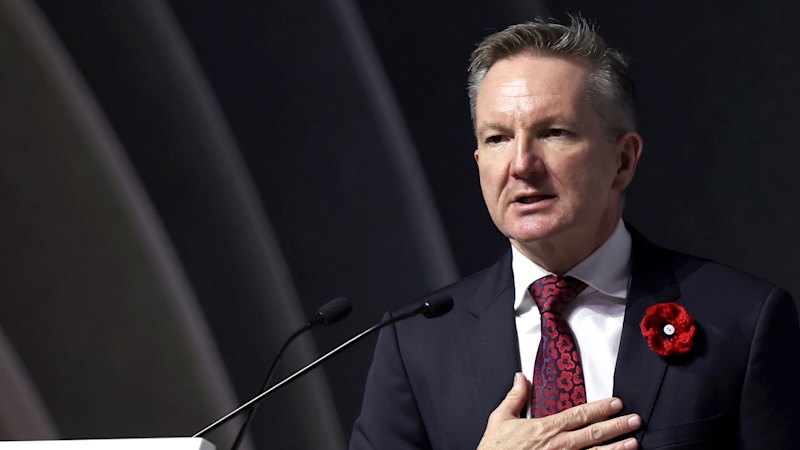
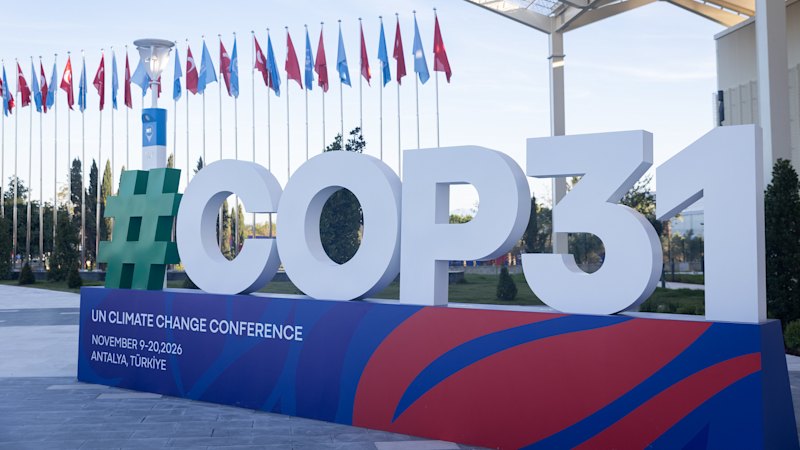
Bowen, in Antalya to lead United Nations climate talks as president of negotiations, is advocating for a global goal to accelerate electrification. asserted
Bowen → lead → electrification
“In the last quarter of last year, renewables generated more electricity across Australia’s national grid than fossil fuels,” Bowen said in his addressing to the climate summit. asserted
Bowen → generate → summit
“This is not only cutting emissions. asserted
This → cut → emissions
It is making our energy system more secure, more sovereign and less exposed to global fuel shocks. asserted
system → make → shocks
“The transformation is also reaching our roads. asserted
transformation → reach → roads
One in four new passenger vehicles sold in Australia this year has been electric. asserted
One → sell → Australia
“Australia’s experience shows what becomes possible when households, businesses and governments move together. asserted
households → show → ?
One home with solar and a battery does not transform an energy system. asserted
home → transform → system
According to the Bloomberg NEF report, the transition to net zero does not require dramatically more overall investment, but a dramatic shift in where capital flows. uncertain
capital → accord → investment
The net zero path requires $2.6 trillion in investment between 2026 and 2050, which is only 3 per cent more than the standard economic transition. asserted
which → require → transition
Bowen said that Australians’ enthusiastic uptake of rooftop solar, home batteries and electric cars showed change could be made at scale. uncertain
change → say → scale
“Australia’s experience proves something more: climate action can strengthen energy security, attract investment, create jobs and build economic resilience,” he said. asserted
he → prove → resilience
“Australians are already demonstrating that transformation, rooftop by rooftop, battery by battery, community by community.” asserted
Australians → demonstrate → community
A draft deal issued by Bowen on Monday in his role as president reflected the extent of disagreements between the nearly 200 countries represented at the talks and highlighted the challenge of agreeing to a meaningful deal by the conference’s official close on Friday. Bowen said the 18-page draft was crucial to the debating process and sought to reflect the range of views. The draft contained two sets of phrasing around fossil fuels. asserted
draft → issue → fuels
reiterated wording agreed in 2023 around “transitioning away” from their use, and another more ambitious clause talked about their “phase out”. asserted
clause → reiterate → phase
Both could be omitted from a final deal. uncertain
Both → omit → deal
Get to the heart of what’s happening with climate change and the environment. asserted
what → get → change

Give feedback · no sign-in needed

No sign-in needed for now. Your note is sent without a name, so it cannot be answered.

History Support