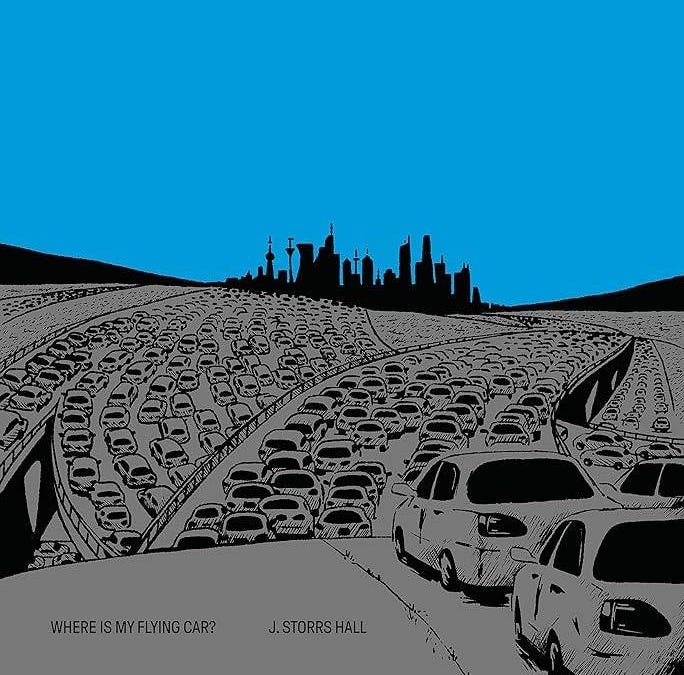
Stripe Press was kind enough to send me several books it had published, and one of these was J. Storrs Hall’s Where Is My Flying Car?.
asserted
Car → send → these
I had been meaning to read this book for a while, especially after Tyler Cowen recommended it and Jason Crawford gave it a glowing review, so I was glad Stripe gave me a copy.
asserted
Stripe → mean → copy
I promptly stuck it on my shelf, paid for the audiobook, and listened to it while walking around San Francisco.
asserted
I → stick → Francisco
That’s called ordinary abundance, folks!
asserted
That → call → ?
In 2011, Peter Thiel famously said: “We wanted flying cars, instead we got 140 characters.”
asserted
we → say → characters
When I first saw that quote, I chuckled, because for my entire life, we’ve had flying buses.
asserted
we → see → buses
And again and again, as I sit on a flying bus and marvel at the thrill of takeoff, and reflect on how amazing it is that man has conquered the air, I look around and see my fellow passengers with their window shades drawn, their noses buried in a book or staring at a phone.
asserted
noses → sit → phone
If we had flying cars, we’d enjoy the thrill for a few weeks, and then we’d be back to tweeting on our phones and wondering when the trip would be over.
asserted
trip → have → phones
I’ve noticed a loose collection of beliefs and attitudes that I’ve decided to call “engineerism”, because I see it most often among engineers.
asserted
I → notice → engineers
I coined the term when I was in college, when I noticed that the engineering majors in my physics classes tended to think differently about the world than the physics majors like myself did.
asserted
majors → coin → myself
Later, I recognized “engineerism” in various sci-fi novels — Lucifer’s Hammer and Footfall by Larry Niven and Jerry Pournelle, The Peace War by Vernor Vinge, and so on.1
When I say “engineerism”, I am not talking about Friedrich Hayek’s “engineering mentality” — the belief that society can be designed and optimized like a machine.2
asserted
society → recognize → machine.2
Nor am I referring to Evgeny Morozov’s “technological solutionism”, which is the idea that social problems can be fixed with technology.
asserted
problems → refer → technology
If I had to define what I call “engineerism” in succinct, simple terms, it would be something like: “The idea that if a technology can be built, we ought to build it.”
asserted
we → have → it
Simply put, engineers like to engineer things, and they become disgruntled when society does not give them the resources to do this.
asserted
society → put → this
It involves a lot of thinking habits that come in handy in engineering — linear approximation, back-of-the-envelope calculations, and so on.
asserted
that → involve → envelope
And in America, it also involves a set of beliefs that have sort of accreted over the years — for example, a belief in the importance of nuclear power.
asserted
that → involve → power
I’ve had the concept of engineerism kicking around in my mind for many years, but in Where Is My Flying Car? I have found its perfect encapsulation — you might even say its Bible.
uncertain
you → have → Bible
Where Is My Flying Car? occupies an interesting middle space between genres.
asserted
Car → occupy → genres
Futurism is about predicting the future.
asserted
Futurism → predict → future
Science fiction is about (among other things) speculating on possible futures.
asserted
fiction → speculate → futures
And history of technology explains the past.
asserted
history → explain → past
Where Is My Flying Car? has bits of all three of these, but fundamentally it’s a book of retrofuturism — it’s about the technologies we thought we would get but didn’t, and why we didn’t, and how we could get them now.
uncertain
we → ’ → them
The main technology Hall talks about is, unsurprisingly, flying cars.
asserted
Hall → talk → ?
Hall argues that a combination of overregulation, scientific groupthink, bad funding mechanisms, and cultural aversion prevented us from achieving all four of these.
asserted
combination → argue → these
Well, not as far as we know, no.
asserted
we → know → ?
In 1989, two top chemists reported that they had managed to get much more heat out of a nuclear experiment than chemistry would be able to produce.
asserted
chemistry → report → experiment
The chemists thought that they had discovered a way to produce nuclear fusion without injecting huge amounts of energy — smashing ions together at insanely high speed, blasting them with a laser, etc.
asserted
they → think → laser
If it worked, cold fusion would be an incredible energy source.
asserted
fusion → work → ?
So naturally, a lot of people tried to follow up on cold fusion.
asserted
lot → try → fusion
A wave of initial replication efforts mostly failed (though some people claimed to find the effect).
asserted
people → fail → effect
But there have been plenty more efforts, including:
A Japanese government project in the 1990s, with funding of around $20 million
A project by Toyota in the 1990s, with around $18 million in funding
A project by the Electric Power Research Institute in the 2000s, with around $10 million in funding
A project by Google in the 2010s, with $10 million of funding
None of these efforts have reliably reproduced the effect that the two chemists claimed in 1989.
asserted
chemists → include → 1989
A few of the researchers found some strange anomalies and possible new physical effects, but nothing even remotely similar to the kind of energy source that cold fusion would represent — and no consistent evidence that fusion is causing the occasional anomalies.3
asserted
fusion → find → anomalies.3
Some other scientists have found ways to enhance fusion using chemical techniques vaguely reminiscent of the methods in the 1989 experiments, but nothing remotely close to the scale of what “cold fusion” would require.
asserted
fusion → find → what
There’s interesting nuclear physics going on in solid-state chemistry, but the original burst of excitement around the 1989 experiment looks like it was misplaced.
asserted
it → ’ → experiment
That’s not the way Hall tells it, though.
asserted
Hall → ’ → it
He claims that cold fusion is a promising area of research, and that what he terms the “Machiavelli Effect” — basically, vested interests trying to shut down research that would supersede their own research programs — strangled the promising field of cold fusion in its cradle by stigmatizing it and depriving it of funding.
uncertain
that → claim → funding
That story just doesn’t pass the smell test.
asserted
story → pass → test
Multiple optimistic, good-faith research efforts, from various countries, from both the public and private sectors, have each thrown tens of millions of dollars at the idea, despite repeated lack of success.
asserted
efforts → throw → success
That is just not what a marginalized area of science looks like.
asserted
area → marginalize → science
Yes, lots of people regarded (and regard) the idea of cold fusion as kooky, but plenty of others didn’t and don’t — including the people who headed the many multimillion-dollar research efforts.
asserted
who → regard → efforts
…and 147 more, not listed.
 The Aporia