If you’re an avid Model Talk reader, you won’t be surprised by today’s newsletter.
asserted
you → ’re → newsletter
After taking tours through the most competitive House and Senate contests over the past two weeks, we’re moving on to the final class of races FLIPR forecasts: governors.
asserted
we → take → races
(This article will probably receive less patronage than our Senate and House tours 😿).
asserted
article → receive → tours
You might care about every Senate race because control of the chamber matters, but if you live in New York, your life is pretty much unaffected by whoever Kansas elects as governor.
uncertain
Kansas → care → governor
(Except — importantly — to the extent that governors play a role in Congressional redistricting.)
asserted
governors → play → redistricting
Indeed, some 2026 election forecasts don’t include gubernatorial races at all.
asserted
forecasts → include → races
But frankly, they can be harder to forecast.
asserted
they → forecast → ?
And some gubernatorial races are just plain weird, with ranked-choice voting like in Alaska or crazy primaries like for Democrats in Wisconsin.
asserted
races → rank → Wisconsin
In these races, different assumptions might produce a different forecast, which is why today’s newsletter has a lot of Model Talk-type content.
uncertain
newsletter → produce → content
The most important difference is that partisanship tells you far less in gubernatorial races: Vermont has a Republican governor, who is very likely to be re-elected, while Kentucky has a Democratic one.
asserted
Kentucky → tell → one
Since partisanship is part of the core of how FLIPR works, it therefore tends to treat gubernatorial races as more uncertain without the crutch of “Kentucky always votes for Republicans”, deferring to polls and expert ratings more than “fundamentals.”
asserted
Kentucky → work → fundamentals
All of this, by the way, reflects rational behavior from voters.
asserted
All → reflect → voters
Senate elections affect who controls the upper chamber of Congress.
asserted
who → affect → Congress
A Republican voter might like the Democratic Senate nominee.
uncertain
voter → like → nominee
Maybe, deep down, they like him more than their own party’s nominee that year.
asserted
they → like → nominee
But in an era of extreme party unity, electing him would put the Democrats one seat closer to a Senate majority.
asserted
electing → elect → majority
There are exceptions to this rule — Susan Collins, for example, has been repeatedly reelected in a state that is heavily Democratic at the presidential level — but they’re getting rarer and rarer.
asserted
they → be → level
Still, your state’s governor probably has more of an impact on your day-to-day life than your two senators.
asserted
governor → have → senators
Once the majority has been decided in Congress, you’re electing people to a notoriously slow national body where members are increasingly likely to consistently vote the party line.
asserted
members → decide → line
Whereas a new governor can make sweeping changes to how a state is run relatively quickly.
asserted
state → make → changes
At the moment, Republicans hold 26 governorships to Democrats’ 24, but Democrats govern more Americans than Republicans: approximately 194 million versus 146 million.
asserted
Democrats → hold → million
That’s largely a function of Democrats controlling many of the largest states, such as California, New York, Illinois, and Pennsylvania.2
asserted
Democrats → ’ → California
We like looking at things this way because unlike in the Senate, being the governor of Texas or California really is more important than being the governor of North Dakota — no offense, North Dakota.
asserted
being → like → Dakota
FLIPR thinks Democrats are overwhelmingly likely to continue governing the most Americans after the midterms.
asserted
Democrats → think → midterms
In fact, they’re projected to govern 215 million compared to Republicans’ 127 million.
asserted
they → project → million
Democrats also have a 62 percent chance of controlling the majority of governorships after November3, netting two seats in an average FLIPR simulation.
asserted
Democrats → have → simulation
For this article, we’re going to focus on the seven gubernatorial elections where one party has at least a 25 percent chance of flipping the seat, plus two honorable mentions that fall just below that threshold.
asserted
that → go → threshold
We’d note two important states that didn’t even make the list: Pennsylvania, where Josh Shapiro is an overwhelming favorite for re-election, and Michigan, where Jocelyn Benson is in a much safer position than Abdul El-Sayed and FLIPR rates the race as “Likely D”.
asserted
FLIPR → note → D
So instead we’ll start with the likeliest gubernatorial flip in the country, Iowa.
asserted
we → start → country
Iowa: Democratic flip probability 84 percent
Iowa’s current Republican governor, Kim Reynolds, isn’t seeking reelection.
asserted
governor → seek → reelection
The state last elected a Democratic governor all the way back in 2006, although Barack Obama carried the state in 2008 and 2012.4
asserted
Obama → elect → 2008
Still, it might seem like this year’s Republican nominee, Zach Lahn, should have a relatively smooth path to victory.
uncertain
nominee → seem → victory
Even though FLIPR estimates that Democrats will win the national popular vote by 6.6 points, Iowa is now red enough that its estimate of Iowa’s “simple fundamentals” — meaning the national generic ballot plus the state’s partisan lean — is R +3.
asserted
estimate → estimate → ballot
But maybe when Ann Selzer showed Kamala Harris ahead in Iowa by 3 points in 2024, she somehow traveled through time and polled the 2026 gubernatorial race instead.
asserted
she → show → race
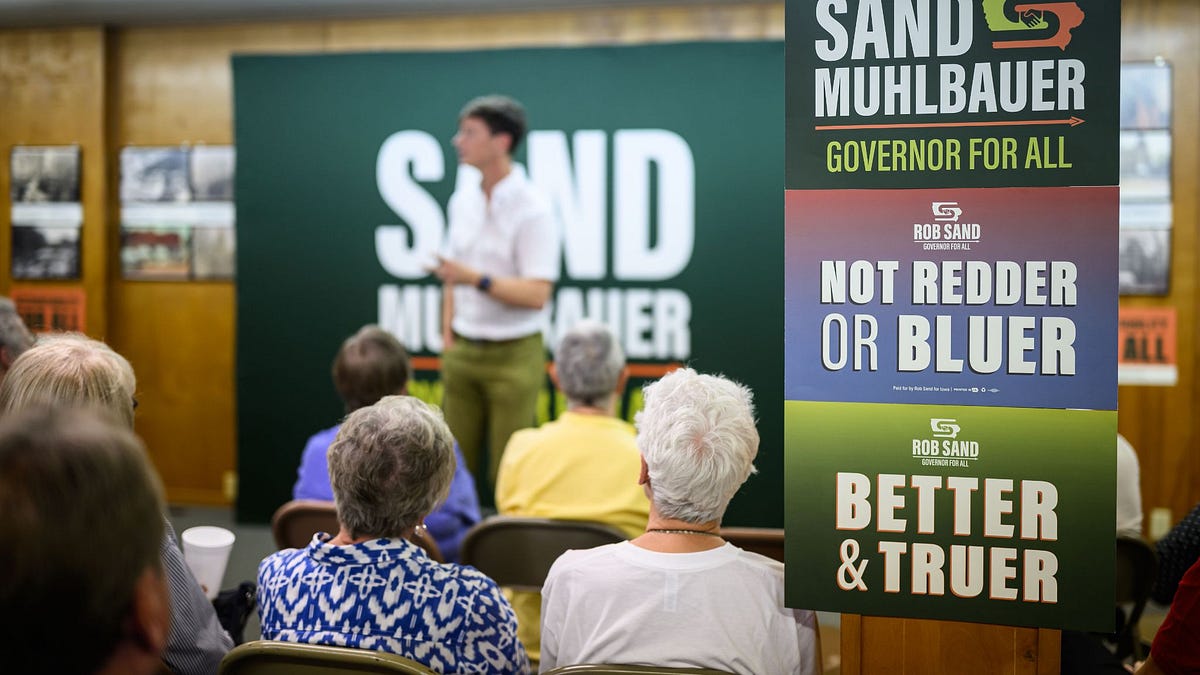
Because as of today, Iowa Auditor of State and Democratic candidate Rob Sand leads by about 5 points in our polling average.
asserted
Sand → lead → average
In fact, Sand has led in every one of the six Iowa gubernatorial polls in our database.
asserted
Sand → lead → database
 The Aporia