Back in 2015, when I was living in Brooklyn, my apartment flooded.
asserted
apartment → live → Brooklyn
My landlord, who owned a bunch of apartments, offered to put me up in temporary accommodations.
asserted
who → own → accommodations
He and his girlfriend were going to be out of town for several months, so he let me stay in her room.
asserted
me → go → room
His girlfriend was an aspiring actress from Minnesota named Poppy Liu.
asserted
girlfriend → aspire → Minnesota
I got to interact with her a number of times, and I can say that she’s one of the more interesting and original people I’ve ever met.
asserted
I → get → people
Poppy finally made it big.
asserted
it → make → ?
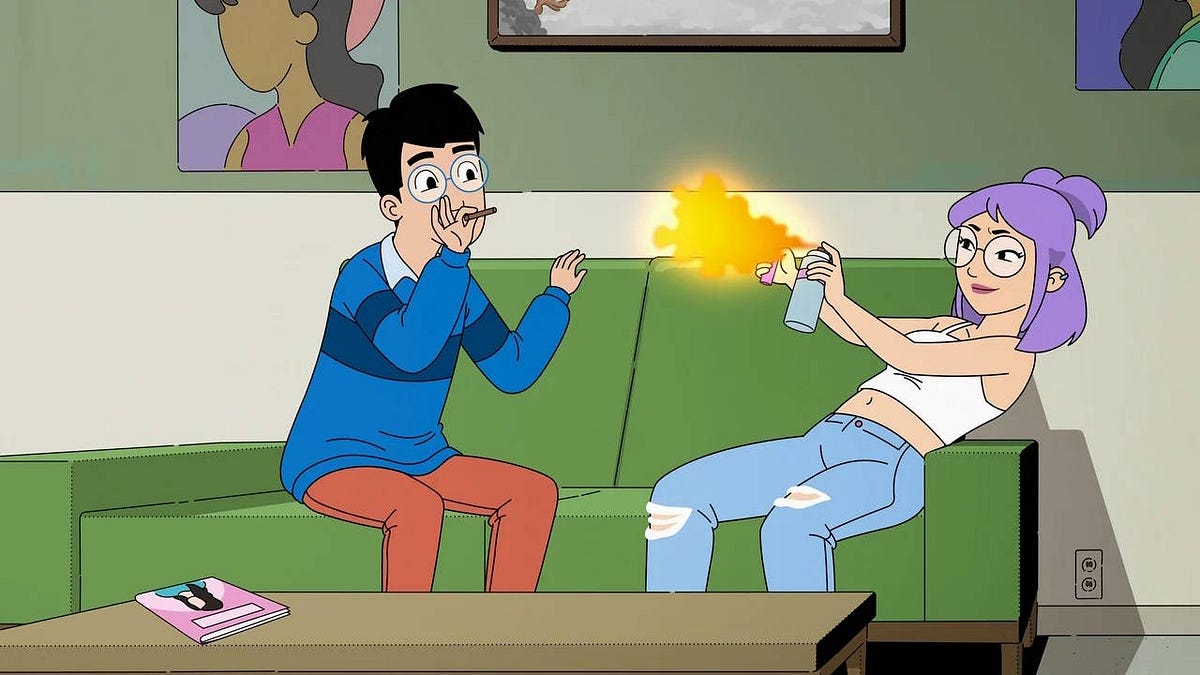
One of her latest roles is as the voice actress for one of the protagonists on the new animated Netflix series DANG!, a story about three Asian Americans living in NYC:
asserted
One → animate → NYC
The show isn’t out yet, but from what I can tell, DANG! is trying to tell a story that will resonate with second-generation Asian Americans1 — one of the characters is a striver who goes off the beaten path, the others were escaping their striver upbringing by leading nontraditional lifestyles from the get-go.
asserted
others → tell → go
That’s probably a pretty typical real-world experience for the American-born children of high-skilled immigrants.
asserted
That → ’ → immigrants
I don’t know if the show will be good or not, but as soon as the trailer hit, people on Twitter started ridiculing it — and using it as an opportunity to make fun of “Asian American media” or “Asian American art” in general.
asserted
people → know → general
It turns out that Asian Americans bashing “Asian American art” is a pretty well-established tradition.
asserted
Americans → turn → art
Here’s another example unrelated to the Netflix show:
asserted
example → ’ → show
(See also here.)
It’s always fun to rag on tired tropes.
asserted
It → see → tropes
But I feel like I should stand up for Asian American art here, because there really is a lot of excellent stuff out there that doesn’t fit into the standard format that people are complaining about.
asserted
people → feel → that
“Asian American art” is defined too narrowly
asserted
art → define → ?
The biggest problem with “Asian American art”, as far as I can tell, is that it’s defined so narrowly that there really isn’t much room for it to be creative.
asserted
it → tell → art
Art made by Asian Americans
Art made about Asian Americans or Asian American culture
As far as I can tell, movies, TV shows, books, etc. only get labeled “Asian American” if they satisfy both of these criteria at once.
asserted
they → make → criteria
But that’s a pretty narrow slice of art!
asserted
that → ’ → art
First, it excludes art made about Asian Americans by non-Asians.
asserted
it → exclude → Asians
There isn’t really a lot of this around, because America’s modern approach to identity politics says that you should only write about a group of people if you’re from that group — if a white author writes a novel with an Asian American protagonist, it’s generally frowned upon.
asserted
it → be → protagonist
There are some notable exceptions that get grandfathered in — Harold & Kumar Go to White Castle was written and directed by three white guys — but the culture of the 2010s really put a damper on that sort of crossover.
asserted
culture → be → crossover
That means a lot of interesting and insightful stories about Asian Americans probably never get told.
asserted
lot → mean → Americans
For example, I thought Ernest Hemingway’s portrayal of a frustrated Jewish striver in The Sun Also Rises was incredibly deep and thoughtful, and managed to say lots of things about how second-generation Jewish Americans were integrating into American society at the time.
asserted
Americans → think → time
That portrayal probably wouldn’t get written today — a lot of people now accuse it of being antisemitic,2 because the character, while complex and sympathetic, is deeply flawed, and Hemingway himself wasn’t Jewish.
asserted
Hemingway → write → it
It also means that works clearly inspired by Asian America don’t generally get recognized as such.
asserted
works → mean → America
The clearest example of this is Avatar: the Last Airbender, which was arguably the best new fantasy IP to come out of the U.S. since the turn of the century.3 ATLA, as it’s sometimes known, drew on a bunch of Asian cultures — mostly Chinese, but also Japanese, Tibetan, Korean, and others — to create a sort of pan-Asian mishmash, informed by American sensibilities and written in a distinctly American style.
asserted
it → come → style
That’s not too different from what Asian American culture is, and many Asian Americans were involved with both the production of the show and its adaptation into graphic novels and other media.
asserted
Americans → ’ → novels
But because the show’s creators themselves were white, it typically isn’t counted as Asian American art.
asserted
it → count → art
Even more importantly, the narrow definition of “Asian American art” also tends to exclude art made by Asian Americans, if it doesn’t deal directly with Asian American culture as its subject matter or motif.
asserted
it → tend → matter
That ends up limiting the idea of “Asian American art” to things like Fresh off the Boat, The Joy Luck Club, Crazy Rich Asians, Everything Everywhere All at Once, American Born Chinese, Past Lives, the first season of BEEF, and so on.
asserted
That → end → BEEF
I’m not saying those shows and movies are bad.
asserted
shows → say → ?
For example, I love Everything Everywhere All at Once, which is among the most original and fun things I’ve seen in the past decade, and a true throwback to the zany 80s movies I loved as a kid.
asserted
I → love → kid
The first season of BEEF is one of the best things I’ve ever seen on TV.
asserted
I → see → TV
But Asian American culture is just a pretty small pool of source material to draw on.
asserted
culture → draw → material
It’s not that big, for one thing — if you exclude South Asians like Indians and Pakistanis, Asian Americans are only around 5.5% of the U.S. population.
asserted
Americans → ’ → population
And Asian American narratives usually don’t tend to carry any special resonance with people in Asia:
asserted
narratives → tend → Asia
And like all immigrant subcultures in America, Asian American culture is probably destined to be a sort of transitory, ephemeral thing.
asserted
culture → destine → thing
The classic second generation experience — “My parents really drove me hard and kids made fun of my weird lunch, until I went to college and met other people with the same background” — almost never lasts beyond the second generation.
asserted
I → drive → generation
Assimilation happens.
asserted
Assimilation → happen → ?
It’s already happening.
asserted
It → happen → ?
…and 74 more, not listed.
 The Aporia