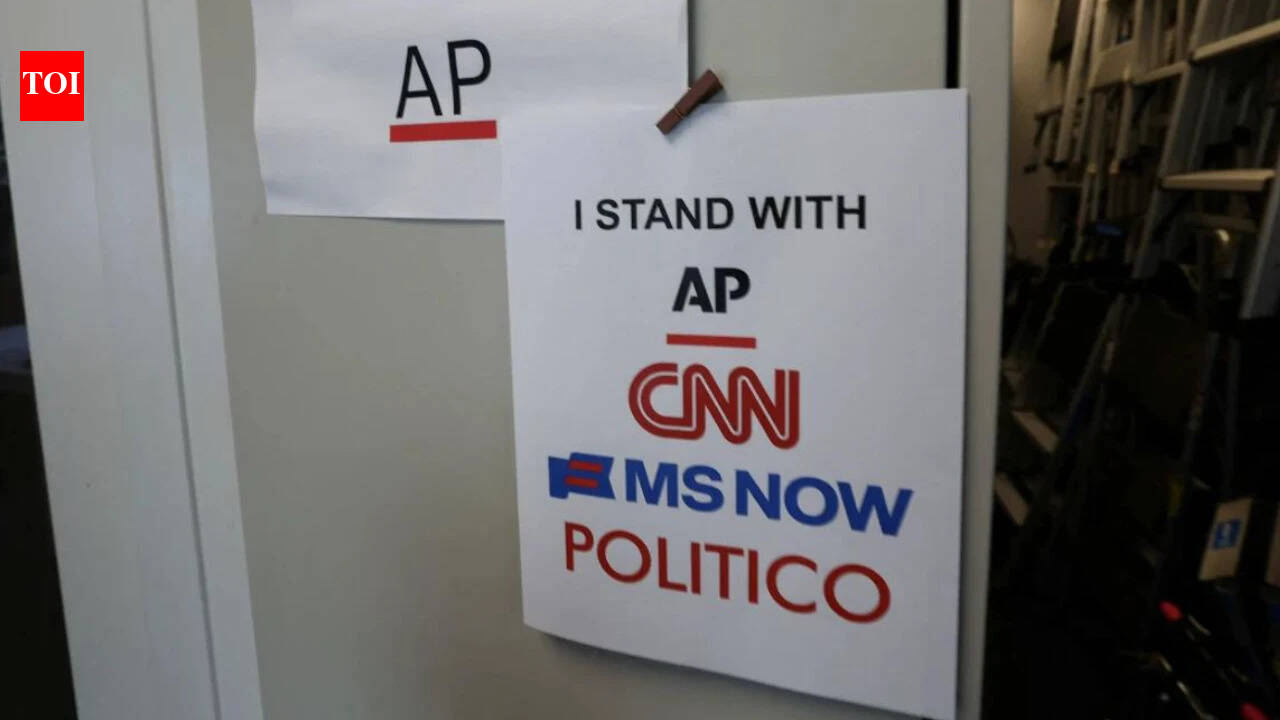
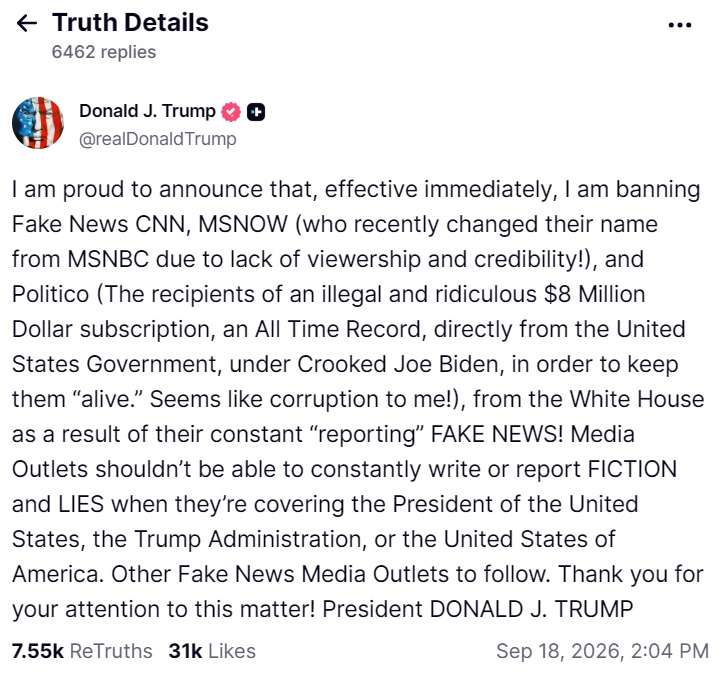
President Trump's Legal Argument in Support of Excluding CNN, MS NOW, and Politico from the White House

Read the original at Reason ↗
Reason · collected 2026-09-23 · by Eugene Volokh

Quick Summary

President Trump's legal team argues against granting CNN, MS NOW, and Politico access to the White House by claiming that the president has compelling interests in setting standards for journalists and protecting national security information. The argument dismisses previous court decisions like Sherrill v. Knight, asserting that access to the White House is a privilege rather than a right and that viewpoints can be considered when granting access. This perspective aligns with more recent judicial rulings such as AP v. Budowich, which allow for consideration of journalists' viewpoints in determining press access.
Written locally by qwen2.5:14b on 2026-09-23, using this article's own text rather than the other coverage of the same event (that is the story summary below).

AI analysis runs on qwen2.5:14b, locally

Story summary

On September 25, US TV networks resumed coverage of President Donald Trump’s events at the White House after a judge ordered the administration to lift its ban on CNN, MS NOW, and Politico. The ban was imposed last week due to what Trump described as unfavorable press coverage. Despite the reinstatement, tensions remain high; the networks ceased filming White House events in solidarity with banned outlets earlier in the week, resulting in no pool footage during Chinese President Xi Jinping's visit on September 24-25. The court battle continues, and CNN was barred from traveling with Trump to Tennessee for a weekend trip, though reasons were not officially provided by the administration.

Written for “White House Press Access Controversy” on 2026-10-05, grounded in this article and the 182 other(s) covering the same event.

Signals How these are calculated →

Claims extracted
45
claim-shaped sentences
Uncertain
11%
5 of 45 hedged
Leaning
Leans strongly right
of the writing, not the subject · beta estimate
Correction & hedging signals
65.8
corrections and hedging in what we collected; not a measure of accuracy
Outlets on this story
183
Politics
Narrative spread
1
articles carrying this framing
Analyzed 2026-09-23 · how these are computed

Story

📰 White House Press Access Controversy
Politics · 183 article(s) covering the same event. See how they differ ↓

How this is being covered How these are calculated →

Article leaning vs. publisher reliability
Source leaning vs. consistency

Compared with similar articles

This article reads leans strongly right and hedges 11% of its claims. Each row says how that neighbour differs.
Toronto Star
⚖️ Leans left further left than this 🔴 0% hedged 0 of 35 📰 publisher trust 63
“Both articles discuss the legal proceedings related to President Trump's decision to exclude certain news outlets from White House access on the same day.”
CBS News
⚖️ Leans left further left than this 🔴 7% hedged 2 of 29 📰 publisher trust 66
“Both articles refer to the legal arguments and court proceedings regarding President Trump's decision to ban CNN, MS NOW, and Politico from White House grounds on the same date.”
Times of India
⚖️ Leans right further left than this 🔴 15% hedged 4 of 26 📰 publisher trust 59
“Both articles refer to the Trump administration and DOJ arguing in a federal court on September 23, 2026, about restricting reporters' access to the White House based on national security grounds.”
BBC News
⚖️ leaning not scored 🔴 9% hedged 1 of 11 📰 publisher trust 78
“Both articles describe President Trump's administration and its legal actions against CNN, Politico, and MS NOW regarding their exclusion from the White House on September 23, 2026.”
Washington Examiner
⚖️ Leans right further left than this 🔴 18% hedged 8 of 45 📰 publisher trust 72
“Both articles discuss President Trump's legal argument for excluding CNN, MS NOW, and Politico from the White House on September 23, 2026.”
The Independent
⚖️ leaning not scored 🔴 0% hedged 0 of 5 📰 publisher trust 59
“Both articles discuss President Trump's legal actions and arguments regarding excluding CNN, MS NOW, and Politico from the White House on September 23, 2026.”
NBC News
⚖️ leaning not scored 🔴 9% hedged 3 of 35 📰 publisher trust 95
“Both articles discuss the same court proceedings involving CNN, Politico, and MS NOW challenging their ban from the White House.”
The Dispatch
⚖️ Leans left further left than this 🔴 0% hedged 0 of 4 📰 publisher trust 97
“The articles discuss different aspects of President Trump's actions regarding press access and freedom of speech, but they describe distinct incidents rather than the same specific occurrence.”
BBC News
⚖️ leaning not scored 🔴 9% hedged 1 of 11 📰 publisher trust 78
“Article A describes Trump announcing a ban on CNN, MS NOW, and Politico from the White House, while Article B discusses legal arguments supporting such an exclusion, indicating it's likely a later development rather than the same immediate announcement.”
Reason
⚖️ Leans left further left than this 🔴 40% hedged 2 of 5 📰 publisher trust 66
“The articles discuss different aspects of a broader issue related to press access, but do not describe the same specific incident or time.”

Publisher

Reason · 529 article(s) · 4 correction(s) detected
Running correction rate · 4 correction(s)
2026-10-02
Would a Firing Squad Have Been More 'Humane' for Christa Pike?
2026-09-26
"I Will Not Stand for Being Jerked Around … by Any Lawyer Who Practices Before Me"
2026-09-18
New Article: Landor v. Louisiana Department of Corrections: Bringing Clarity To The Necessary and Proper Clause
2026-09-05
Lawyers' Responsibility for Hallucinations in Briefs That They Sign

Who wrote this

Eugene Volokh
117 article(s) here · 1 carrying a prediction
🔮 Since 2020, the Department has also collected the names of individual foreign donors while stating that it would not publish them.
🔮 When officers told him he would need to move, Geri refused and threatened to throw one of his explosive devices into the street to demonstrate its destructive power.
🔮 Here's an excerpt from the discussion of why Matar was acting sufficiently under the direction of a foreign terrorist organization (which is required under the relevant federal statute) rather than just independently—if he had been acting independently, that would have still been attempted murder punishable under state law, but likely not a violation of these statutes:
🔮 Because in the late 1800s, "race" was understood to include what today might refer to "ethnicity" (e.g., German, Arab, Jewish), the Court concluded that § 1981 extends to such discrimination based on ethnicity.
🔮 Mostly law professors | Sometimes contrarian | Often libertarian | Always independent From yesterday's Blackman v. Substack, Inc., by California Court of Appeal Justices Tracie Brown and Danny Chou and Marin County Judge Andrew Sweet: "'[I]f a newspaper lawfully obtains truthful information about a matter of public significance then state officials may not constitutionally punish publication of the information, absent a need to further a state interest of the highest order.'"
🔮 On June 7th of 2020, while Stephanie Rapkin was sleeping in her bed, members of the Shorewood and Whitefish Bay police departments were outside her home, trying to think of an excuse to enter, so they could arrest her on allegations that she pushed a protestor picketing outside of her home.
🔮 I mean, I could list off all kinds of examples, but we're not here for an art history lesson.
🔮 On August 21, 2024—the same day that StopAntisemitism shared its feature on plaintiff—Valley Catholic informed plaintiff that it would not be renewing her contract for the 2024-2025 school year….
🔮 The White House therefore retains discretion to determine, including on the basis of viewpoint, which journalists will be admitted.
🔮 Ms. Freeman will answer EVERY question that is put to her—whether or not the question was asked previously.
Also by Eugene Volokh
Open Thread
2026-10-04 · Reason
Open Thread
2026-10-03 · Reason
Nothing else under this byline is closely related to this article, so these are simply their most recent.
All 117 articles by Eugene Volokh →

Topics

D.C. Cir. White House the D.C. Circuit the D.C. Circuit's the White House

Subjects

the White House ORG · 4× Sherrill PERSON · 3× White House ORG · 3× D.C. Cir. ORG · 2× Knight PERSON · 2× the D.C. Circuit ORG · 2× the D.C. Circuit's ORG · 2× Budowich PERSON · 1× Sherill PERSON · 1× Washington GPE · 1×

Narrative

Defendants "believe that the President's determination to revoke credentials for news outlets and reporters that have caused such interference with government functions would be effective in reducing the amount of information that is published that undermines national security." The motion will be heard today (Wednesday) at 3:30 pm; presumably Judge Timothy Kelly will issue a decision fairly soon.
framing: assertive · carried by 1 article(s) · first seen 2026-09-23
🔮 [T]he President's actions were not retaliatory because the Government would have taken the same action anyway, notwithstanding Plaintiffs' speech criticizing the President—indeed, the President has not revoked access to other outlets that have equally criticized the President….

Claims (45 extracted, 5 hedged)

Mostly law professors | Sometimes contrarian | Often libertarian | Always independent Here's an excerpt from the opposition to plaintiffs' temporary restraining order motion (for my view on why the plaintiffs should prevail as to access to the main press briefing room, see this post): asserted
plaintiffs → prevail → post
While the D.C. Circuit has held that some areas of the White House grounds constitute a nonpublic forum, Sherrill v. Knight (D.C. Cir. 1977), that decision is wrong and should be overruled. asserted
decision → hold → Knight
But even under Sherrill, the President's actions must be sustained because the President has "compelling interest[s]" in enforcing minimum standards for bona fide journalists and safeguarding national security information…. asserted
President → sustain → information
[T]he President's actions were not retaliatory because the Government would have taken the same action anyway, notwithstanding Plaintiffs' speech criticizing the President—indeed, the President has not revoked access to other outlets that have equally criticized the President…. asserted
that → take → President
Sherrill v. Knight … held that because "White House press facilities hav[e] been made publicly available as a source of information for newsmen, the protection afforded newsgathering under the first amendment guarantee of freedom of the press, requires that this access not be denied arbitrarily or for less than compelling reasons." asserted
access → hold → reasons
While Defendants acknowledge the D.C. Circuit's decision in Sherrill, that case was wrongly decided, and Defendants expressly reserve their right to argue so on appeal. asserted
Defendants → acknowledge → appeal
In Sherill, the D.C. Circuit emphasized that "[t]hese press facilities [were] perceived as being open to all bona fide Washington-based journalists[.]" asserted
facilities → emphasize → journalists
The reality is much better described by the D.C. Circuit's more recent decision in AP v. Budowich (D.C. Cir. 2025). asserted
reality → describe → Budowich
There, the court acknowledged that there are more journalists who wish to interview the President than he can accommodate; "[i]n deciding which journalists to speak with, the President may of course take into account their viewpoint." uncertain
President → acknowledge → viewpoint
Accord Baltimore Sun Co. v. Ehrlich (4th Cir. 2006) (upholding State Governor's press directive that "no one in the Executive Department or Agencies" should speak with two named reporters because the "Governor's Press Office feels that currently both are failing to objectively report on any issue dealing with" that administration). asserted
both → uphold → administration
As a result, the court concluded that at least for certain spaces, "the White House may consider journalists' viewpoints when deciding whether to grant access." uncertain
House → conclude → access
The same logic and standard should apply to access to White House grounds more generally. asserted
logic → apply → grounds
"Opening" the "White House" to some journalists should not "transform these spaces into nonpublic fora to which access must be granted on a viewpoint neutral basis." asserted
access → open → basis
Indeed, there are currently a finite number of hard passes, and yet the White House briefing room and West Wing facilities can accommodate only so many reporters. asserted
room → be → reporters
Under the AP decision, this counsels against the conclusion that the White House is a nonpublic forum. asserted
House → counsel → conclusion
See AP ("These spaces should not be classified as nonpublic fora because access to them is tightly controlled and highly selective…. asserted
access → see → them
In short, there is no principled way of easily distinguishing between rooms that are a nonpublic forum and those that are no forum at all—particularly where the White House is not obligated to respond to any questions by reporters in the first place. asserted
House → be → place
But this activity could occur anywhere and therefore lacks the essential connection to the government space required to create even a nonpublic forum."). uncertain
activity → occur → forum
The reasoning of AP should properly control as to all parts of the White House complex. asserted
reasoning → control → complex
Note that whatever one may think of the implications of AP's reasoning, it reaffirmed (citing Sherrill v. Knight (D.C. Cir. 1977)) that "When the White House opens its facilities to the press generally, as it does in the Brady Briefing Room, it cannot exclude journalists based on viewpoint." uncertain
it → note → viewpoint
Yet even under Sherrill, Defendants' decision to deny Plaintiffs continued access to White House grounds complies with the First Amendment because they have at least two "compelling reasons," namely, enforcing minimum standards of professionalism for journalists and protecting classified information…. asserted
they → deny → information
First, Defendants may lawfully deny access to Plaintiffs because the President has concluded they fail to satisfy the minimum requirements of professionalism. uncertain
they → deny → professionalism
Indeed, the D.C. Circuit has acknowledged that the White House can set standards governing qualifications for journalistic access. asserted
House → acknowledge → access
Nothing about Sherrill is inconsistent with the President's judgment that reporters who publish classified and sensitive information fail to meet the Sherill standard. asserted
who → publish → standard
Nor does Sherrill prevent the President from concluding that bona fide journalists would identify sources instead of relying on anonymous sources, commit to factual accuracy, and provide the White House an opportunity to comment. asserted
journalists → prevent → opportunity
The President believes basic journalistic standards require calling, asking for comment, and providing a reasonable opportunity for a response. asserted
standards → believe → response
At a bare minimum, it is a significant violation of decorum to publish classified and sensitive national security information. asserted
it → publish → information
To be sure, the D.C. Circuit in Sherrill and Karem v. Trump (D.C. Cir. 2020) has held that advanced notice of prohibited conduct and of the consequences of noncompliance are required before a hard pass can be revoked. asserted
pass → hold → noncompliance
Defendants submit those holdings should be overruled, but in any event, the White House has satisfied those requirements by providing an explanation of the relevant standards, both generally and with respect to Plaintiffs conduct specifically. asserted
House → submit → conduct
Here, the President's letters set out with specificity what is required and how Plaintiffs have failed to adhere to these standards. asserted
Plaintiffs → set → standards
The letters point out with specificity examples of Plaintiffs' conduct that he determined fell below these standards. asserted
he → point → standards
The letters also provide Plaintiffs with an opportunity to respond to these concerns and submit materials for the President's reconsideration…. asserted
letters → provide → reconsideration
Second, Plaintiffs' reporting gives rise to reasons to doubt their trustworthiness and, in fact, the President has determined that Plaintiffs have reported classified or sensitive information bearing on national security. asserted
Plaintiffs → give → security
Defendants have a compelling governmental interest in protecting such information. asserted
Defendants → have → information
Indeed, the Supreme Court has recognized that the Constitution vests the President with the "authority to classify and control access to information bearing on national security." asserted
Constitution → recognize → security
Ultimately, the responsibility and "authority to protect such information falls on the President as head of the Executive Branch and as Commander in Chief." asserted
responsibility → protect → Chief
Here, as explained in the Letters, the President has found that Plaintiffs have engaged in a number of reporting incidents that have threatened national security. asserted
that → explain → security
Indeed, multiple examples concern reports about the White House complex currently under construction. asserted
examples → concern → construction
Cf. Nat'l Park Serv. v. Nat'l Tr. for Historic Pres. in the United States (2026) (weighing increased "risk of foreign actors 'gathering intelligence' on the project"). asserted
actors → weigh → project
Such reporting directly raises national security concerns. asserted
reporting → raise → concerns
…and 5 more, not listed.

💬Give feedback
🕘History 🎫Support