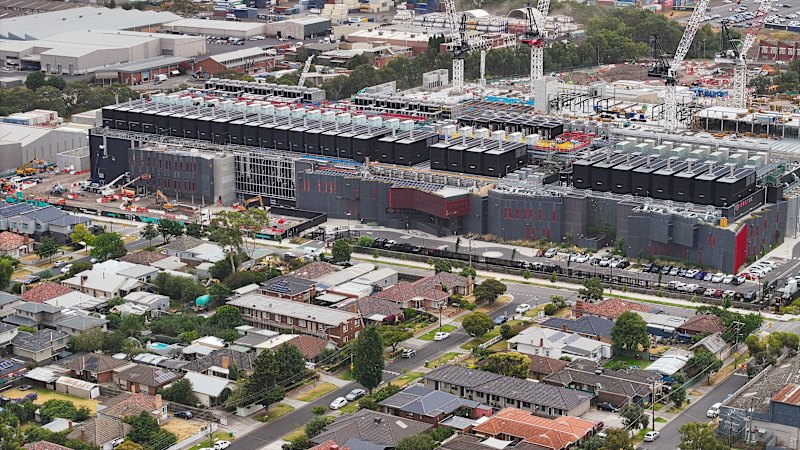
Photo via The Guardian

Datacentres in Victoria to be banned in residential areas

Read the original at The Guardian ↗
Cite

correspondent, B. K. V. s. (2026, September 21). Datacentres in Victoria to be banned in residential areas. The Guardian. https://www.theguardian.com/australia-news/2026/sep/22/datacentres-in-victoria-to-be-banned-in-residential-areas

Dated when The Aporia collected the article, usually within hours of publication. Check the original for its exact date and byline.

The Guardian · collected 2026-09-21 · by Benita Kolovos Victorian state correspondent

Quick Summary

Victoria’s state government will ban the construction of datacentres in residential areas and mandate that they use renewable energy and contribute to local communities under new rules set to be announced by Premier Ben Carroll on Tuesday. These regulations include prohibitions against building datacentres near schools, childcare centers, and in rural regions unable to support them, along with requirements for a 150-meter buffer zone from homes and community involvement through job creation and infrastructure development. The announcement follows growing opposition in Labor-held areas over environmental concerns and impacts on residential living conditions.
Written by AI on 2026-09-21, from this article's own text only (the story summary below draws on all the coverage).
See how they differ ↓

AI analysis

Story summary

On Tuesday, the Premier Ben Carroll of Victoria unveiled a strategy requiring all new data centers in the state to use renewable energy and mandate a 150-meter buffer zone between these facilities and homes. The policy aims to address concerns raised by residents over the rapid growth of data center construction near residential areas. Additionally, data centers will be banned from using drinking water and placed under restrictions prohibiting them near schools and childcare centers, as well as in rural areas unable to support such infrastructure. The government asserts that these measures are designed to ensure economic benefits while protecting local communities, with $5.8 billion invested in the sector last year through capital expenditure. This announcement comes ahead of the upcoming state election scheduled for November 28, where community concerns over data center impacts will be a key issue.

Written for “Victoria Data Centre Regulations” on 2026-11-18, grounded in this article and the 1 other(s) covering the same event.

How they differ

2 outlets covered “Victoria Data Centre Regulations”.

What each outlet says

One AI summary per outlet of its latest article on this story, written from that article alone and checked against it. Open the article for the outlet's own words.

The GuardianThis outlet21 Sep

Victoria’s state government will ban the construction of datacentres in residential areas and mandate that they use renewable energy and contribute to local communities under new rules set to be announced by Premier Ben Carroll on Tuesday. These regulations include prohibitions against building datacentres near schools, childcare centers, and in rural regions unable to support them, along with requirements for a…

Datacentres in Victoria to be banned in residential areas (this article)
ABC News (AU)21 Sep

Victoria’s Premier Ben Carroll announced new requirements for data centres on Tuesday, including sourcing renewable energy and maintaining a 150-metre buffer from residential areas. The rules also ban drinking water use by data centres, which must instead rely on recycled or non-drinking water sources. These measures aim to address community concerns while supporting the sector's economic benefits; however, it…

Victoria unveils data centre strategy with renewables requirements →

Compared with similar articles

This article reads leans left and hedges 12% of its claims. Each row says how that neighbour differs.
ABC News (AU)
Leans left Hedges 3 of 36 claims Outlet record 67/100
The Sydney Morning Herald
Hedges 1 of 13 claims Outlet record 61/100
“The articles describe different events related to data centers and renewables in two separate states with distinct governmental actions.”
ABC News (AU)
Leans strongly left further left than this Hedges 1 of 28 claims Outlet record 67/100
“Article A describes the announcement of new regulations by the Victorian government regarding datacentres, while Article B reports on residents demanding compensation near an existing data centre and mentions the government's strategy but does not describe it as the same specific event.”
Reason
Hedges 2 of 38 claims Outlet record 67/100
“The articles describe different policy actions by federal legislators and the Victorian state government, respectively.”
The Sydney Morning Herald
Leans left Hedges 4 of 44 claims Outlet record 61/100
“Article A describes the announcement of new rules, while Article B discusses reactions and exemptions to those rules announced in Article A.”

Story

Victoria Data Centre Regulations
Politics · 2 article(s) covering the same event. See how they differ ↑
How this article was measured signals, leaning charts, publisher record, byline, topics and claims

Signals How these are calculated →

Claims extracted
17
sentences that state something as happening or true
Uncertain
12%
2 of 17 hedged ("reportedly", "may", "according to")
Leaning
Leans left
of the writing, not the subject · beta estimate
Publisher signals
64/100
The Guardian's corrections and hedging, across everything collected from it. Not a measure of accuracy.
Outlets on this story
2
Politics
Same framing elsewhere
1
articles that frame the event the way this one does
Analyzed 2026-09-21 · how these are computed

How this is being covered How these are calculated →

Article leaning vs. publisher reliability
Source leaning vs. consistency

Publisher

The Guardian · 3642 article(s) · 8 correction(s) detected
Running correction rate · 8 correction(s)

Who wrote this

Benita Kolovos Victorian state correspondent
12 article(s) here · 1 carrying a prediction
The move has sparked a war of words between the two parties, with each accusing the other of striking a “dodgy deal” that could help the Liberals and One Nation get elected on 28 November.
The Victorian Greens say Labor’s “frankly unforgivable” decision not to preference the minor party in a key inner-city seat could hand the upcoming election to a Liberal-One Nation coalition.
George Hasanakos, DemosAU’s head of research, said if the poll were replicated on election night then many contests across the state would be between the Liberals or Nationals and One Nation, which would then result in a “clear Coalition majority”. “If that happens, One Nation has to poll really, really well to have a chance of winning, because Labor and Greens preferences will flow to the Liberals,” he said.
One Nation’s federal leader, Pauline Hanson, and Victorian deputy leader, Colleen Harkin, were expected to visit the man in hospital on Tuesday morning.
No further action is expected to be taken.
She said it would cost $136m over four years but admitted it was a “ballpark” figure that would depend on how many babies were born each year. “We don’t go hard on figures, because we actually don’t have access to the detail of this stuff,” Harkin told reporters.
Dave Hughes says he will no longer be taking the stage at Victorian Liberal events, claiming the party decided having him on the bill could run afoul of the state’s political donation laws.
The first briefing, which Allan did not sign, warned that the industrial relations environment on MTIA projects had become “highly challenging,” with an increase in “concerning behaviour” that could “significantly impact project costs and schedule”.
Datacentres in Victoria will be banned in residential areas and required to use renewable energy and contribute to the community, under new state government rules.
A re-elected Victorian Labor government will create two new Australian-first offences aimed at closing “loopholes” it says have allowed perpetrators of family violence to escape punishment.
Also by Benita Kolovos Victorian state correspondent
Nothing else under this byline is closely related to this article, so these are simply their most recent.
All 12 articles by Benita Kolovos Victorian state correspondent →

Topics

Labor NextDC Queensland Victoria Victorians

Subjects

Labor ORG · 4× Victoria GPE · 4× NextDC ORG · 2× Ben Carroll PERSON · 1× Carroll PERSON · 1× Jacinta Allan PERSON · 1× Northern Territory GPE · 1× Queensland GPE · 1× Victorian NORP · 1× Victorians NORP · 1×

Narrative

“In Victoria, we set the rules – datacentres must power themselves, protect homes and pay their way,” Carroll said in a statement before Tuesday’s announcement. “If we get that right, we can all share in their economic benefits, especially the local community.” The new rules include a ban on datacentres near schools and childcare centres and in rural areas that cannot support them, along with a 150-metre buffer zone between new developments and homes.
framing: assertive · carried by 1 article(s) · first seen 2026-09-21
Datacentres in Victoria will be banned in residential areas and required to use renewable energy and contribute to the community, under new state government rules.
2026-09-21 · The Guardian
Datacentres in Victoria to be banned in residential areas · assertive framing

Claims (17 extracted, 2 hedged)

Datacentres in Victoria will be banned in residential areas and required to use renewable energy and contribute to the community, under new state government rules. asserted
Datacentres → ban → rules
On Tuesday, the premier, Ben Carroll, will release the government’s sustainable datacentre action plan, after it was approved by cabinet on Monday. asserted
it → release → Monday
The government claims the rules are the “strongest” and “clearest” governing datacentres in the country. uncertain
rules → claim → country
“In Victoria, we set the rules – datacentres must power themselves, protect homes and pay their way,” Carroll said in a statement before Tuesday’s announcement. “If we get that right, we can all share in their economic benefits, especially the local community.” The new rules include a ban on datacentres near schools and childcare centres and in rural areas that cannot support them, along with a 150-metre buffer zone between new developments and homes. asserted
that → set → developments
Datacentres will be required to source their own renewable energy and will have to pay for connection costs and network upgrades. asserted
Datacentres → require → costs
They will also need to use recycled or non-drinking water for cooling or offset their usage. asserted
They → need → usage
The government said new datacentres will also have to give back to community via a “local investment guarantee”, which could include jobs, Tafes and parks. uncertain
which → say → jobs
They will also be required to employ Victorians during construction and train people for long-term jobs when up and running. asserted
They → require → jobs
The plan also includes mandating “fair community consultation”, as well as existing noise limits fire and safety rules. asserted
plan → include → rules
The federal government had previously flagged plans to require all new datacentres to be powered by renewable energy rather than coal and gas but was forced to back down on the mandate after opposition from the Queensland and Northern Territory leaders. asserted
government → flag → leaders
Last year, the then Victorian premier, Jacinta Allan, vowed to make Victoria the datacentre capital of the country. But there has been growing community opposition in the lead-up to the November election, particularly in Labor-held seats. asserted
Victoria → vow → seats
They include Footscray, held by Labor’s Katie Hall on 4.2% margin against the Greens, who ran a “stop AI data centres day of action” in the electorate on Saturday. asserted
who → include → Saturday
NextDC has lodged an application with the state government for fast-tracked approval to expand its Footscray datacentre, known as M3, to cover 10ha , drawing 225MW of power and running 24/7. asserted
NextDC → lodge → 24/7
Some residential homes are within 15 metres of the datacentre’s boundary, which is zoned in an industrial area. asserted
which → zone → area
NextDC has also bought 169ha of land just outside Geelong, which had been earmarked for future residential development. asserted
which → buy → development
Labor MP for Lara, Ella George, expressed concern about the acquisition to the Age in July. There are also Syncline Energy’s plans to develop a 350ha, 2.4GW datacentre in Plumpton, in Melbourne’s outer north-west, which is opposed by federal Labor MPs Alice Jordan-Baird and Sam Rae. asserted
which → express → MPs
The proposed centre is larger than any currently operating in Australia and would consume more electricity than is generated by Victoria’s largest power station, Loy Yang A. asserted
centre → propose → station
Give feedback · no sign-in needed

No sign-in needed for now. Your note is sent without a name, so it cannot be answered.

History Support