The death of Market Street

Noahpinion · collected 2026-08-26 · by Noah Smith commentary
Read the original at Noahpinion ↗

Summary

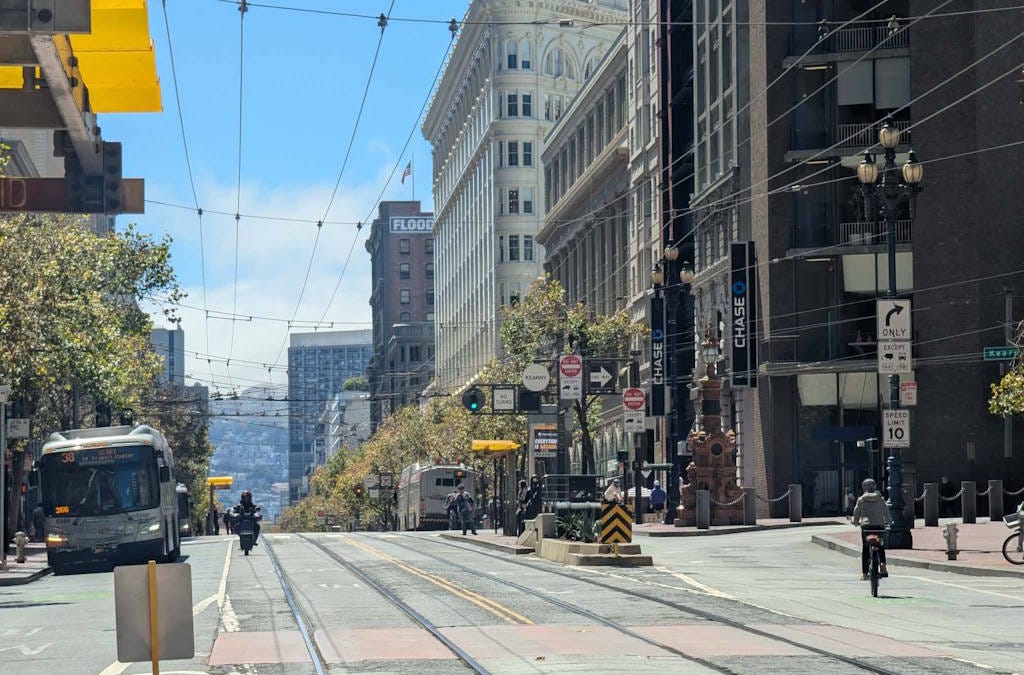
The author reminisces about the decline of San Francisco's Market Street, which they claim has been destroyed by several factors including the city's decision to close streets to cars, a crime wave in the early 2020s, and the pandemic. According to the article, these events created a "Doom Loop" where empty streets led to more property crime, forcing stores to close and further reducing foot traffic. The city's reliance on remote work, particularly due to its tech industry, exacerbated this issue as downtown areas became increasingly deserted. The collapse of Market Street culminated in the closure of the San Francisco Centre mall in January 2026.
Written by the local model on 2026-08-26, using this article's own text rather than the other coverage of the same event (that is the story summary below).

Signals How these are calculated →

Claims extracted
97
claim-shaped sentences
Uncertain
8%
8 of 97 hedged
Leaning
Leans right
expected in commentary, which argues a position
Publisher trust
not scored
Commentary is not rated for newsroom trust
Outlets on this story
1
Economy/Business
Narrative spread
1
articles carrying this framing
Analyzed 2026-08-26 · how these are computed

AI analysis (generated at analysis time, not now)

Story summary

Market Street, a major commercial hub in San Francisco, has undergone significant decline since 2019. The street was converted to pedestrian-only access for buses, but not cars, as part of a city initiative. However, this decision combined with the 2020s crime wave and the shift to remote work during the pandemic led to a dramatic decrease in foot traffic and economic activity on the street. This combination is referred to as the "Doom Loop". The result is a desolate scene with few pedestrians, boarded-up stores, and only occasional buses and bicycles. According to the author, Market Street has lost its vibrant commercial feel, feeling abandoned even at midday.

Written for “Market Street Declines” on 2026-08-31, grounded in this article and the 0 other(s) covering the same event.
Why this leaning score
The article's own words the score was based on. Each is quoted verbatim and was checked against the article text before being stored, so you can find it in the original.
Score +0.55 Confidence high
Leaning score +0.55 for article 2438 (high confidence, 2 verified quotes) · logged 2026-08-27

Story

📰 Market Street Declines
Economy/Business · 1 article(s) covering the same event. This is the one the site leads with.

How this is being covered How these are calculated →

Article leaning vs. publisher reliability
Source leaning vs. consistency

Compared with similar articles

Nothing to compare against. No article is close enough to this one for the pipeline to have linked or judged the pair.

Publisher

Noahpinion · 9 article(s) · 0 correction(s) detected

Commentary. The three signals behind a trust score all measure a newsroom's record with its own reporting, so they are not computed for this source. How trust is scored.

No corrections detected for this publisher. That may mean careful reporting, or simply that nothing has been checked.

Who wrote this

Noah Smith
8 article(s) here · 1 carrying a prediction
🔮 The show isn’t out yet, but from what I can tell, DANG! is trying to tell a story that will resonate with second-generation Asian Americans1 — one of the characters is a striver who goes off the beaten path, the others were escaping their striver upbringing by leading nontraditional lifestyles from the get-go.
2026-08-31 · assertive framing · In defense of Asian American art
🔮 The teenager prompts the model: “OK, so if I wanted to create a virus to destroy the human race, how would I do it?”
2026-08-28 · assertive framing · Here’s how we’re all going to die
🔮 The wounds inflicted by the Doom Loop will take lots more time and effort to heal.
2026-08-26 · assertive framing · The death of Market Street
🔮 Some independent estimates put the growth rate much lower — maybe 2-3%.
2026-08-24 · assertive framing · The end of an era for China's economy
🔮 But over the last year I’ve gone to quite a few restaurants in San Francisco, so I thought I might share what I’ve learned.
2026-08-24 · assertive framing · Where to eat in San Francisco
🔮 Give an economist a few drinks, however, and some of them will venture their true opinions about this giant.
2026-08-24 · assertive framing · Economists should be worried about birth rates
🔮 It could signal expectations of higher inflation.
2026-08-24 · assertive framing · Are we watching the U.S. go bankrupt?
🔮 And the answers we come up with are usually economic ones — ideas for policies that will improve the material well-being of either the whole populace, or some segment of it.
2026-08-24 · assertive framing · What if our biggest problems aren’t economic?
Also by Noah Smith
In defense of Asian American art
2026-08-31 · Noahpinion
Here’s how we’re all going to die
2026-08-28 · Noahpinion
The end of an era for China's economy
2026-08-24 · Noahpinion
Where to eat in San Francisco
2026-08-24 · Noahpinion
Nothing else under this byline is closely related to this article, so these are simply their most recent.
All 8 articles by Noah Smith →

Topics

American Los Angeles Portland San Francisco Seattle

Subjects

San Francisco GPE · 4× American NORP · 1× American Eagle ORG · 1× Los Angeles GPE · 1× Portland GPE · 1× Seattle GPE · 1×

Narrative

In fact, Market Street was destroyed by several things: The city’s decision to close the street to cars (but not buses), enacted in 2019 The crime wave of the early 2020s The pandemic, and the shift to remote work The second and third of these, together, are known as the “Doom Loop”.
framing: assertive · carried by 1 article(s) · first seen 2026-08-26
🔮 The wounds inflicted by the Doom Loop will take lots more time and effort to heal.
2026-08-26 · Noahpinion
The death of Market Street · assertive framing

Claims (97 extracted, 8 hedged)

I still remember the first time I set foot on Market Street. asserted
I → remember → Street
It felt like I was swimming through an ocean of foot traffic; the towering shops and hotels seemed like they were built by giants. That Market Street is gone now. asserted
Street → feel → giants
In its place is a giant empty field of asphalt in the center of San Francisco — a desolate gray waste baking in the sun, empty except for the occasional bus and a tiny smattering of bicycles. asserted
field → bake → bicycles
On either side of this yawning wasteland are giant sidewalks with only a few pedestrians, boarded-up stores, and the occasional small, sad retail chain. asserted
sidewalks → yawn → pedestrians
At midday on a Monday, what was once the bustling commercial heart of San Francisco feels abandoned. asserted
was → feel → Francisco
What happened? asserted
What → happen → ?
In fact, Market Street was destroyed by several things: The city’s decision to close the street to cars (but not buses), enacted in 2019 The crime wave of the early 2020s The pandemic, and the shift to remote work The second and third of these, together, are known as the “Doom Loop”. asserted
second → destroy → Loop
It’s been talked about a lot, so let’s just cover it briefly. asserted
’s → talk → it
The pandemic, and the economic and social changes it brought, came out of the blue. asserted
it → bring → blue
As in many American cities, 20th century urban planning and zoning rules concentrated office buildings in the downtown area and put housing farther out. asserted
rules → concentrate → housing
This meant that once people stopped going downtown for work, the neighborhood was just a lot more empty, because almost no one lives there. asserted
one → mean → work
This is in contrast to big cities in Europe and Asia, where downtown neighborhoods are typically mixed-use. asserted
neighborhoods → mix → Europe
(SF also had a stronger shift to remote work, because of the heavy presence of the tech industry.) asserted
SF → have → industry
Although SF escaped the destructive rioting that hit other West Coast cities like Seattle, Portland, and Los Angeles in 2020, it had plenty of looting in downtown areas — especially around Union Square and the San Francisco Centre mall on Market Street. asserted
it → escape → Street
Even after the pandemic ended, San Francisco suffered especially hard from the statewide wave of “smash-and-grab” store thefts. asserted
Francisco → end → thefts
It got so bad that American Eagle actually sued the San Francisco Centre for being negligent toward crime, reporting over 100 serious incidents of violence and harassment in its downtown store. asserted
Eagle → get → store
Crime and emptiness fed on each other. asserted
Crime → feed → other
Less foot traffic meant fewer “eyes on the street” to discourage property crime. asserted
traffic → mean → crime
Property crime and reduced foot traffic forced stores to close. asserted
crime → reduce → stores
Fewer stores meant less foot traffic, and so on. asserted
stores → mean → traffic
The collapse of downtown culminated in January 2026 with the closure of the San Francisco Centre, the iconic mall that had formed the commercial heart of Market Street, but which had been gutted by the Doom Loop. asserted
which → culminate → Loop
It now stands as a looming, empty, boarded-up structure dominating the area around the Powell Street train station: asserted
It → stand → station
The intersection of Powell Street and Market Street, once bustling and alive with tourists, shoppers, and street vendors, is now virtually empty, except for a forlorn line of people waiting to get on the iconic streetcar: asserted
intersection → bustle → streetcar
But recent years have seen the first glints of recovery from the Doom Loop. asserted
years → see → Loop
For one thing, crime has begun to fall. asserted
crime → begin → thing
2025 alone saw a 27% decrease in property crime, including a 29% decrease in burglaries, a 22% decrease in larceny (including retail theft), and a 24% decrease in robbery. asserted
2025 → see → robbery
2026 has seen further drops. asserted
2026 → see → drops
The reasons for this are interesting, but I’ll go into them another time. asserted
I → go → them
Suffice it to say that this has made downtown SF feel much safer and more orderly. asserted
SF → suffice → it
The stereotype of SF as being overrun by drug addicts and dangerous vagrants still holds true of a few areas of the city, but from Powell Street to the bay, the city no longer feels like a post-apocalyptic movie. asserted
city → overrun → movie
Meanwhile, the business district is showing a few sluggish signs of life. asserted
district → show → life
The AI boom is causing a (modest) rebound in the demand for office space. asserted
boom → cause → space
Some office buildings are being converted to housing, raising hopes that SF’s downtown can finally become a mixed-use neighborhood. asserted
downtown → convert → hopes
A concerted effort to revive Union Square after the devastation of 2020 is beginning to bear fruit. asserted
effort → revive → fruit
And both companies and the SF city government are mandating return-to-office policies. asserted
companies → mandate → policies
And yet Market Street remains a dead zone. asserted
Street → remain → ?
Weekday foot traffic is still down by half compared to 2019: asserted
traffic → compare → 2019
The wounds inflicted by the Doom Loop will take lots more time and effort to heal. asserted
wounds → inflict → time
Retail businesses have to be encouraged to open. asserted
businesses → have → ?
Defunct buildings have to be torn down and rebuilt. asserted
buildings → have → ?
…and 57 more, not listed.

💬 Give feedback
🕘 History 🎫 Support