Australia's latest Intergenerational Report projects a significant demographic shift where deaths will outnumber births starting in the 2060s, leading to an aging population similar to Japan and South Korea today. By 2066, Australia’s median age is expected to rise to 45 from its current 38.5, with the number of people over 65 growing eight times faster than those aged 0-20. The report highlights that by 2066, there will be 39 working-age individuals supporting each person over 65, compared to 29 currently, raising concerns about economic strain and budget pressures due to increased health and aged care costs.
Written locally by qwen2.5:14b on 2026-09-21,
using this article's own text rather than the other coverage of the
same event (that is the story summary below).
Story summary
Treasurer Jim Chalmers is set to release Australia's seventh Intergenerational Report (IGR) on Monday, forecasting that by 2066, Australia’s population will reach nearly 40 million people with longer life expectancies but lower fertility rates. The IGR outlines significant economic challenges due to an aging population and declining birthrates, emphasizing the critical role of migration in maintaining workforce growth.
Chalmers has hinted at potential further tax cuts for workers as part of his plan to address these long-term issues, suggesting that recent budget improvements have created room for additional relief. However, critics argue that while borrowing less than previously expected is positive, it does not equate to having surplus funds available for such measures without sustainable funding from spending restraint or alternative revenue sources.
The report also highlights the need for policy decisions today to prepare future generations for technological advancements like AI and to address geopolitical uncertainties in a more fragmented world. Prime Minister Anthony Albanese has been pushing for global cooperation on AI regulation during his visit to the United States, where he announced Siobhan McKenna as Australia's next Consul-General in New York, despite concerns about her past ties with News Corp. The announcements come amid efforts by the Australian government to secure a two-year term on the UN Security Council.
Written for “Australia's Economic Future Challenges” on 2026-10-05,
grounded in this article and the 18 other(s) covering the same event.
For the first time, Australia has a projected date when deaths will outpace births.
asserted
deaths → have → births
Japan, Italy and South Korea have already passed the point where their populations are no longer growing thanks to 'natural increase', and from the 2060s onwards Australia will join them, meaning the population will shrink without ongoing migration.
asserted
population → pass → migration
Australians are getting much older and having fewer babies, with both of these trends accelerating according to the latest Intergenerational Report released today.
uncertain
both → get → Report
By 2066, the median age of an Australian will be 45 compared to 38 and a half today — the population aged over 65 is expected to grow eight times faster than those aged 0 to 20.
asserted
population → compare → those
The security blanket expected to provide resilience against the budget and workforce pressures that an aging population will cause is continued migration to Australia.
But there is a fierce political contest to cut migration which could up-end that resilience.
uncertain
which → expect → resilience
Australia is young, but that is changing
asserted
that → change → ?
There is a statistic used by demographers to work out how much pressure an aging population is putting on the workforce and wider economy, called the Old Age Dependency Ratio.
asserted
population → be → workforce
Basically, it measures how many workers there are for every person aged over 65, the traditional retirement age.
asserted
it → measure → 65
Right now, Australia has an old age dependency ratio of about 29 per cent, meaning there are 29 people aged over 65 for every 100 working-age people.
asserted
Australia → have → people
By 2066, that ratio will rise to about 39 per cent, meaning there will be 39 people aged over 65 for every 100 working-age people.
asserted
ratio → rise → people
The obvious conclusion from the Intergenerational Report is that "a smaller share of working-age Australians will need to support a growing number of retirees who are living longer".
asserted
who → work → retirees
It also has implications for the federal budget, which will be more strained by health and aged care demands and more dependent on income tax from workers.
asserted
which → have → workers
The report shows that people aged over 85 cost as much to the federal budget as what four working-age people contribute — and the number of 85-year-olds is expected to triple over the next 40 years.
It says that burden will increase the risk of higher debt, "passing the cost of spending to future generations", unless new revenue sources are found.
There is expected to be a small offset thanks to more people working later in life, which is expected to grow by 1 per cent, and by more women participating in the workforce.
However an older workforce could also put a drag on productivity, according to the report, making it harder for wages and living standards to grow.
Treasurer Jim Chalmers said the decline in birth rates was one of the biggest changes from three years ago.
But he said while the government expects "fertility rates to fall further and faster", he caveated that Australia would not cross the threshold of more deaths than births until decades later than nations like Japan and South Korea, adding those were "really quite good" economies.
Ongoing migration the greatest source of 'resilience' against aging population
The good news, the report says, is that Australia is generally on better footing when it comes to an aging workforce than most other developed economies.
uncertain
it → show → economies
Australia has a relatively young population, and the nation's migration program has helped to "moderate the pace of aging".
asserted
program → have → aging
The Intergenerational Report says while the workforce in 40 years will be smaller than previously expected due to declining fertility, "unlike many OECD economies, Australia's working-age population is projected to keep growing, supported by skilled migration, providing a source of demographic resilience".
asserted
population → say → resilience
Former home affairs secretary Mike Pezzullo said on Friday that Australia needed roughly 235,000 people per year longer-term in order to prevent major issues caused by an aging population.
asserted
Australia → say → population
"If you don't want to get out of control with that ratio, which places a lot of strain on the budget … you need to have long-term [net overseas migration] of about 235,000 per annum, year after year after year for about 40 years," Mr Pezzullo told News24.
asserted
Pezzullo → want → News24
One Nation has proposed deep cuts to Australia's migration program that it says would lead to overall emigration from Australia for three years, before an ongoing annual cap of 130,000 is imposed.
asserted
cap → propose → 130,000
On Thursday the federal government announced measures it would take to create breathing room for housing construction to catch up to population growth — though those measures are only designed to bring migration down to 225,000 by 2028, the rate already forecast by Treasury.
asserted
measures → announce → Treasury
The Coalition has not yet set a migration target, though it says it should be tied to the pace of housing construction.
asserted
it → set → construction
Mr Pezzullo said there was value in a temporary decline in net overseas migration (NOM) to allow for housing and infrastructure to catch up.
asserted
housing → say → migration
"[But] I wouldn't allow that catch-up to become baked in forever because then we will have those demographic challenges … if we keep NOM suppressed," Mr Pezzullo said.
"If we tank NOM too much, and certainly numbers like 130,000 … if that was sustained for 40 years I would want to ask the Centre for Population in Treasury to give a snapshot: what would the population look like then?
asserted
population → allow → what
"There's only two choices there: we either have robots with newborn babies et cetera, because we just won't have the workforce … or we are going to have humans to do it.
asserted
we → be → it
That is really the fundamental question here: do we want a human-centric society, or do we want a shrinking society or an aging society where robots increasingly have to do a lot of that work?"
asserted
robots → want → work
In Japan, which has the world's highest old-age dependency ratio at about 51 per cent, working ages have been extended, while advanced robotics and artificial intelligence platforms are being used to assist in aged care.
asserted
robotics → have → care
In Italy, which has already reached the old age dependency ratio forecast for Australia in 40 years' time, a shrinking tax base and high social spending has contributed to Italy's massive public debt and led to labour shortages.
The Intergenerational Report says Australia's aging population can be kept in check through skilled migration, employers supporting participation through flexible work and making workplaces more age-inclusive.
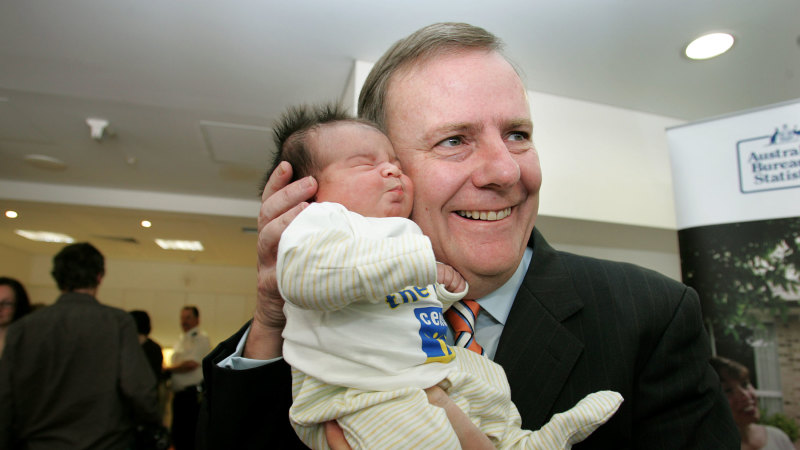
It notes research that suggests cash payments to incentivise families to have more children, such as the Howard-era "baby bonus" introduced to slow Australia's aging population, have a limited impact.
uncertain
payments → reach → impact
 The Aporia