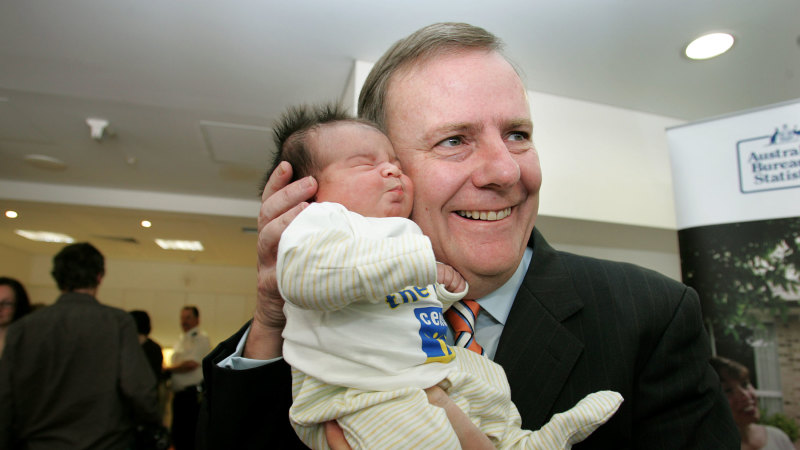
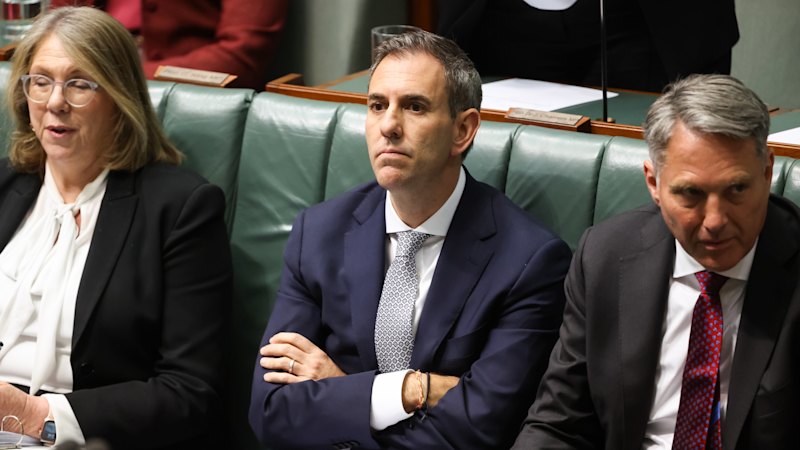
There is one certainty about Jim Chalmers’ upcoming intergenerational report – it will be wrong.
asserted
it → be → report
Brimful with huge projections about how the federal budget, the economy and Australian society will look by the mid-2060s, it will outline a future markedly different to what we are experiencing today.
asserted
we → look → what
But, like the six previous iterations of this report that was first produced by Peter Costello in 2002, its prognostications are unlikely to be correct.
asserted
prognostications → produce → 2002
Costello’s idea was to examine the budget’s long-term demographic pressures by focusing on productivity, participation in the workforce and the nation’s population.
asserted
idea → examine → workforce
They remain key to the document.
asserted
They → remain → document
That first intergenerational report predicted the budget would remain in surplus until 2017 before a demographic tsunami overwhelmed the nation’s finances.
asserted
tsunami → predict → finances
In his second report in 2007, the tsunami had been delayed, with surpluses forecast until at least 2022.
asserted
surpluses → delay → 2022
But a year later an American investment bank called Bear Stearns collapsed, precipitating what we now call the global financial crisis and a 15-year string of budget deficits.
asserted
we → call → deficits
That’s the danger with making long-term prognostications.
asserted
That → ’ → prognostications
Something unforeseen can upend them all.
asserted
Something → upend → them
In his first report, Costello noted that it provided plausible insights into the nation’s fiscal future.
asserted
it → note → future
“The results indicate a possible future, but within a wide band of uncertainty,” he said.
asserted
he → indicate → uncertainty
Costello and every other treasurer – Wayne Swan, Joe Hockey, Josh Frydenberg and Jim Chalmers – who has released an intergenerational report have warned that the nation would eventually face sizeable budget deficits.
Costello’s two reports forecast surpluses before running into deficits that would ultimately hit 5 per cent of GDP.
asserted
that → release → GDP
Hockey, Frydenberg and Chalmers never forecast a surplus – just a sea of red all the way out to the 2060s.
asserted
Hockey → forecast → 2060s
While Swan’s 2010 report missed the current deficit, it was the only one to forecast there would be surpluses in 2022-23 and the following year.
asserted
it → miss → 2022
Highlighting just how events can throw out forecasts, Frydenberg’s intergenerational report of 2021, compiled during the pandemic, forecast a deficit of 4.6 per cent of GDP for 2022-23.
asserted
report → highlight → 2022
Instead, Chalmers would oversee a surplus of 1 per cent of GDP.
asserted
Chalmers → oversee → GDP
Deficits mean debt.
asserted
Deficits → mean → debt
And only the Chalmers report of 2023 – largely because it was so recent – has got close to accurately predicting the current level of net debt.
asserted
it → get → debt
Swan believed the value of government assets would outweigh its debts to the tune of 5.5 per cent of GDP by 2026-27.
asserted
value → believe → 2026
Hockey was a little more circumspect, tipping net debt of 5 per cent of GDP for the same year before a rapid improvement.
asserted
Hockey → tip → improvement
But political failure – in Swan’s case, an overhaul of mining taxes, and in Hockey’s case, his unloved 2014 budget – coupled with the hit to the government’s finances by COVID and the financial crisis left debt growing far greater than any treasurer had expected.
asserted
treasurer → couple → debt
Getting a grip on the budget’s key spending pressures has also been extremely difficult.
asserted
Getting → get → pressures
Every intergenerational report focuses on spending on welfare, the health system, defence, aged care and education.
asserted
report → focus → welfare
Since 2015, the National Disability Insurance Scheme has been included.
asserted
Scheme → include → 2015
The budget’s single largest expense, outside the GST which flows to the states, is the age pension.
asserted
which → flow → states
Here, governments have made unexpected savings.
asserted
governments → make → savings
Costello’s first report forecast that by 2032, the age pension would cost 4.4 per cent of GDP, or about $135 billion.
asserted
pension → forecast → GDP
Chalmers’ last report forecast the cost of the age pension at 2.4 per cent of GDP, or less than $80 billion.
asserted
report → forecast → GDP
The Rudd government’s decision to lift the age pension access age to 67 and the increase in the superannuation guarantee levy to 12 per cent have helped keep a lid on the age pension.
asserted
decision → lift → pension
Costello’s first report also expected health spending to reach about $226 billion, or 7.3 per cent of GDP by 2032.
asserted
spending → expect → 2032
Hockey’s 2015 report, following on from his contentious 2014 budget, sliced this to 4 per cent.
asserted
report → follow → cent
Costello and Wayne Swan didn’t have to account for it in their reports as it did not exist.
asserted
it → have → reports
Hundreds of billions of dollars that would have once been counted as health spending are now tied to the scheme.
asserted
that → count → scheme
That pressure was finally addressed in this year’s budget with the deep cuts in NDIS spending outlined by Health Minister Mark Butler.
asserted
pressure → address → Butler
The other area that has caught treasurers is defence.
asserted
that → catch → treasurers
The first three intergenerational reports had defence spending constant at 1.8 per cent of GDP by the early 2030s.
asserted
spending → have → 2030s
But the geopolitical turmoil of the past decade has forced all governments to increase their expected spend on defence, which in Chalmers’ 2023 report was pushed up to 2.3 per cent of GDP by 2032.
asserted
which → force → 2032
The intergenerational reports do not cover all government spending.
asserted
reports → cover → spending
While most reference the nation’s interest bill in passing, Chalmers’ 2023 edition noted the pressure this was putting on the budget.
asserted
this → reference → budget
…and 49 more, not listed.
 The Aporia