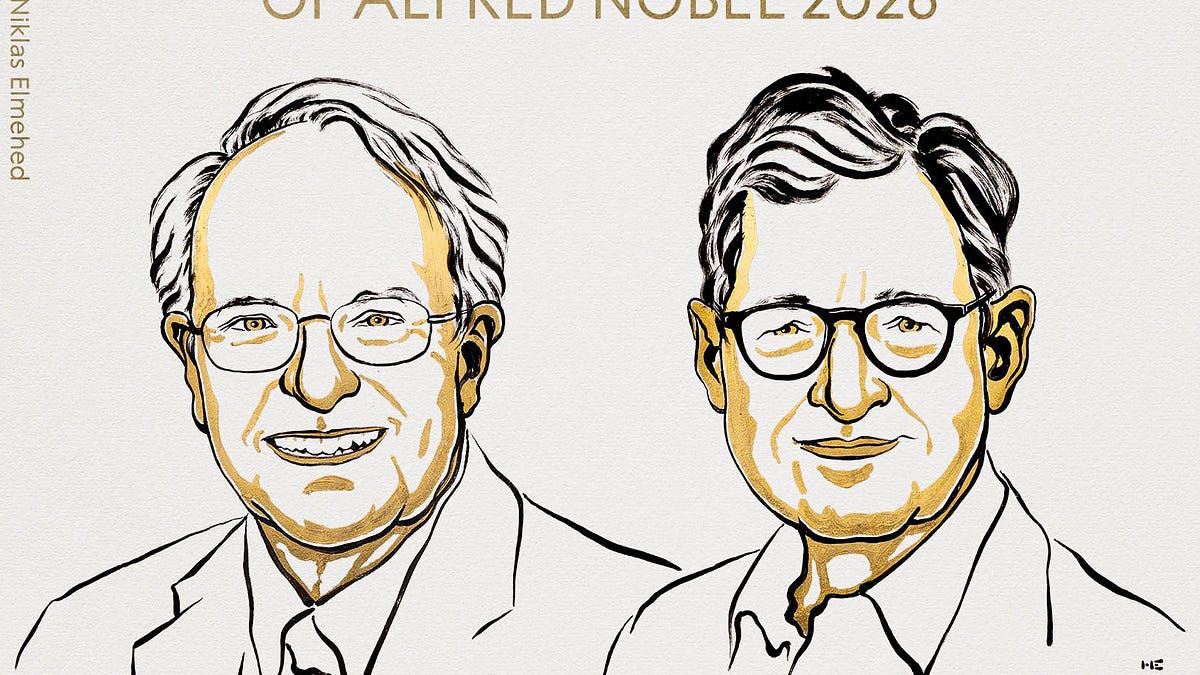
The Economist has an interesting article this week, in which it goes after Daron Acemoglu.
asserted
it → have → Acemoglu
Acemoglu is probably the top economist in the world at this point, having just earned a Nobel prize, and sitting right at the top of the list of most cited economists.
asserted
Acemoglu → earn → economists
So it’s kind of funny that when it talks about people who doubt Acemoglu’s research, the one person it mentions is…me!
asserted
it → ’ → research
Give an economist a few drinks, however, and some of them will venture their true opinions about this giant.
asserted
some → give → giant
“Much of his theoretical work is useful, but he uses his models to inform populist policies that have been tried before and failed,” blasts one well-known economist.
asserted
economist → use → policies
Some commentators do not require Dutch courage.
asserted
commentators → require → courage
“I’ve been yelling about Acemoglu for literally a decade,” Noah Smith, an economics blogger, has said, in response to a flurry of online criticism of Mr Acemoglu’s work.
asserted
Smith → yell → work
(For the record, The Economist did not actually interview or contact me for this article.
asserted
Economist → interview → article
Their quote of me was from a tweet from June, which they did not link to in the article.
asserted
they → link → article
In 2012 I argued strongly against a paper he wrote in which he claimed that America is more entrepreneurial than Sweden because America’s weaker safety net forces people to work harder (in actuality, Sweden is more entrepreneurial by most measures).
asserted
Sweden → argue → measures
In 2022 I pointed out that a famous Acemoglu paper claiming that robots destroy jobs was actually an outlier, and listed a bunch of other papers that reach the opposite conclusion.
asserted
that → point → conclusion
I liked his book Why Nations Fail, but I also admit that its empirical foundations are fairly shaky.
asserted
foundations → like → book
I didn’t like Acemoglu’s more recent book Power and Progress, and I was highly critical of a recent paper Acemoglu wrote about AI and productivity.1
asserted
Acemoglu → like → AI
I also think Acemoglu’s argument that skilled immigration has crippled the American education system — now being heavily cited by Breitbart and such — is extremely implausible.
asserted
immigration → think → Breitbart
I go after Acemoglu’s work because I know he can take it; he’s a titan of the economics field, and I am but a lowly blogger.
asserted
I → go → field
Nothing I say is going to affect his reputation or his prestige, even if someone at The Economist mentions my critiques in an article.
asserted
someone → say → article
Indeed, after the article came out, top figures in the profession rushed to condemn it and to defend Acemoglu.
asserted
figures → come → Acemoglu
The Economist does list a bunch of — usually justified — criticisms of Acemoglu’s work, but this does not mean Acemoglu has been discredited as a researcher or exposed as overrated; indeed, it would be difficult to name a top economist whose body of work does not contain a variety of questionable theoretical assumptions, motivated reasoning, and/or shaky empirical results.
asserted
body → list → assumptions
This is a problem with the field itself, not the man; it’s part of a broader crisis of unreliability throughout much of academia.
asserted
it → ’ → academia
But for that same reason, despite the Economist article’s lack of newsworthiness, I think it’s good that the magazine decided to come at the king.
asserted
magazine → think → king
Younger and less accomplished researchers routinely defer to the authority of famous and senior figures, and critics from outside the field are typically brushed off.
asserted
critics → defer → field
Exactly how it got to be this way is a topic that deserves a longer post, but I believe the hierarchical, closed culture of econ has resulted in a research literature that has been too skewed toward the priorities and intuition of top authority figures.
asserted
that → get → figures
I thus think it’s generally a healthy thing to tweak the tails of those Olympian figures, as long as criticisms are grounded in substance.
asserted
criticisms → think → substance
As they say, “science is the belief in the ignorance of experts.”
asserted
science → say → experts
So in that spirit, let’s critique another Acemoglu paper.
asserted
’s → let → paper
Recently, a lot of people (including myself, but also prominent economists) have begun worrying about low fertility rates.
asserted
lot → include → rates
Across all countries — poor as well as rich — fertility just keeps going down and down, with no floor in sight.
asserted
floor → keep → sight
This presents two distinct dangers: population aging and population shrinkage.
asserted
This → present → dangers
Aging, rather mechanically, creates a burden for young people, because you have more retirees who have to be supported by each worker, either through taxes or through family support.
asserted
who → age → support
It also might reduce productivity, for example if older managers are less innovative, but that’s more speculative.
uncertain
that → reduce → example
Population shrinkage, meanwhile, is a threat to total GDP, which you might care about if you want your country to be more powerful.
uncertain
country → care → which
There’s also the possibility that a smaller population might reduce growth — by reducing the opportunities for specialization, or by reducing the available pool of researchers.
uncertain
population → ’ → researchers
But some people argue that a shrinking population is no problem — or might even be a good thing.
uncertain
population → argue → ?
When you make human workers scarce, it creates an incentive to invest in labor-saving technology, which boosts productivity.
asserted
which → make → productivity
This mechanism has been proposed by some growth theorists, and some economic historians, like Robert Allen, even think this is what caused the Industrial Revolution!
asserted
what → propose → Revolution
This effect might be strong enough to cancel out the aggregate effect of population aging, so that society stays just as rich — or even gets richer — due to low fertility rates.
uncertain
society → cancel → rates
I have to say, I’m skeptical that it works in the general case.
asserted
it → have → case
Human beings aren’t just labor supply; they also create labor demand.
asserted
they → create → demand
The incentive for businesses to buy new machine tools, robots, AI, etc. is that someone is going to buy the stuff they produce with those tools.
asserted
they → buy → tools
If you have fewer people, you have fewer consumers.
asserted
you → have → consumers
…and 103 more, not listed.
 The Aporia