Around 3,700 miles separate the Gothic towers of Canada’s Parliament in Ottawa from the glass-fronted modern European Parliament building in eastern France.
asserted
miles → separate → France
But judging by the thunderous applause shaking the E.U. chamber Thursday, President Donald Trump’s threats are helping to close that distance.
asserted
threats → judge → distance
Canada and Europe have long been close U.S. allies, benefiting from American military power and trading heft.
asserted
Canada → benefit → power
But Trump has upended those relationships, waging trade wars against Canada and the E.U., while threatening to absorb Canada as America’s 51st state and take control of Greenland, Denmark’s autonomous Arctic territory.
asserted
Trump → upend → Greenland
Without a reliable partner in the White House, the spurned allies are now forging their own path.
asserted
allies → forge → path
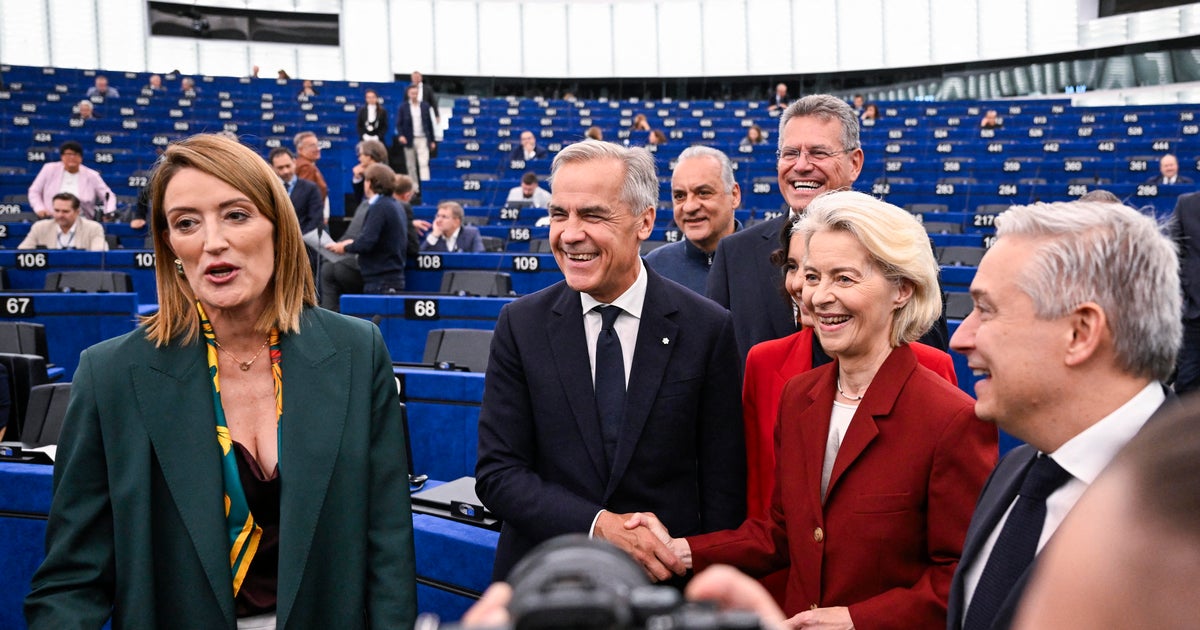
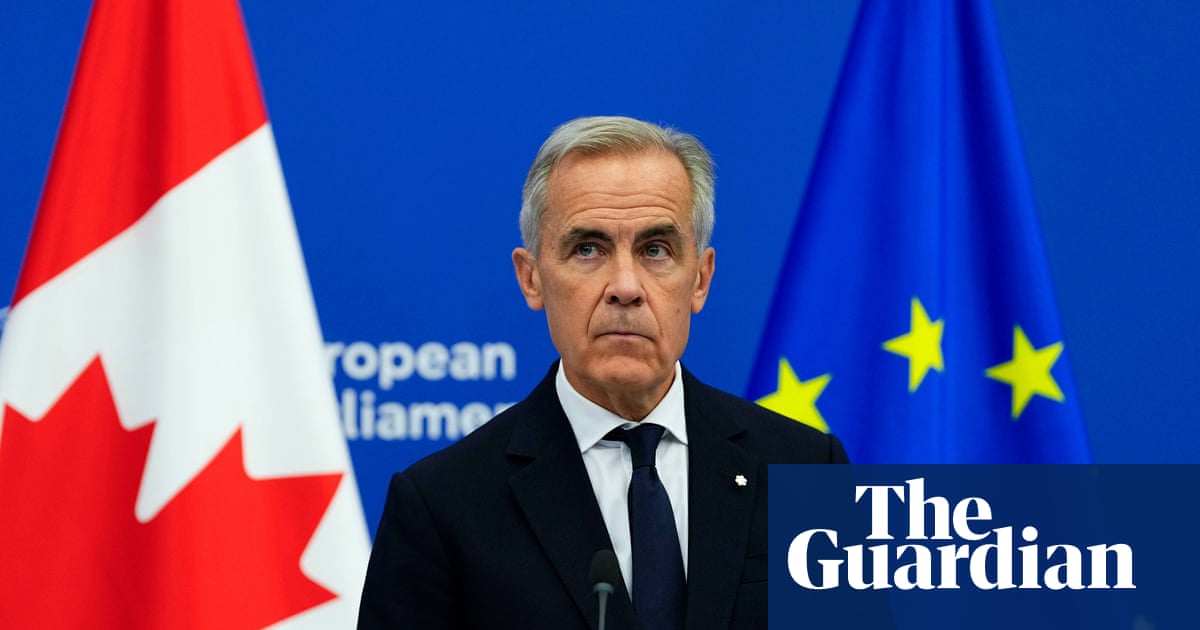
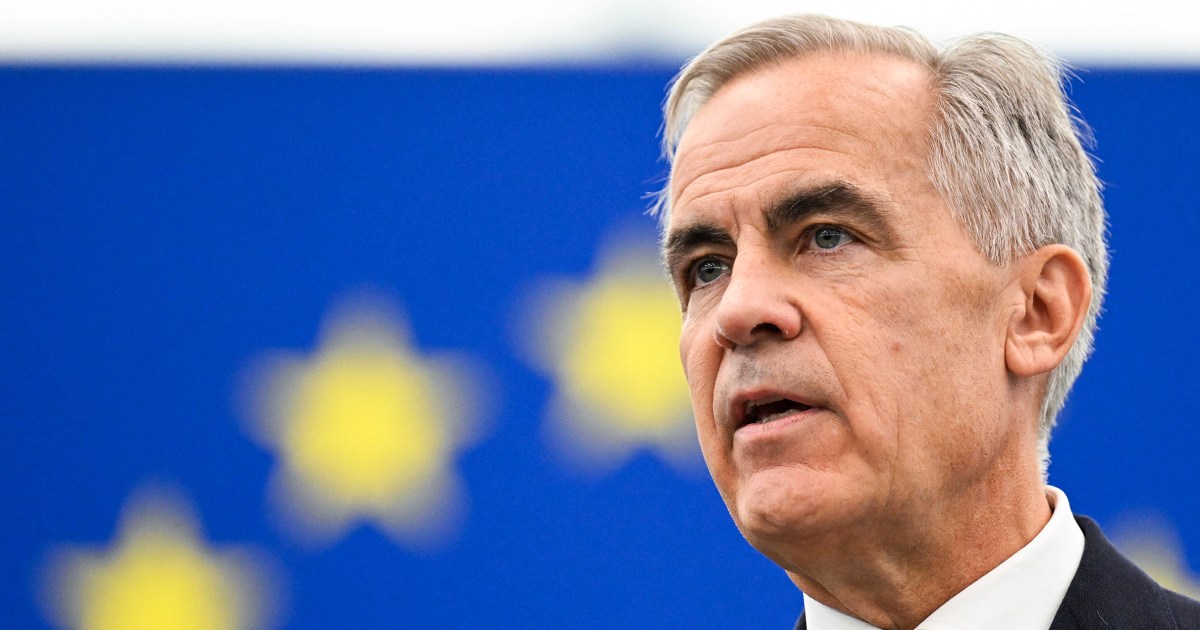
Canadian Prime Minister Mark Carney urged the world’s “middle powers” to join forces in a speech before the European Parliament in Strasbourg on Thursday to create “an alliance strong enough so that no one can dictate our choices.”
asserted
one → urge → choices
“I’m not proposing a third bloc in order to become a great power rival, only with better manners,” he stressed.
“We do not seek power to dominate others,” Carney continued.
asserted
Carney → propose → others
“On the contrary, we are pursuing resilience.
asserted
we → pursue → resilience
So no one — no one — can control our open markets, impair our sovereignty, threaten our territorial integrity or undermine our freedoms, our democracies, our rule of law.”
asserted
one → control → law
The remarks appeared aimed in part at Trump, though Carney did not name the president in his speech.
asserted
Carney → aim → speech
The response in the room was a near-unanimous standing ovation from lawmakers representing the bloc’s 27 member countries.
asserted
response → represent → countries
Some European leaders, meanwhile, appear ready to grant Canada more favorable access to its closely guarded single market.
asserted
leaders → appear → market
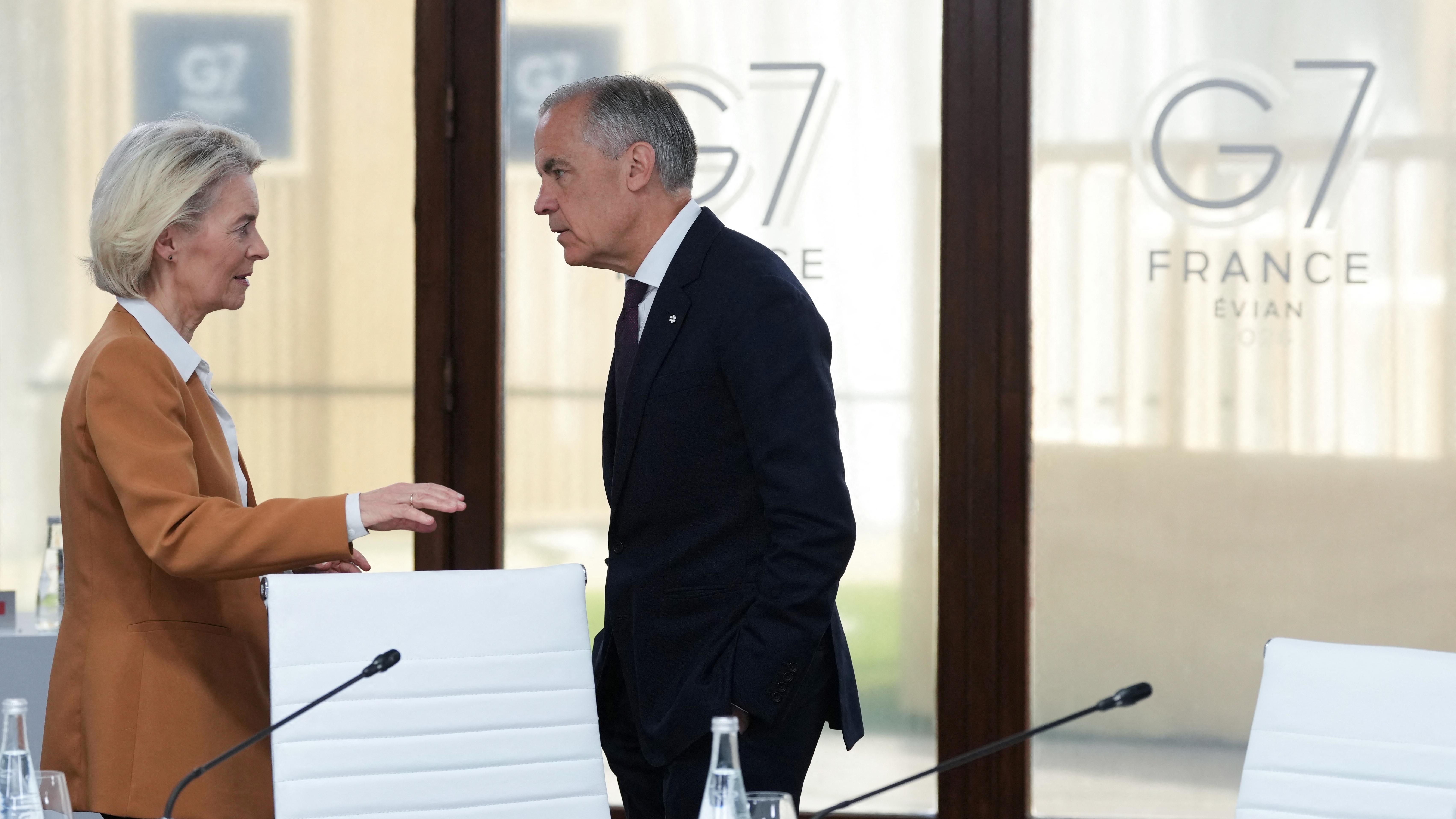
European Commission President Ursula von der Leyen caused a stir Wednesday when she suggested making Canada the E.U.’s first “associate member.”
uncertain
Canada → cause → stir
She also outlined an “alliance for the future” that would increase cooperation on defense, energy, critical minerals, artificial intelligence and other tech.
asserted
that → outline → defense
“This is a partnership not against anyone else, but for our common strength,” she said.
asserted
she → say → strength
At a news conference Thursday, Carney stressed that Canada was “not in a position, nor seeking, to become a full member” of the European Union, a long and drawn-out process of regulatory alignment that can sometimes take decades for applicant countries.
asserted
that → stress → countries
“What matters is the substance,” he said of the associate membership proposal.
asserted
he → matter → proposal
Carney has deep links to Europe, having served as governor of the Bank of England before his political homecoming propelled him to Canada’s leadership.
asserted
homecoming → have → leadership
He tapped into those ties Wednesday, bonding with British Prime Minister Andy Burnham at an Everton soccer match.
asserted
He → tap → match
The two vowed “close cooperation” separate from the European Union, which Britain left six years ago, while Carney also announced that Canada had applied to join the British-led Joint Expeditionary Force, a military coalition of 10 European NATO countries.
asserted
Canada → vow → countries
Carney’s speech Thursday was hailed by some as a historic moment.
“A new world order really is being shaped and it is not how Trump’s USA imagined,” wrote British political commentator Alastair Campbell, former communications chief to ex-Prime Minister Tony Blair.
asserted
Campbell → hail → Blair
“It used to be taken as read that the US President led the free world.
asserted
President → use → world
No more,” he posted to X.
Spanish Prime Minister Pedro Sánchez, a leftist who has repeatedly clashed with Trump, posted a playful image of the E.U. flag appended with the Canadian maple leaf.
Trump, for his part, has proved less welcoming of Canada’s European ambitions, calling the prospect of E.U. associate membership “laughable.”
asserted
Trump → post → membership
He told reporters Wednesday that “if it’s a good intention, that’s fine.
asserted
that → tell → reporters
If it’s a bad intention, we’ll put very heavy tariffs on Europe.”
asserted
we → ’ → Europe
While the specific label of “associate membership” appears to be an escalation, Canada and Europe have been pursuing closer ties for some time, partly to weather the storm Trump has unleashed on global trade.
asserted
Trump → appear → trade
The E.U. is Canada’s second-largest trading partner after the U.S., with a 2017 free trade agreement eliminating most tariffs between them, though some trading barriers remain.
asserted
barriers → trade → them
They signed a defense partnership in June 2025, and Canada joined the E.U.’s military procurement program this February, giving its companies greater access to European contracts.
asserted
Canada → sign → contracts
Negotiations on a digital trade agreement followed in March.
asserted
Negotiations → follow → March
“Middle powers must act together because if you are not at the table, you are on the menu,” Carney told the World Economic Forum in January.
asserted
Carney → act → January
Enthusiasm for closer ties has so far been accompanied by caution — on both sides.
asserted
Enthusiasm → accompany → sides
“We’re not there,” Canada’s incoming ambassador to Brussels, Jonathan Wilkinson, told reporters in Strasbourg when asked about associate membership.
asserted
ambassador → ’re → membership
“What we’re focused on is actually driving results.”
asserted
focused → focus → results
German government spokesperson Stefan Kornelius, meanwhile, said that while the idea was good, “we should reconsider the terminology — the label — associated with it.”
asserted
we → say → it
It is not clear how associate membership might work, nor what rights and responsibilities Canada might gain.
uncertain
Canada → work → rights
The plan would need buy-in from all 27 members, an often fractious alliance with their own ideologies and geopolitical and domestic practical considerations.
asserted
plan → need → ideologies
Opening the door to a perceived lighter form of E.U. membership, just weeks after Icelanders voted against seeking to join the bloc, could risk dulling hopes of further E.U. expansion and revive fears of further disunity.
uncertain
Icelanders → open → disunity
Despite recent acrimony, tariff threats and trade boycotts, roughly 70% of Canadian exports go to the U.S., the two countries bound together by a 5,525-mile border, as well as centuries of cultural and historical ties.
asserted
% → go → ties
The U.S.-Canada trading relationship, in which individual car parts often cross the border multiple times during the manufacturing process, cannot easily be replaced by trade that requires crossing thousands of miles of the Atlantic Ocean.
asserted
that → cross → Ocean
Nonetheless, Carney’s stated calculation is that, by diversifying their partners in trade, military and other areas, middle powers can reduce their reliance on big beasts such as the U.S. and improve their resilience in an increasingly belligerent world.
asserted
powers → state → world
…and 3 more, not listed.
 The Aporia

.jpg?branch=production&width=5426&quality=75&auto=webp&crop=16:9)