Photo via NPR

Do school cellphone bans work? New study says yes – but it's complicated

Read the original at NPR ↗
Cite

Turner, C. (2026, November 17). Do school cellphone bans work? New study says yes – but it's complicated. NPR. https://www.npr.org/2026/11/17/nx-s1-6035684/school-cellphone-ban-learning-loss-yondr-research

Dated from the outlet's own feed. Check the original for its byline.

NPR · collected 2026-11-17 · by Cory Turner

Quick Summary

A new study suggests that strict cellphone bans in schools may help improve students' reading and math achievement, reversing some of the learning losses observed since around 2013. Researchers from Harvard University and Dartmouth College analyzed test scores of over 3 million students across the country before and after schools implemented locked pouches to store phones during school hours. The study found that these bans led to small but statistically significant improvements in test scores, equivalent to 1-2 weeks of learning per year. However, the findings contrast with a previous study from April that found no significant impact on student test scores from using similar phone pouches.
Written by AI on 2026-11-17, from this article's own text only (the story summary below draws on all the coverage).
See how they differ ↓

AI analysis

Story summary

A new study from Harvard University and the National Bureau of Economic Research suggests that strict cellphone bans in U.S. schools, requiring students to place their phones in locked pouches during the school day, result in small but statistically significant academic gains. The research, analyzing test scores of 3.3 million students at 4,600 schools, found that these bans led to improvements equivalent to about an additional week or two of learning over a school year. However, the study's authors, including Harvard's Tom Kane and Dartmouth's Douglas Staiger, emphasize that while the bans show positive effects, they are not a cure-all solution, as student achievement has been declining globally since 2013, coinciding with the rise of smartphones and social media.

Written for “School Cellphone Ban Study Finds Benefits” on 2026-11-18, grounded in this article and the 1 other(s) covering the same event.

How they differ

2 outlets covered “School Cellphone Ban Study Finds Benefits”.

What each outlet says

One AI summary per outlet of its latest article on this story, written from that article alone and checked against it. Open the article for the outlet's own words.

NPRThis outlet17 Nov

A new study suggests that strict cellphone bans in schools may help improve students' reading and math achievement, reversing some of the learning losses observed since around 2013. Researchers from Harvard University and Dartmouth College analyzed test scores of over 3 million students across the country before and after schools implemented locked pouches to store phones during school hours. The study found that…

Do school cellphone bans work? New study says yes – but it's complicated (this article)
The Guardian17 Nov

A study by Harvard’s Center for Education Policy Research found that strict cellphone restrictions in US schools lead to small academic improvements, equivalent to about an additional week or two of learning over a school year. Analyzing test scores of 3.3 million students across 4,600 schools, the researchers concluded that while the gains are modest, they could accumulate over time. The study suggests that phone…

School phone bans result in ‘modest’ academic gains for students, study shows →

Compared with similar articles

This article reads unscored and hedges 12% of its claims. Each row says how that neighbour differs.
The Guardian
Leans right Hedges 7 of 40 claims Outlet record 64/100

Story

School Cellphone Ban Study Finds Benefits
Education · 2 article(s) covering the same event. See how they differ ↑
How this article was measured signals, leaning charts, publisher record, byline, topics and claims

Signals How these are calculated →

Claims extracted
50
sentences that state something as happening or true
Uncertain
12%
6 of 50 hedged ("reportedly", "may", "according to")
Leaning
not political
takes no side on a contested political question
Publisher signals
60/100
NPR's corrections and hedging, across everything collected from it. Not a measure of accuracy.
Outlets on this story
2
Education
Same framing elsewhere
1
articles that frame the event the way this one does
Analyzed 2026-11-17 · how these are computed

How this is being covered How these are calculated →

Article leaning vs. publisher reliability
Source leaning vs. consistency

Publisher

NPR · 1333 article(s) · 4 correction(s) detected
Running correction rate · 4 correction(s)

Who wrote this

Cory Turner
5 article(s) here · 1 carrying a prediction
Now, new research suggests putting students' phones in locked pouches during the school day may help restore some of those historic losses.
It will soon become reality
Under the change, any borrower who was enrolled as of May 6, 2015, would qualify for a loan discharge and refund of any past payments.
Amit says he's often up late, and his mom, who tends to work late, "would be mad at me and say, 'Hey Amit, why are you going to sleep so late?'" Urs laughs.
2026-10-09 · assertive framing · Why we remember: One student's journey into memory
In the same announcement, the department's Office for Civil Rights (OCR) issued new federal guidance warning school leaders that they should not consider a student's race in discipline matters or they would risk being investigated.
Also by Cory Turner
Nothing else under this byline is closely related to this article, so these are simply their most recent.

Topics

Center for Education Policy Research Dartmouth College's Harvard Harvard University's U.S.

Subjects

Kane PERSON · 3× U.S. GPE · 3× Jacob PERSON · 2× NWEA ORG · 2× Yondr ORG · 2× Dartmouth College's ORG · 1× Douglas Staiger PERSON · 1× Harvard ORG · 1× Harvard University's ORG · 1× Tom Kane PERSON · 1×

Narrative

Research on phone bans is mix Tuesday's headline finding, that locking phones during the school day led to small but statistically significant improvements in math and reading scores, comes with an important caveat: A separate study, from April, found that these pouches had "close to zero" impact on student test scores – and if there was a benefit, it was not statistically significant. "Overall, we didn't find evidence of meaningful achievement gains," says Brian Jacob, a co-author of that April study and a professor of education policy at the University of Michigan.
framing: assertive · carried by 1 article(s) · first seen 2026-11-17
Now, new research suggests putting students' phones in locked pouches during the school day may help restore some of those historic losses.

Claims (50 extracted, 6 hedged)

Do school cellphone bans work? asserted
bans → work → ?
New study says yes – but it's complicated Do school cellphone bans work? asserted
bans → say → ?
New study says yes – but it's complicated asserted
it → say → ?
The rise of smartphones in the U.S. coincided with a dramatic slide in K-12 students' reading and math achievement. asserted
rise → coincide → achievement
Now, new research suggests putting students' phones in locked pouches during the school day may help restore some of those historic losses. uncertain
putting → suggest → losses
"Around 2013, U.S. students started losing 2-3 weeks of learning each year," says Harvard University's Tom Kane, one of the new study's co-authors. asserted
Kane → start → authors
"It's been a slow leak that, over time, has put U.S. 8th graders almost a year behind. asserted
that → put → graders
Strict cellphone bans seem to plug about half of that leak. asserted
bans → seem → leak
That's a small but, according to Kane, statistically significant improvement. uncertain
That → accord → Kane
"That could add up over time, just as the initial declines did," adds Dartmouth College's Douglas Staiger, another co-author. uncertain
Staiger → add → time
The study's authors say it is the first nationwide analysis of student-level test scores in math and reading both before and after schools enforced locked-pouch cellphone bans. asserted
schools → say → bans
Kane, Staiger and their teams analyzed a nationwide sample of more than 3 million elementary-, middle- and high-school students over the past five school years, comparing the test scores in schools that adopted phone pouches to the scores at similar schools that did not. asserted
that → analyze → schools
Not only did strict cellphone bans appear to trigger small learning gains, the researchers say, those gains didn't seem to fade out after the first year of implementation. asserted
gains → appear → implementation
Instead, Kane says, the gains appeared to continue, year after year – at least up to three years after adoption. asserted
gains → say → adoption
Research on phone bans is mix Tuesday's headline finding, that locking phones during the school day led to small but statistically significant improvements in math and reading scores, comes with an important caveat: A separate study, from April, found that these pouches had "close to zero" impact on student test scores – and if there was a benefit, it was not statistically significant. "Overall, we didn't find evidence of meaningful achievement gains," says Brian Jacob, a co-author of that April study and a professor of education policy at the University of Michigan. asserted
Jacob → lock → Michigan
What should we make of these seemingly contradictory results? asserted
we → make → results
Both are large-scale studies by well-respected teams of researchers. asserted
Both → respect → researchers
The April study has been peer-reviewed; the more recent study has not. asserted
study → review → ?
Both studies similarly focused on schools' adoption of lockable pouches made by the for-profit company Yondr. asserted
studies → focus → company
According to Tuesday's paper, more than 3,300 schools nationwide began using the pouches between the '19-'20 and '25-'26 school years. uncertain
schools → accord → years
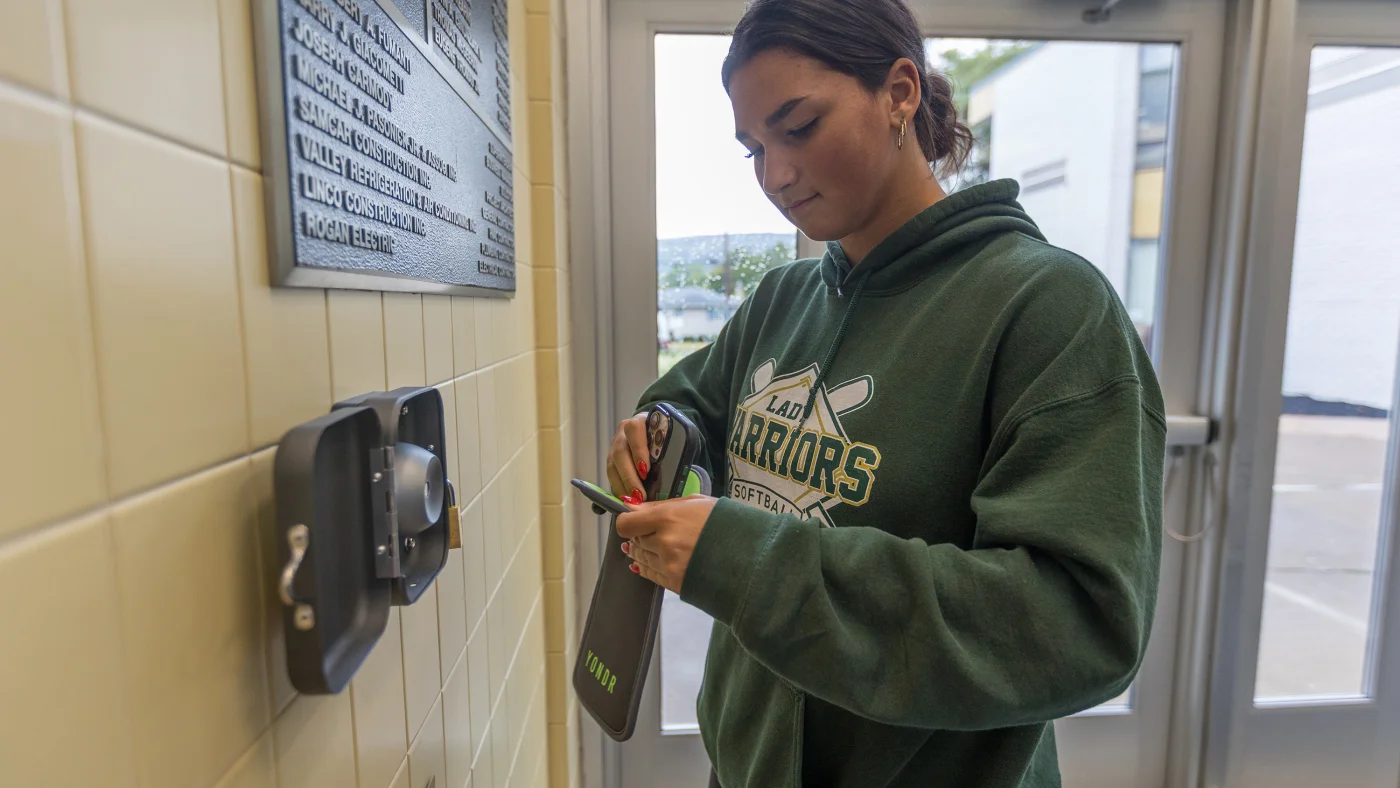
Typically, schools that use the pouches require that students put their phones in them at the beginning of the day and don't get them back until the end of the school day, when the pouches are unlocked by a school administrator with a special magnetic device. asserted
pouches → use → device
But the two studies also differ in key ways. asserted
studies → differ → ways
The April study pooled school-level mean test scores at several thousand Yondr-adopting schools, while Tuesday's study used student-level scores at the 844 schools that use both Yondr pouches and tests administered by NWEA. asserted
that → pool → NWEA
Simply put, the study released Tuesday had more fine-grain, student-level data, but the study released in April was able to examine a much larger sample of schools. asserted
study → put → schools
But the two studies' findings also aren't as different as they may seem. uncertain
they → seem → ?
Jacob and his co-authors did find statistically significant gains with Yondr pouches in high school math. asserted
Jacob → find → math
It's just that those gains were offset by ban-related learning losses in middle school. asserted
gains → offset → school
Overall, Jacob says, the new study "is encouraging. asserted
study → say → ?
And if [the benefit] really persists and accumulates over time, it really could be a meaningful benefit. uncertain
it → persist → time
I think we'll just have to wait and see if that happens." asserted
that → think → ?
Another co-author of that April study, Tom Dee, a professor at Stanford University's Graduate School of Education, says of Tuesday's findings, "I hope they are right that these very small test score gains will aggregate and add up over time. asserted
gains → say → time
However, I'm not comfortable making that extrapolation from estimates that are small, sensitive and based on just a few years of phone bans." asserted
that → make → bans
Taken together, Dee says, he considers the results from these early studies into cellphone bans "largely disappointing," and insists "we need continued study on this topic." Kane sees the results differently. asserted
Kane → take → results
Even if the benefit is small, he argues, relative to the cost – roughly $25 per student – these pouches still make financial sense for schools. asserted
pouches → argue → schools
"That's still a lot less than having to pay teachers for an extra week or two of instruction. asserted
That → have → instruction
When it all went wrong For nearly a quarter-century, from 1990 to 2013, math achievement among fourth- and eighth-graders rose steadily. asserted
achievement → go → graders
Reading scores also improved. asserted
scores → improve → ?
Then around 2013, student test scores began a sustained tumble that continued through the COVID-19 pandemic and has only recently begun to slow. asserted
that → begin → pandemic
For years, politicians and pundits blamed pandemic-era school closures for the losses, but the data tells a different story. asserted
data → blame → story
"Particularly in reading, test scores were going down for four to six years before the pandemic," Stanford University researcher Sean Reardon told NPR earlier this year. asserted
Reardon → go → NPR
…and 10 more, not listed.
Give feedback · no sign-in needed

No sign-in needed for now. Your note is sent without a name, so it cannot be answered.

History Support