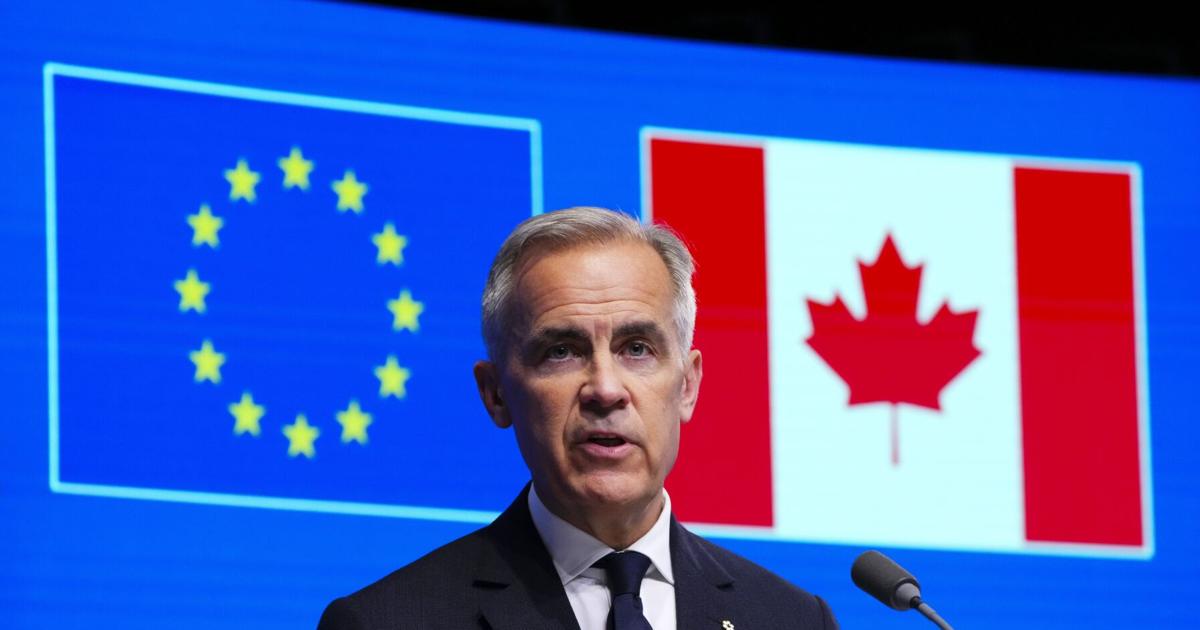
Mark Carney’s investment summit is a sign that perhaps, finally, after a decade of missed opportunities, our government understands that we have to get serious about our lack of productivity, per capita GDP growth and business investment.
asserted
we → miss → capita
Among the Prime Minister’s remarks on Tuesday, we learned that the Liberals plan to privatize the operations of Canada’s four largest airports; operations at Toronto, Montreal, Calgary and Vancouver all up for grabs.
asserted
Liberals → learn → grabs
With any luck, privatizing Canadian airports is a harbinger of further privatization efforts and efficiency in more areas of Canadian life.
asserted
privatizing → privatize → life
Unions oppose the plan almost unanimously, with Unifor releasing a strongly worded statement.
asserted
Unifor → oppose → statement
In the letter Unifor National President Lana Payne said “Airport workers know from experience that privatization comes at a cost to them and the travelling public and creates worse working conditions across the aviation industry.”
asserted
privatization → say → industry
Some commentators have also decried the announcement as something the Liberals “have no mandate” for.
asserted
Liberals → decry → mandate
Privatization should be welcomed, not feared, as it should benefit both passengers and the country.
asserted
it → welcome → passengers
It is a well established fact that markets and private enterprise are far more efficient than government at running companies and organizations.
asserted
markets → establish → companies
The reason is simple: corporations and private companies have a clear profit incentive to which they respond.
asserted
they → have → which
This benefits everyone and is the magic of the market at work.
asserted
This → benefit → work
Adam Smith, the father of capitalism, recognized this in his totemic work, The Wealth of Nations back in 1776.
asserted
Smith → recognize → 1776
“It is not,” Smith wrote, “from the benevolence of the butcher, the brewer or the baker that we expect our dinner but from their regard to their own interest.
asserted
we → write → interest
We address ourselves not to their humanity but to their self-love.”
asserted
We → address → love
Smith’s recognition that by looking out for their own profit interests, individuals, without any formal coordination, would all move towards producing better products more efficiently and at a lower price.
asserted
individuals → look → price
This is the famous invisible hand of the market which makes capitalist societies tick.
asserted
societies → make → market
Yet somehow this observation, which has done more to produce wealth and prosperity than almost any other in the world, is offensive when applied to Canadian airports.
asserted
which → do → airports
IATA, the International Air Transport Association, a trade association representing over 370 airlines worldwide, noted in 2024 that Canada’s air transport price competitiveness ranked 101st.
asserted
competitiveness → represent → 101st
On a typical round trip from Toronto to Montreal, Airport Improvement Fees of $70 were charged between the two airports.
asserted
Fees → charge → airports
A domestic round trip in the United States, by contrast, had a passenger facility charge — the U.S. equivalent — of only approximately $12 Canadian dollars.
asserted
trip → have → dollars
While not all airports are the same — Vancouver is lower than Pearson’s $40 at $25 — the fact remains that Canadian airports are not as cost competitive as their United States counterparts.
asserted
airports → remain → counterparts
Currently Canadian airports operate as non-profit entities, meaning any profit is reinvested in the airport, as there are no shareholders.
asserted
profit → operate → airport
In a private model the airport would have a profit mandate to create returns for investors.
asserted
airport → have → investors
Critics will portray this as a downside, when is reality it is the profit incentive which drives efficiency and innovation.
asserted
which → portray → efficiency
Further, the upfront capital provided by companies wishing to operate the Canadian airports in question will be enormous.
asserted
capital → provide → question
That capital, as Carney indicated in his remarks, will be “reinvested into infrastructure that Canada needs.”
asserted
Canada → indicate → that
Carney has noted this could amount to tens of billions of dollars of unlocked value for the airport leases.
uncertain
this → note → leases
By retaining ownership of the underlying assets and airport, the government seems to be following a model similar to Australia, which underwent the same process in the 1990s and early 2000s.
asserted
which → retain → 1990s
In 2002 the long-term lease signed for the Sydney airport and netted $AUD 5.6 billion for the Australian government.
asserted
lease → sign → government
That being the case way back in 2002, Carney’s comment of “tens of billions” in Canada today seems entirely realistic.
asserted
comment → seem → Canada
By handing over airport operations to profit driven companies Mark Carney is removing unwanted government involvement from an area it doesn’t need to be in, while unlocking significant asset value for Canadians.
asserted
it → hand → Canadians
The fact that the idea has been met as though it is some kind of revolution, is indicative of the fact that Canada has gotten far too comfortable with government control in areas of the economy they should leave.
asserted
they → meet → economy
Airport privatization is a hopeful step towards reigniting Canadian potential and productivity.
asserted
privatization → reignite → potential
With any luck, the Carney government will soon take a similar approach to our healthcare system.
asserted
government → take → system
 The Aporia