The US Federal Reserve has raised interest rates by 25 basis points for the first time in three years, primarily to address high inflation and rising oil prices. The decision’s potential impact on Pakistan includes increased external debt servicing costs and pressure on Pakistan's currency, according to financial analysts. Experts suggest that while Pakistan’s near-term financing is somewhat protected due to a recent Eurobond issuance, longer-term concerns include capital flight and PKR depreciation as investors move towards higher-yielding US treasuries.
Written by the local model on 2026-09-17,
using this article's own text rather than the other coverage of the
same event (that is the story summary below).
Story summary
On September 16, the Federal Reserve is expected to raise interest rates by 25 basis points, from a range of 3.75% to 4%, following its meeting on Wednesday. This move aims to combat elevated inflation, which has risen due to global conflicts like the Iran war and increased oil prices above $100 per barrel. Despite President Trump's demands for lower interest rates, financial markets strongly anticipate this hike, with a 94.5% probability indicated by CME Group’s FedWatch tool. The decision reflects concerns over inflation remaining stubbornly high at 2%, surpassing the central bank's target.
Written for “Fed Interest Rate Hike” on 2026-09-17,
grounded in this article and the 31 other(s) covering the same event.
Why this leaning score
This article does not take a side on a contested political
question, so it has no leaning score. That is an
answer rather than a gap: a match report or a rescue can be warmly
or critically written without being left or right, and scoring it
anyway is how approval of a subject gets recorded as a political
position.
No political leaning scored for article 15421 · logged 2026-09-17
The US Federal Reserve has raised interest rates in the world’s largest economy by 25 basis points (bps), the first hike in three years.
asserted
Reserve → raise → years
The decision aims to tackle stubbornly high inflation that has been exacerbated by rising oil prices amid the US-Israeli war on Iran.
asserted
that → aim → Iran
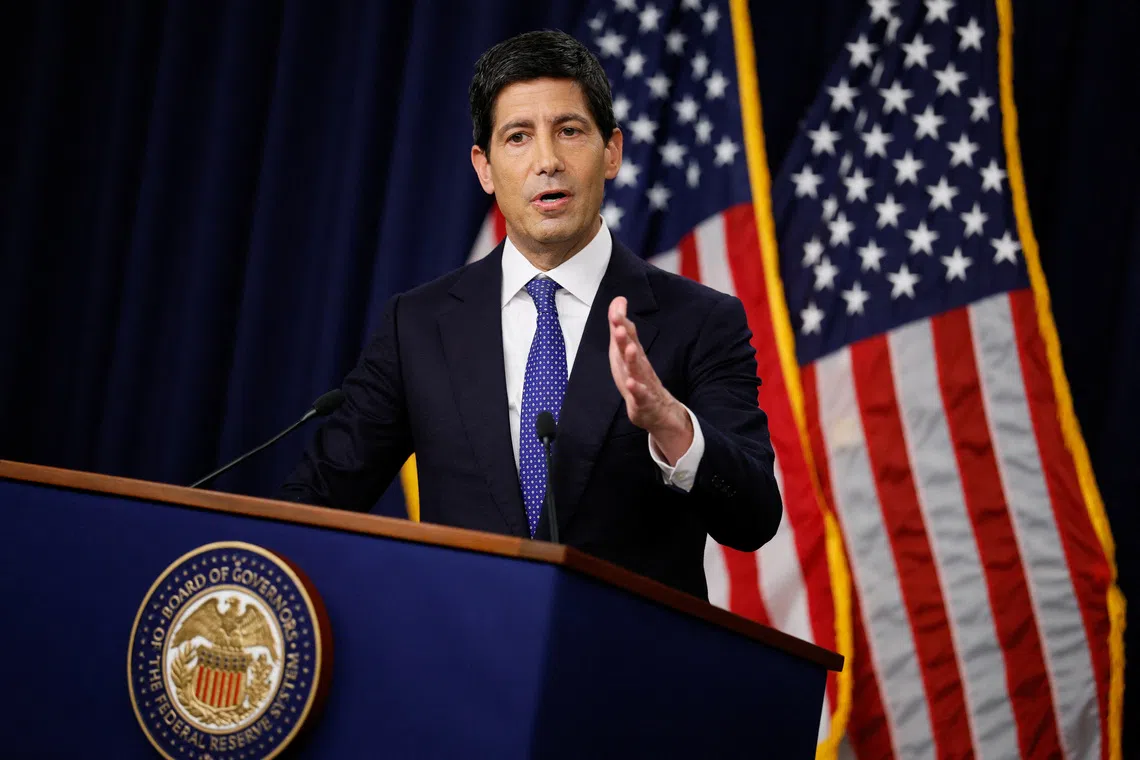
Making the announcement, US Federal Reserve Chair Kevin Warsh stressed that the hike was not influenced by financial markets.
asserted
hike → make → markets
However, will the effects of the decision reverberate in Pakistan?
asserted
effects → reverberate → Pakistan
Dawn takes a look at how it may impact Pakistan’s economy, with analysts voicing caution for the country’s own policy rate and external debt servicing.
uncertain
analysts → take → rate
US media outlet CNBC, citing experts, noted that for global markets, a “renewed US tightening cycle could mean a stronger dollar, greater pressure on currencies elsewhere and less room for other central banks to ease monetary policy”.
uncertain
banks → cite → policy
Mark Zandi, chief economist at Moody’s Analytics, told CNBC that the US hike and signals for another one were putting some upward pressure on the dollar and downward pressure on other currencies.
asserted
hike → tell → currencies
This was already evident on Thursday, with the US dollar hitting a seven-week high.
asserted
dollar → hit → high
Shares in Asia, including MSCI’s broadest index of Asia-Pacific shares outside Japan and Japan’s Nikkei, also edged up.
asserted
Shares → include → Japan
Similarly, the Pakistan Stock Exchange (PSX) opened in the positive and gained 0.90 per cent by 1pm.
asserted
Exchange → open → 1
Commenting on what the US hike could mean for Pakistan, Ammar H Khan, assistant professor of practice at the Institute of Business Administration (IBA), said: “On a forward-looking basis, we may either increase the interest rate by 50-100bps, or the PKR may depreciate.”
uncertain
PKR → comment → 100bps
Waqas Ghani Kukaswadia, research head at JS Global, also said the US Fed hike could add “some pressure on the rupee and tighten global financial conditions, while making future external borrowing expensive”.
uncertain
borrowing → say → conditions
“However, Pakistan’s near-term financing is relatively insulated, as the $3 billion Eurobond issued in September is already locked in.
asserted
Eurobond → issue → September
The bigger immediate risk remains elevated oil prices, given their direct impact on Pakistan’s import bill and external account,” he noted.
asserted
he → remain → bill
Business journalist and Dawn columnist Khurram Hussain quipped that the hike was “large enough to annoy” US President Donald Trump but “too small to help bring down yields in 10-year and 30-year paper”.
asserted
hike → quip → paper
However, he added, there was “nothing major” in terms of the impact on Pakistan.
asserted
he → add → Pakistan
He explained that the exposure for the country was “not that large”.
asserted
exposure → explain → country
“It will mean some increase in external debt service costs, in line with the 0.25pc increase.
asserted
It → mean → increase
But that’s more or less it,” Hussain said.
asserted
Hussain → ’ → ?
Financial analyst Jibran Sarfraz, however, expressed concern over the Fed rate hike.
asserted
Sarfraz → express → hike
He said the 25bps surge could hurt the fiscal scenario of emerging markets like Pakistan to a severe extent.
uncertain
surge → say → extent
“The South Asian nation could face capital flight as investors shift their capital into US treasuries due to higher yields, leading to PKR depreciation as Pakistan could face reduced dollar supply,” he said.
uncertain
he → face → supply
Sarfraz added to Hussain’s concerns, noting that Pakistan held significant external debt in dollars and therefore, the rate hike could spike the servicing and make payments costlier.
uncertain
payments → add → servicing
“However, the major threat to the entire mantra would be the escalating inflation due to a rise in the import cost of essential items, especially food products, and the cumulative inflation — which is already in double digits — could worsen numerically.”
uncertain
which → escalate → digits
 The Aporia