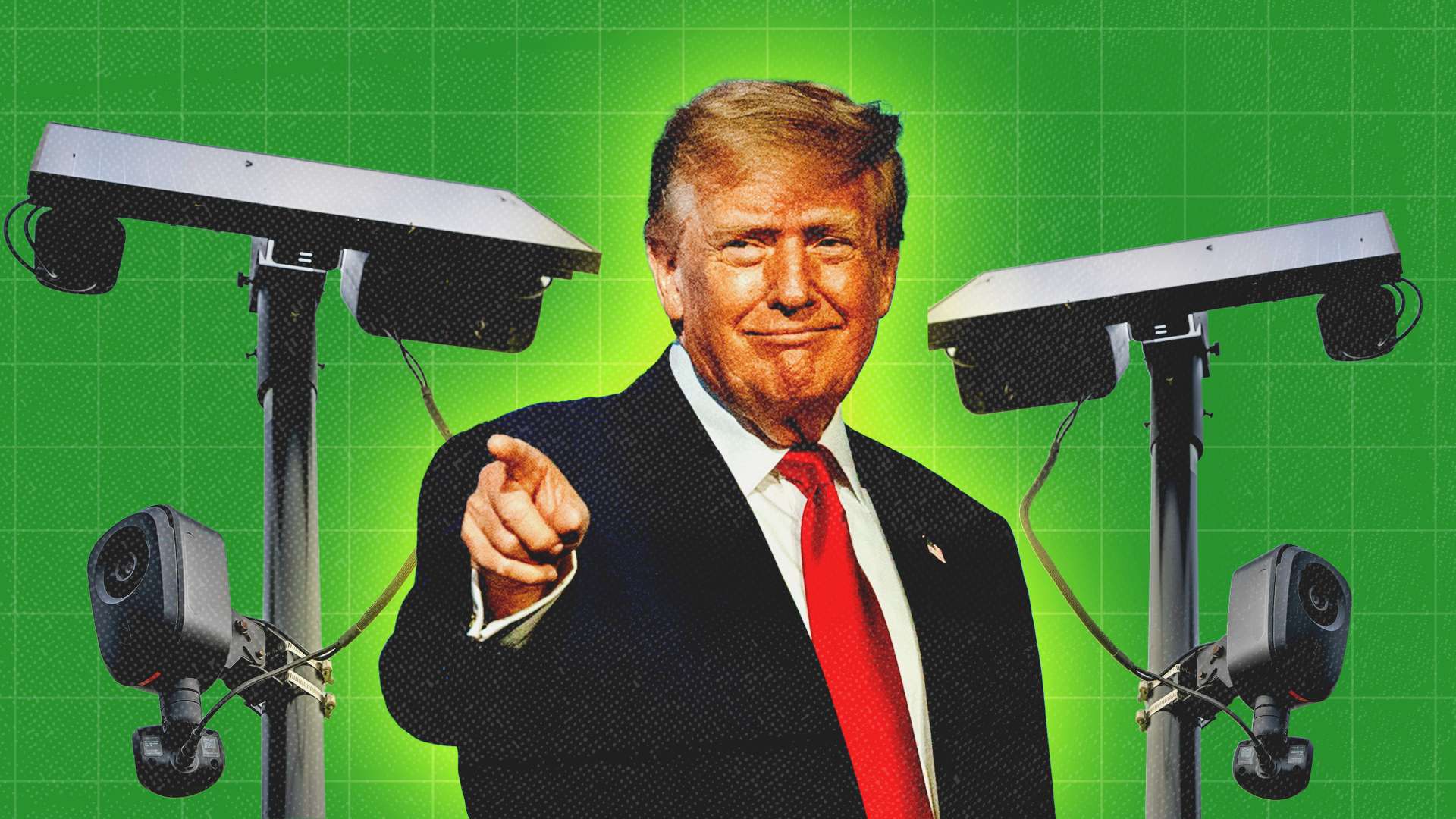
This week, President Donald Trump expressed support for automated license plate readers (ALPRs), which record and store images of license plates in a searchable police database.
asserted
which → express → database
Flock Safety, by far the country's largest ALPR supplier, has come under fire for the privacy violations and police abuses its products have enabled.
asserted
products → come → violations
But Trump's support for such a controversial product is perfectly consistent with his stated beliefs on policing.
asserted
support → state → policing
During a press gaggle aboard Air Force One on Sunday, a reporter asked Trump for his thoughts on Flock cameras.
asserted
reporter → ask → cameras
"I sort of like them," Trump said, "because of law enforcement.
asserted
Trump → like → enforcement
Some people don't.
asserted
people → do → ?
They think it's an infringement.
asserted
it → think → ?
But I like them."
asserted
I → like → them
Trump didn't elaborate any further, though as The Washington Post noted, he "has previously sidestepped questions about his stance."
asserted
he → elaborate → stance
When asked about Flock cameras last month in the Oval Office, Trump said, "You have pros and cons, right?
asserted
You → ask → pros
It's being studied right now.
asserted
It → study → ?
We'll have an answer as to our views on it over the next couple of weeks."
asserted
We → have → weeks
Trump's answer this week seemed more like a gut reaction—drawing a line directly to the fact that law enforcement likes them—than having been informed by the results of a study.
asserted
enforcement → seem → study
It's also perfectly consistent with his long-held beliefs on policing.
asserted
It → hold → policing
As the president mentioned in his aside, the cameras have indeed enabled abuses and "infringements" against members of the public.
asserted
cameras → mention → public
But Trump often speaks of the police as if they're too constrained to do their jobs properly and says he wishes they could simply act with impunity.
uncertain
they → speak → impunity
While running for president in 2016, Trump supported stop and frisk, in which police officers routinely stop people and search them for drugs or weapons without probable cause.
asserted
officers → run → cause
"We did it in New York [City], it worked incredibly well," he said, and he pledged to roll it out nationwide.
asserted
he → do → it
Of course, stop and frisk ended in New York City in 2014 after a federal judge found it unconstitutional, violating both the Fourth and 14th Amendments.
asserted
it → stop → Amendments
And despite Trump's claims to the contrary, stop and frisk did not work, much less "incredibly well."
uncertain
stop → stop → contrary
Officers disproportionately targeted young black and Latino men for searches but rarely turned up anything illegal.
asserted
Officers → target → anything
And after the program ended, crime not only didn't rise, it fell.
asserted
it → end → ?
During his first term, in a July 2017 speech nominally about immigration and violent gangs, Trump pivoted, telling police officers, "please don't be too nice" when arresting suspects, adding, "when you guys put somebody in the car" and "you put your hand over" their head to protect it, "you can take the hand away, OK?"
asserted
you → pivot → hand
("I believe he was making a joke at the time," said then-White House press secretary Sarah Huckabee Sanders.
asserted
Sanders → believe → time
During a 2024 campaign stop, Trump said, "We have to let the police do their job," even "if they have to be extraordinarily rough."
asserted
they → say → job
"They're not allowed to do it, because the liberal left won't let them do it.
asserted
them → allow → it
The liberal left wants to destroy them," he added.
asserted
he → want → them
"One rough hour—and I mean real rough—the word will get out, and it will end immediately."
asserted
it → mean → ?
Perhaps most infamously, in 1989, police arrested five teenagers, between the ages of 14 and 16, for beating and raping a jogger in Central Park.
asserted
police → arrest → Park
Trump took out full-page newspaper ads in four New York City newspapers calling for their execution.
asserted
Trump → take → execution
"Bring back the death penalty," the ad declared.
asserted
ad → bring → penalty
"Bring back our police!"
The suspects confessed, but only after being interrogated by police for hours without an attorney or a parent present.
asserted
attorney → bring → hours
They were convicted even though no physical evidence tied them to the scene; each served between six and 13 years in prison before they were exonerated.
asserted
they → convict → prison
The city ultimately awarded them $41 million.
asserted
city → award → million
After their exoneration, not only did Trump not change his tune, he still insisted they were guilty, despite DNA evidence demonstrating that none of the five teens were involved.
asserted
none → change → teens
As recently as the 2024 presidential debate, Trump said, "They admitted…they pled guilty, and I said, Well, if they pled guilty, they badly hurt a person—killed a person ultimately."
asserted
they → say → person
(None of them pleaded guilty, and the victim is still alive.)
asserted
victim → plead → them
It makes sense, then, that Trump would support Flock cameras, even in spite of their capacity for misuse or abuse.
asserted
Trump → make → misuse
In recent years, police have pulled over or detained dozens of innocent people because of Flock misidentifications, while an increasing number of officers have been caught using Flock's database to spy on current or former romantic partners.
asserted
number → pull → partners
It's especially notable that Trump chose this moment to register his support for Flock cameras, just as there is a growing bipartisan backlash.
asserted
Trump → choose → cameras
…and 9 more, not listed.
 The Aporia