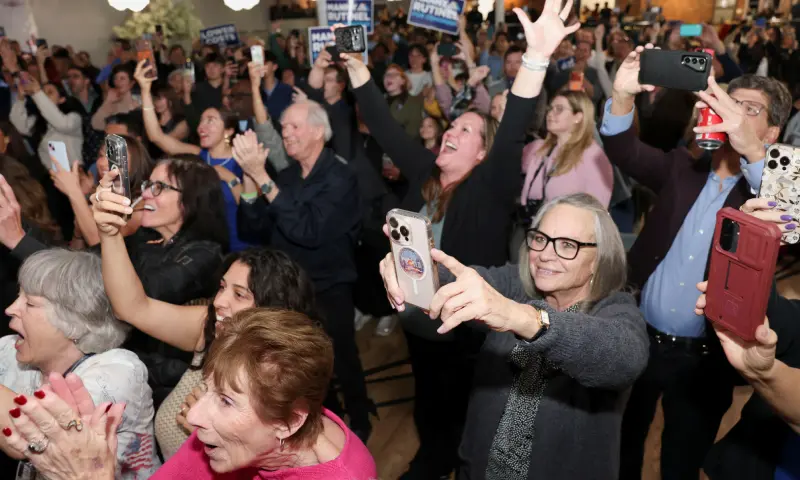
The 2026 midterm elections saw historic gains for Democrats, who won control of both chambers of Congress and flipped key seats in states like Texas, Kansas, and South Carolina.
asserted
who → see → Texas
The electorate’s leftward swing was diverse and widespread, but three demographics showed notable shifts that helped support Democrats on Tuesday.
asserted
that → show → Tuesday
Distinct gains came from young, rural, and Hispanic voters—all of whom were key to President Donald Trump’s victory in 2024.
asserted
all → come → 2024
National polling on how these groups voted in House races offers a broad measure of their support for Democrats, while Senate contests reveal how those trends played out in key states.
asserted
trends → vote → states
Experts weigh in on what may have prompted the shifts.
uncertain
what → weigh → shifts
Young voters
Young people overwhelmingly supported Democratic candidates this election cycle.
asserted
people → support → candidates
According to the AP Voter Poll, which was conducted Oct. 19 through Nov. 3, about 7 in 10 voters ages 18 to 29 said they supported the Democratic candidate in their local House races, while about 3 in 10 said they voted Republican.
uncertain
they → accord → Republican
Although Trump was not on the ballot, the poll found that 60% of young voters said their House vote was intended to “express opposition to Donald Trump.”
asserted
vote → find → Trump
This marks a sharp change from the presidential election in 2024, when Trump won an estimated 39% of young voters, making historic gains among the demographic.
asserted
Trump → mark → demographic
But the Republican Party was unable to capitalize on those gains just two years later.
asserted
Party → capitalize → gains
Outside of commentary on the President, 43% of young voters said that their top issue was the economy.
asserted
issue → say → voters
Santiago Meyer, the executive director of Voters of Tomorrow, tells TIME that young people felt “betrayed” by Trump’s economic policies.
asserted
people → tell → policies
“Young people trusted Donald Trump to bring prices down and work on affordability,” the 24-year-old explains.
asserted
old → trust → affordability
“He betrayed everything that he told us: He made prices higher with tariffs, he did not work on housing, and he started an illegal war.”
asserted
he → betray → war
Meyer says that while it's undeniable that Trump won over young men in 2024, he did so at the time with a $1.2 billion investment in youth in the five years preceding 2024, outspending the left 10 to 1.
asserted
he → say → 1
“The difference this year is that the money just didn’t cut it, there was a misread by Republicans of what drove young people toward them in 2024,” he says, claiming that Trump had targeted young men at a time when they felt particularly “left behind.”
asserted
they → cut → time
This year, it was the opposition that was able to best speak to those sentiments.
asserted
that → speak → sentiments
If Democrats are to retain the support they won in this election, however, Meyer says they will need to deliver in Congress.
asserted
they → retain → Congress
“Democrats got the trust of young people this time, so they need to deliver, or else they might swing again, or stay on the couch for the next election,” he says, pointing out that the latest data, which is still being tallied, already shows that Gen Z is on track to either match or exceed its record turnout in 2018, the first year for which the generation was eligible to vote.
uncertain
generation → get → which
“Young people need to be able to afford the lives they were promised by older generations,” he says.
asserted
he → need → generations
About 6 in 10 Hispanic voters said they chose the Democratic candidate in their local House race in 2026, according to the AP Voter Poll.
uncertain
they → say → Poll
In Texas, they were particularly instrumental in flipping the open Senate seat.
asserted
they → flip → seat
Roughly 6 in 10 Hispanic voters in the Texas Senate race supported Democrat James Talarico, compared to just 3 in 10 who supported Trump-endorsed Republican Ken Paxton.
asserted
who → support → Paxton
Stephanie Valencia, a co-founder of Equis Research, tells TIME that one of the big takeaways from Tuesday’s midterms was how consequential the Hispanic vote has become in America.
asserted
vote → tell → America
“Key takeaway from last night is that Latinos are the key swing voter,” she says.
asserted
she → say → night
“People love to call the Latino vote the ‘sleeping giant,’ but we are the swinging giant.”
asserted
we → love → vote
The latest swing was largely informed by two areas of discontent, according to recent polls: Trump’s presidency overall and, specifically, his handling of the economy.
uncertain
swing → inform → economy
Trump’s approval rating among Latino voters dropped from 38% in February 2025 to 24% in September and October, according to a Pew Research Center poll from last month.
uncertain
rating → drop → month
Of those who backed him in 2024, the decline was even greater, with approval down from 93% in 2025 to 57% in October.
asserted
decline → back → October
A survey by BSP Research and the African American Research Collaborative found that specific economic grievances included the cost of living and inflation.
asserted
grievances → find → living
More than 7 in 10 Latino voters disapproved of Trump’s handling of the economy, according to an AP-NORC poll from October.
uncertain
voters → disapprove → October
Valencia says that Tuesday’s vote was a “middle finger to Trump and Republicans and their misplaced promises” from the Hispanic community.
asserted
vote → say → community
It’s the same way they showed dissatisfaction toward Democrats when they supported Trump in 2024, she says, and therefore it should be noted that “while the shifts and the gains are real, they are not necessarily permanent.”
asserted
they → ’ → 2024
“The lesson for Democrats is not to interpret their opponents' loss as their victory,” she says.
asserted
she → interpret → victory
“The worst they could do is see 2024 as a blip and not see how they are in a probationary period with Latinos.”
uncertain
they → do → Latinos
In 2024, when Trump drew near even with his opponent Kamala Harris among Hispanic voters, Valencia said that the demographic was driven by the same priorities they have expressed in 2026: cost of living, inflation, and immigration.
asserted
they → draw → living
“For both Biden and Trump, the common thread is rising costs and not rising wages,” Valencia says.
asserted
Valencia → rise → Biden
The challenge for a Democratic-controlled Congress, now, is to figure out how to work with Trump and provide “clear delivery” to Latino voters, she adds.
asserted
she → control → voters
Traditionally, there is a large party divide between urban voters and rural voters—with the former overwhelmingly voting for Democrats and the latter more often voting for Republicans.
asserted
latter → be → Republicans
The Pew Research Center shows a pronounced gap in 2024, with nearly 70% of validated voters who described their communities as rural voting for Trump, and 29% voting for Harris.
asserted
% → show → Harris
…and 14 more, not listed.
 The Aporia