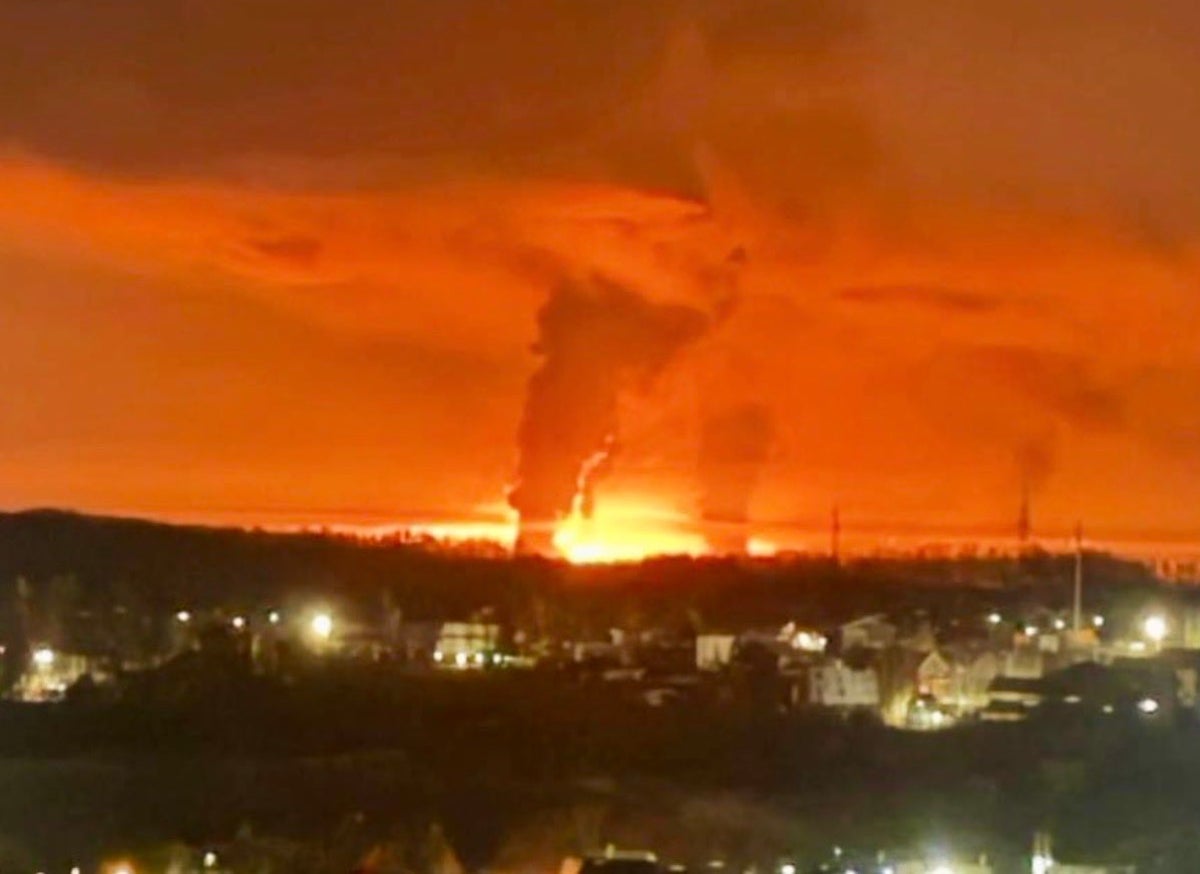
On Sunday night, millions of Ukrainians were sent an alert to their phones that would usually spark panic and fear.
asserted
that → send → panic
Citizens were told that there was an imminent threat of radiation, chemical attacks and fighting on the streets of Kyiv through an app used to by the government to issue nationwide notifications in emergencies.
asserted
Citizens → tell → emergencies
It was quickly followed up with a clarification that the system had likely been hacked by Russia and that no such threat existed.
asserted
threat → follow → Russia
“The Air Alarm application has probably been subjected to hostile interference,” read a follow-up message on Telegram.
asserted
message → subject → Telegram
Shortly after, Russia told its citizens that Ukraine had hacked its systems to warn its people of imminent nuclear strikes.
asserted
Ukraine → tell → strikes
Neither countries have claimed responsibility and it is unclear where or how the incidents were sparked.
uncertain
incidents → claim → responsibility
But they have been widely interpreted by officials and analysts as tit-for-tat attacks, started by Russia.
asserted
they → interpret → Russia
A hacker within the Ukrainian “hacktivist” community told the BBC that the breach of the Russian alert system was likely to be a “retaliatory attack” by Ukraine.
asserted
breach → tell → Ukraine
The ensuing chaos has laid bare the increasingly devastating impact of cyberattacks.
asserted
chaos → ensue → cyberattacks
According to the Ukrainian security service (SBU) , citing its cybersecurity department, more than 16,000 Russian cyber attacks and “critical cyber incidents” had been neutralised between the start of the war in February 2022 and July this year.
uncertain
attacks → accord → February
Brigadier general Volodymyr Karasteliov referred to one large-scaled DDoS arrack that lasted three hours against a nationwide Ukrainian television channel.
asserted
that → refer → channel
“The botnet generated up to 200,000 requests per minute from nodes in Asia, Europe, and the United States,” he said.
asserted
he → generate → Asia
“The attack targeted the website's application layer, with hackers imitating the behaviour of real users in an attempt to overload the server with complex requests and make the site unavailable.”
asserted
site → target → requests
According to research published in PLOS in April 2024, Russia ranked as the number one hotspot for cybercriminals worldwide, followed by Ukraine.
uncertain
Russia → accord → Ukraine
Cybersecurity firm CybelAngel noted that the attacks between Russia and Ukraine are largely asymmetric.
asserted
attacks → note → Russia
The company’s REACT team recorded 1,651 cyber incidents targeting Ukrainian entities with 575 targeting Russian entities between January 2025 and January 2026.
asserted
team → record → January
“The asymmetry isn’t new, since the prior twelve months looked nearly identical in shape and scale,” it said.
asserted
it → look → shape
Experts told The Independent that the attacks serve a more sinister purpose than simply the disruption of communication systems.
asserted
attacks → tell → systems
“A message from your air raid alert system generates emotion straight away, almost like a phishing email, with that sense of panic and urgency, and you respond and react,” says Adam Pilton, cyber security adviser at Heimdal.
asserted
Pilton → generate → Heimdal
“That’s exactly why the air raid systems were hit.
asserted
systems → ’ → ?
The attack strikes at the point where people trust their government.”
asserted
people → strike → government
He compares the incident to the cyber attack on ASOS a few weeks ago, explaining that when communication is disrupted from official platforms, it leads to uncertainty and confusion for civilians.
asserted
it → compare → civilians
“If you can’t trust communications that purportedly come from official platforms, whether a business or your government, then what can you trust?
asserted
you → trust → what
That’s exactly the purpose of this attack, to erode trust,” he says.
asserted
he → ’ → trust
Pilton reiterates that the purpose of the strikes is to sow panic and uncertainty despite claims that the systems are legitimate targets as communication platforms.
uncertain
systems → reiterate → platforms
“Russia has claimed that this is not an actual air raid system but just a communication platform.
asserted
this → claim → ?
Whether that’s true or not is irrelevant.
asserted
’s → ’ → ?
What matters is that people look to their leaders to understand what’s happening,” he explains.
asserted
he → matter → leaders
If they receive an official communication, they will follow it.
asserted
they → receive → it
That’s different from the media, which they’ll take with a pinch of salt and probably look a bit further.
asserted
they → ’ → salt
Speaking to the BBC, Oleksandr Merezhko, chair of the Ukrainian parliament’s foreign affairs committee and a member of Volodymyr Zelensky’s Servant of the People party, said that the country and its people are prepared for all scenarios.
asserted
country → speak → scenarios
“It's a very unpleasant fact but it is part of cyber war and people in Ukraine understand that.
asserted
people → understand → that
It is possible and we are quite prepared for such possibilities,” he said.
asserted
he → prepare → possibilities
 The Aporia