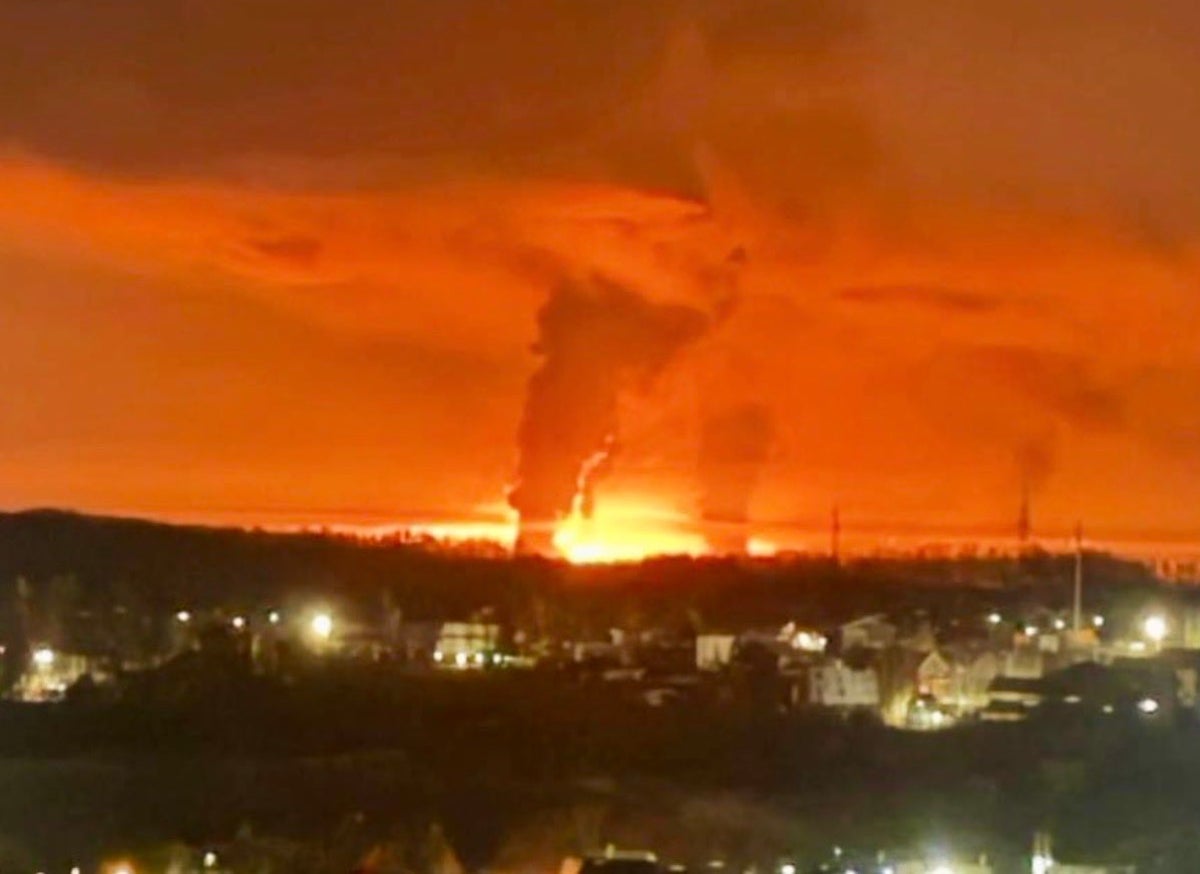
Photo via The Guardian

Ukraine and Russia say emergency air-raid warning systems hit by cyber-hacks – Europe live

Read the original at The Guardian ↗
Cite

Mao, F. (2026, November 2). Ukraine and Russia say emergency air-raid warning systems hit by cyber-hacks – Europe live. The Guardian. https://www.theguardian.com/world/live/2026/nov/02/ukraine-russia-emergency-warning-systems-hack-zelenskyy-streeting-eu-latest-news-updates

Dated from the outlet's own feed. Check the original for its byline.

The Guardian · collected 2026-11-02 · by Frances Mao

Quick Summary

Ukraine and Russia reported simultaneous cyber-hacks on their emergency air-raid warning systems late Sunday night. The Ukrainian app falsely warned of a nuclear radiation threat, chemical attack, street fighting, and incoming hypersonic missiles in Kyiv, while Russian authorities had to take their warning app offline. A Ukrainian hacker group claimed responsibility for sending fake alerts about nuclear warheads to users inside Russia. Both sides also conducted strikes on energy sites like oil refineries during the cyber attacks.
Written by AI on 2026-11-02, from this article's own text only (the story summary below draws on all the coverage).

AI analysis

Story summary

As of November 2, 2026, the Ukrainian Air Force reported that the country's public air raid alert app was hacked, sending false warnings about nuclear and chemical threats in areas including the capital Kyiv. The alerts urged residents to stay indoors due to a supposed radiation hazard and chemical attack. However, these warnings were later found to be false, with the military stating there is no actual radiation threat. Ukraine’s Air Force warned on Telegram that “the air alert app appears to have been subjected to enemy influence.” Meanwhile, Russian officials also claimed their emergency warning system was hacked, raising concerns about cyber warfare tactics in both countries during the ongoing conflict.

Written for “Ukraine's Air Raid App Hacked” on 2026-11-02, grounded in this article and the 12 other(s) covering the same event.
Why this leaning score
This article does not take a side on a contested political question, so it has no leaning score. That is an answer rather than a gap: a match report or a rescue can be warmly or critically written without being left or right, and scoring it anyway is how approval of a subject gets recorded as a political position.
No political leaning scored for article 122724 · logged 2026-11-02

Story

📰 Ukraine's Air Raid App Hacked
Technology · 13 article(s) covering the same event. Compare every outlet's account →

Compared with similar articles

This article reads unscored and hedges 0% of its claims. Each row says how that neighbour differs.
ABC News (AU)
Hedges 0 of 3 claims Outlet record 68/100
ABC News (AU)
Hedges 0 of 4 claims Outlet record 68/100
The Hindu
Hedges 1 of 25 claims Outlet record 77/100
The Independent
⚖️ Leans left Hedges 2 of 32 claims Outlet record 59/100
“The articles describe different events - one about train travel disruptions due to drone strikes and the other about cyber-hacks on emergency air-raid warning systems.”
The Straits Times
Hedges 0 of 7 claims Outlet record 66/100
Al Jazeera
Hedges 2 of 10 claims Outlet record 60/100
Fox News
Hedges 0 of 14 claims Outlet record 69/100
The Sydney Morning Herald
Hedges 1 of 19 claims Outlet record 61/100
The Independent
Hedges 4 of 41 claims Outlet record 59/100
Al Jazeera
Hedges 2 of 39 claims Outlet record 60/100
How this article was measured signals, leaning charts, publisher record, byline, topics and claims

Signals How these are calculated →

Claims extracted
9
sentences that state something as happening or true
Uncertain
0%
0 of 9 hedged ("reportedly", "may", "according to")
Leaning
not political
takes no side on a contested political question
Publisher signals
66/100
The Guardian's corrections and hedging, across everything collected from it. Not a measure of accuracy.
Outlets on this story
13
Technology
Same framing elsewhere
1
articles that frame the event the way this one does
Analyzed 2026-11-02 · how these are computed

How this is being covered How these are calculated →

Article leaning vs. publisher reliability
Source leaning vs. consistency

Publisher

The Guardian · 2822 article(s) · 6 correction(s) detected
Running correction rate · 6 correction(s)

Who wrote this

Frances Mao
7 article(s) here · 0 carrying a prediction
🔮 Budget week conversation has moved on a bit; Tory leader Kemi Badenoch is doing the rounds of the politics shows this morning and she has an op-ed in the Telegraph railing against the delayed defence spending commitment, claiming instead that the Conservatives could find that spend while cuting the deficit and lowering taxes.
🔮 Good morning and welcome to our live coverage of events in Europe – we will be closely following protests across the continent today.
🔮 It remains to be seen if operations will continue at other Saudi airports.
🔮 Attack on Kyiv as Merz arrives shows upsurge in Russian attacks on capital The North Bridge – one of several connecting central historic Kyiv to the residential suburbs across the Dnipro river -was struck not long after the German chancellor’s arrival in the Ukrainian capital. The incident has been confirmed by Kyiv’s mayor Vitali Klitschko this morning who wrote on Telegram: “Impact on the road surface of the Northern Bridge.
🔮 That emergency brake would give renters vital breathing space.
🔮 “I don’t see that swapping out a leadership figure would really bring a change,” Education Minister Karin Prien, who is also a deputy CDU leader, has told Phoenix television.
Also by Frances Mao
Nothing else under this byline is closely related to this article, so these are simply their most recent.
All 7 articles by Frances Mao →

Topics

Air Force Kyiv Oreshnik Russia Ukraine

Subjects

Ukraine GPE · 4× Russia GPE · 2× Air Force ORG · 1× Kyiv GPE · 1× Odesa GPE · 1× Russian NORP · 1× Telegram ORG · 1× Ukrainian NORP · 1× Zaporizhzhia GPE · 1×

Narrative

In the Ukraine hack, the app started spewing out alarming fake messages late on Sunday night – warning residents of a nuclear radiation threat in the capital Kyiv, a chemical attack, street fighting and also incoming Oreshnik hypersonic missiles, which Ukraine lacks interceptors for.
framing: assertive · carried by 1 article(s) · first seen 2026-11-02

Claims (9 extracted, 0 hedged)

Ukraine and Russia have reported corresponding cyber-hacks on their app warning systems overnight. asserted
Ukraine → report → systems
These are the mobile apps which send alerts and air-raid warnings, alerting citizens to when missiles and drones are incoming (and thus advising residents to seek shelter or go down to a bunker). asserted
missiles → send → bunker
This appears to be the first breach of the app, on such a scale, during the war so far; directly immobilising one of the most important channels of communication authorities have to help advise citizens. asserted
authorities → appear → citizens
In the Ukraine hack, the app started spewing out alarming fake messages late on Sunday night – warning residents of a nuclear radiation threat in the capital Kyiv, a chemical attack, street fighting and also incoming Oreshnik hypersonic missiles, which Ukraine lacks interceptors for. asserted
Ukraine → start → interceptors
Ukraine’s Air Force issued clarification within the hour on Telegram, urging people to remain calm and disregard the messages, one of which was written in Russian. asserted
one → issue → Russian
Some hours later, Russian authorities said its warning app had been hacked and had to be taken offline. asserted
app → say → ?
A Ukrainian hacker group has claimed to have sent fake alerts warning of nuclear warheads to users inside Russia. asserted
group → claim → Russia
Amid the cyber warfare overnight, both sides also carried out strikes, targeting energy sites like oil refineries. asserted
sides → carry → refineries
Strikes have been reported in Zaporizhzhia and Odesa. asserted
Strikes → report → Zaporizhzhia
💬Give feedback
🕘History 🎫Support