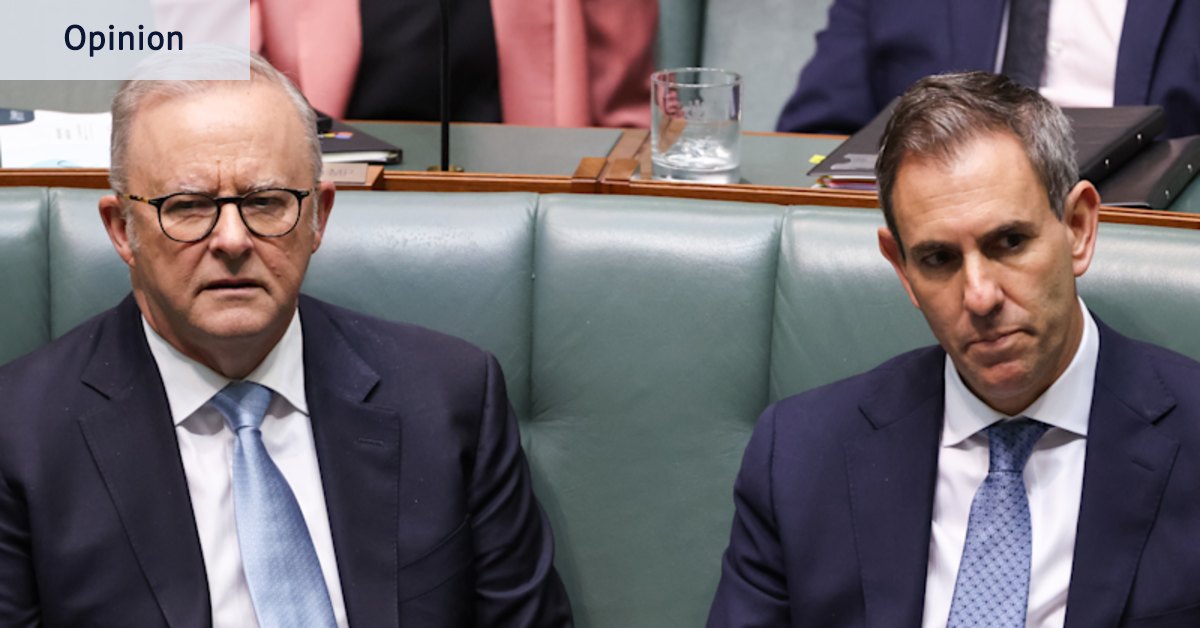
Four months ago, Anthony Albanese reminded his caucus of something Paul Keating had said – that Labor was like a bicycle.
asserted
Labor → remind → bicycle
Keating said it more than once.
asserted
Keating → say → it
On one occasion he attributed the sentiment (though not the phrase) to Gough Whitlam.
asserted
he → attribute → Whitlam
“Gough understood that the ALP was like a bicycle.
asserted
ALP → understand → bicycle
It only stands up when you pedal.
asserted
you → stand → ?
If you stop pedalling it falls over.
asserted
it → stop → ?
If you run out of ideas and you run out of push and you run out of drive, it just sort of lays to one side.
asserted
it → run → side
It’s mostly forgotten now, but Whitlam could be a sharp critic of the Hawke government.
uncertain
Whitlam → forget → government
So that occasion was significant in part because, as the late Michael Gordon recounted in his biography of Keating, the speech in which Keating said this – matched by Whitlam praising Keating – marked a “rapprochement” between the two men.
asserted
Whitlam → recount → men
After this year’s budget, though, he swooped in to defend Labor’s taxation agenda against its critics.
asserted
he → swoop → critics
There was a nice symmetry, then, in Albanese quoting Keating’s olive branch to Whitlam – perhaps while offering an olive branch of his own.
asserted
Albanese → be → own
And this made sense, because the budget marked this government’s strongest declaration of purpose – stepping into the Labor tradition to which both Whitlam and Keating were attached.
asserted
Whitlam → make → which
With their housing tax changes, Albanese and Jim Chalmers chose to do something significant about our increasingly unequal society.
asserted
Albanese → choose → society
And there was a second part, which would likely have appealed to Keating: Chalmers argued, too, that Labor’s changes to housing taxes would improve productivity by making sure people were investing in the areas most likely to drive economic growth, rather than areas most likely to benefit from tax incentives.
asserted
people → be → incentives
So where are we now, five months after what Chalmers described as the most significant tax reform in a generation?
asserted
Chalmers → describe → generation
The question is difficult to answer, in part because poor polling can cloud judgment.
asserted
polling → answer → judgment
Polling doldrums are too easily read as proof that a government is not just unpopular but bad at governing.
asserted
government → read → proof
We should be particularly cautious about such judgments at a time when the poor polling is almost certainly driven greatly by inflation, a large part of which is outside the government’s control.
asserted
part → drive → control
(Yes, the government plays some part, which I’ll get to.)
asserted
I → play → which
Albanese has, at least at the level of obvious activity, kept pedalling since the budget, with action on migration, AI, the NDIS, the digital duty of care and gambling (whether those policies work is another question).
asserted
work → keep → care
And remember: it has only been five months.
asserted
it → remember → ?
The government seems to be falling into a malaise in which at least some of its MPs, too, begin to believe polling offers an authoritative answer to the question of whether it is doing a good job.
asserted
it → seem → job
The newspapers are suddenly full of Labor ministers and MPs offering views about each other.
asserted
ministers → offer → other
There is nothing wrong with disagreement – in fact, this government hasn’t had enough of it.
asserted
government → be → it
So far, much of this backgrounding seems to be at the level of political whingeing.
asserted
much → seem → whingeing
Still, senior figures are obviously taking it seriously.
asserted
figures → take → it
On the subject of olive branches, you will not get many stronger mea culpas from senior ministers than Chalmers’ recent admission to this masthead: “I should make more time for my colleagues.”
asserted
I → get → colleagues
A type of urgency is building in the media: the sense that Labor must define itself clearly and perhaps even stake out some new direction.
asserted
Labor → build → direction
That pressure will ramp up after the next rate rise, predicted this week.
asserted
pressure → ramp → rise
Is that urgency justified?
asserted
urgency → justify → ?
The first is that Labor must be wary of jumping at shadows.
asserted
Labor → jump → shadows
A sudden swerve would look like panic.
asserted
swerve → look → panic
And a pivot in the dying weeks of the year is unlikely to succeed, as voters begin to switch off.
asserted
voters → die → year
The second answer is that Labor must not assume the ship (or bicycle) will right itself, in part because of one significant difference between this term and its first term.
asserted
ship → assume → term
It is easy to see this term’s housing tax changes as equivalent to last term’s tax cuts changes: both are about equity, both involved breaking promises, both brought concerns about Labor’s future to the fore.
asserted
both → see → fore
But the changes to the stage 3 tax cuts were announced just over a year before the election.
asserted
changes → announce → election
Afterwards, the government went fairly quiet, until a policy burst at the beginning of election year.
asserted
government → go → year
The housing tax changes, though, were announced two years before the likely date of the next election.
asserted
changes → announce → election
That leaves significantly more time to fill.
asserted
That → leave → time
This is the question that senior figures must surely now be thinking about.
asserted
figures → think → that
…and 10 more, not listed.
 The Aporia