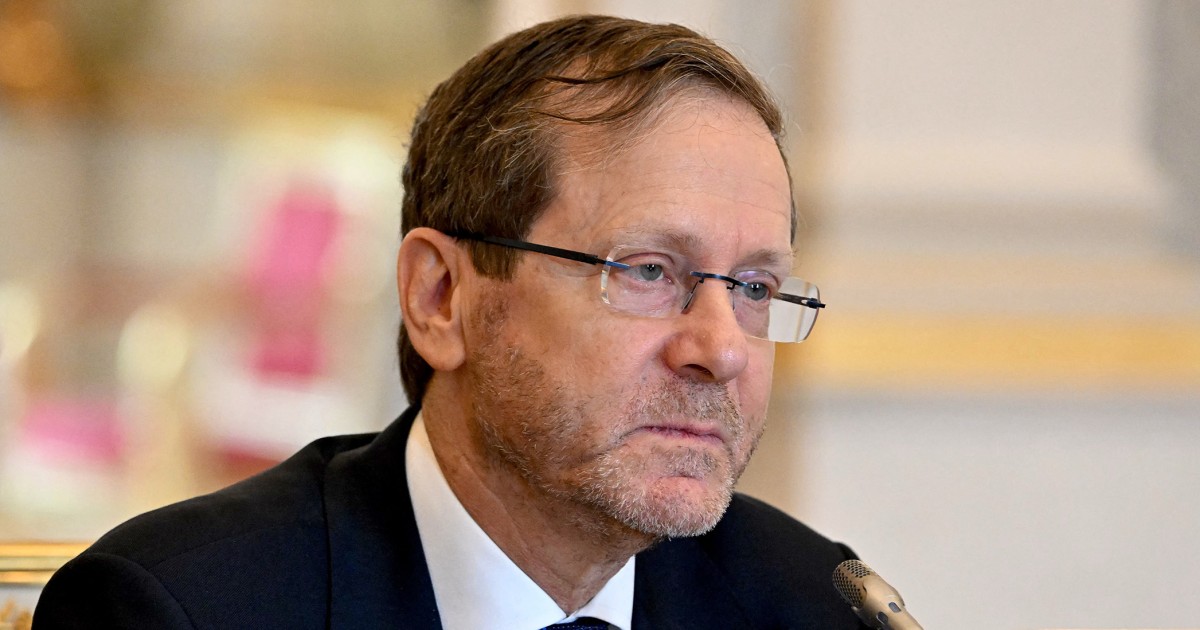
Israeli President Isaac Herzog has urged the country’s political parties to enter negotiations on forming a new government with an “open heart,” as he prepares to consult with factions on a path forward after an uncertain election result.
asserted
he → urge → result
Last week’s elections saw Prime Minister Benjamin Netanyahu’s bloc denied a majority, with the parties in his ruling coalition claiming 53 seats in Israel’s 120-member Knesset.
asserted
parties → see → Knesset
Parties in the bloc aligned with Netanyahu’s main rival, Gadi Eisenkot, won 48 seats, leaving neither man with an obvious path to forming a government.
asserted
Parties → align → government
The balance of power is held by parties representing Israel’s minority Arab community, which nearly doubled its representation in Israel’s parliament with 19 seats.
asserted
which → hold → seats
But both Netanyahu and Eisenkot had ruled out working with them prior to the vote.
asserted
Netanyahu → rule → vote
Netanyahu has since continued to attack the Arab parties, accusing them of holding stances on Gaza and the West Bank he considers unacceptable.
asserted
he → continue → Gaza
Eisenkot, however, has indicated he is open to working with anyone who agrees to four conditions on Israeli sovereignty and opposition to Hamas, potentially opening a path to a deal that could propel him to power and avoid fresh elections.
uncertain
that → indicate → elections
While Netanyahu is the leader of the single largest party, it is up to Herzog — largely a ceremonial figure — to decide who has the first shot at forming a government.
asserted
who → decide → government
He will hold initial consultations with party officials on Wednesday, beginning a delicate process that could last weeks.
uncertain
that → hold → process
“I hope the representatives will come with an open mind, and today I add: with an open heart,” Herzog said in a statement Sunday.
asserted
Herzog → hope → statement
Israel launches strikes on Gaza
Netanyahu, who is set to remain in his post as a caretaker until a new government can be formed, has claimed Arab parties used foreign backing to “steal” the elections, without providing evidence.
asserted
parties → launch → evidence
Israeli intelligence agency Shin Bet has said it is investigating possible foreign interference in the election but that the probe was not intended to “cast aspersions” on any specific group.
asserted
probe → say → group
Arab party leaders have strongly denied any wrongdoing, while Herzog pushed party leaders to accept the election result.
asserted
Herzog → deny → result
“During an election campaign, candidates naturally and predictably climb to lofty positions,” Herzog said in his statement.
asserted
Herzog → climb → statement
And now is the time to call on all our leaders to stop climbing and face this reality.”
asserted
time → call → reality
The four conditions Eisenkot set out for prospective partners include recognizing Israel as a Jewish state, committing to the values of its independence, accepting mandatory military service for all Israeli citizens and recognizing Hamas as a terrorist organization.
asserted
Eisenkot → set → organization
“Every Knesset member who is willing to sign on to these principles is a potential partner on the path to establishing a new and better government for Israel,” he said in a statement on Saturday.
asserted
he → sign → Saturday
“The door to the government we will form will be open to every public representative who accepts these principles and is ready to rise to the occasion.”
asserted
who → form → occasion
Netanyahu, meanwhile, said Sunday that it was “forbidden” to form a government with Mansour Abbas, head of Arab-led party Ra’am.
asserted
it → say → Ra’am
He said on X that Abbas wants to establish a Palestinian state with East Jerusalem as its capital, and evacuate Israeli settlements in the occupied Palestinian territories, citing an old Ra’am policy platform.
During the campaign, Netanyahu’s Likud party repeatedly alleged that Eisenkot would usher the Arab parties into power.
asserted
Eisenkot → say → power
In one of several AI-generated videos posted by Netanyahu, Eisenkot was portrayed astride a wooden Trojan horse, with Abbas and left-wing politician Yair Golan inside.
asserted
Eisenkot → generate → horse
Abbas said Friday that he was coordinating with other Arab leaders on “the prospects for forming a government to replace the one led by Netanyahu.”
asserted
he → say → Netanyahu
Eisenkot’s anti-Netanyahu bloc contains a broad array of ideologies and views on the issue, ranging from Golan, who has publicly advocated for a deal with the Arab parties, to Avigdor Lieberman of the right-wing Yisrael Beiteinu party, who continues to oppose working with them.
asserted
who → contain → them
With that much friction, a stalemate and more elections remain a real possibility.
asserted
stalemate → remain → friction
Fawaz Gerges, a professor of international relations at the London School of Economics, told NBC News that Israel still appears stuck, adding that Eisenkot’s conditions for the Arab parties are effectively asking them to “forsake their identity.”
“I don’t think we will see the opposition led by Eisenkot forming a government in Israel,” he said.
asserted
he → tell → Israel
For the major Israeli parties, it is a choice “between Israel as a democratic state or Israel as a Zionist exclusive society,” he said.
asserted
he → say → society
But Yossi Mekelberg, a senior consulting fellow with the Middle East and North Africa Program at U.K. think tank Chatham House, sees flexibility that could yield a breakthrough.
uncertain
that → consult → breakthrough
Parties “make all these promises before the election, and it is obvious that you break at least some of them after the election,” he said.
asserted
he → make → election
 The Aporia