Photo via The Guardian

Friday briefing: Israel has a dilemma - can its opposition govern with Palestinian parties?

Read the original at The Guardian ↗
Cite

Brooks, L. (2026, October 30). Friday briefing: Israel has a dilemma - can its opposition govern with Palestinian parties? The Guardian. https://www.theguardian.com/world/2026/oct/30/friday-briefing-israel-has-a-dilemma-can-its-opposition-govern-with-palestinian-parties

Dated from the outlet's own feed. Check the original for its byline.

The Guardian · collected 2026-10-30 · by Libby Brooks

Quick Summary

Israel's election results present a complex political situation where Benjamin Netanyahu’s far-right coalition lost its mandate, while the opposition bloc now has a potential majority if it forms a governing pact with Palestinian Israeli parties, which have secured 19 seats, a record high. However, tensions are high as Netanyahu and his supporters accuse Palestinian-led parties of election fraud without providing evidence, complicating the path to forming a new government.
Written by AI on 2026-10-30, from this article's own text only (the story summary below draws on all the coverage).

AI analysis

Story summary

Benjamin Netanyahu’s far-right coalition lost its majority in Israel's October 27 parliamentary election, with 53 seats compared to the opposition’s 48 seats, including a record-high 19 seats for Arab parties. This outcome presents a significant challenge as party leaders now face lengthy and complex negotiations to form a government. The centrist Yashar party, led by Gadi Eisenkot, is projected to win 20 of the Knesset's 120 seats, ahead of Netanyahu’s Likud. Thousands rallied in Tel Aviv before the election calling for an inquiry into security failures leading to the October 7, 2023 Hamas attacks. The opposition accuses Netanyahu and his bloc of spreading unsubstantiated claims about Arab parties stealing the election and warns against Islamization.

Written for “Netanyahu Falls Short in Israeli Election” on 2026-10-30, grounded in this article and the 204 other(s) covering the same event.
Why this leaning score
The article's own words the score was based on. Each is quoted verbatim and was checked against the article text before being stored, so you can find it in the original.
Reading Leans left (beta estimate) Confidence medium
Leaning: leans left for article 116649 (medium confidence, 2 verified quotes) · logged 2026-10-30

Story

📰 Netanyahu Falls Short in Israeli Election
Politics · 205 article(s) covering the same event. Compare every outlet's account →

Compared with similar articles

This article reads leans left and hedges 13% of its claims. Each row says how that neighbour differs.
Al Jazeera
⚖️ Leans right further right than this Hedges 3 of 60 claims Outlet record 60/100
The Guardian
⚖️ Leans strongly left further left than this Hedges 1 of 34 claims Outlet record 66/100
National Post
Hedges 5 of 29 claims Outlet record 60/100
National Post
⚖️ Leans left Hedges 1 of 34 claims Outlet record 60/100
“The articles discuss different aspects of the Israeli election and its aftermath; Article A discusses Canada's opportunity to reset relations with Israel, while Article B focuses on the political dilemma facing Israel after the election.”
Eizenkot’s Choice Same event
Persuasion
⚖️ Leans left Hedges 3 of 46 claims
The Dispatch
⚖️ Leans left Hedges 1 of 3 claims Outlet record 61/100
“The articles discuss different aspects of Israel's political situation and election outcomes, not a single specific incident.”
Al Jazeera
⚖️ Leans strongly left further left than this Hedges 3 of 34 claims Outlet record 60/100
“While both articles discuss elections in Israel and their implications, they describe different stages of events: Article A focuses on the campaign period with emphasis on Netanyahu's bloc versus the opposition, while Article B discusses the aftermath of the election results and the governing dilemma that arises from those results.”
Al Jazeera
⚖️ Leans left Hedges 0 of 5 claims Outlet record 60/100
“The articles discuss different aspects of Israel's political landscape, with Article A focusing on continuous policies regarding Palestinian land despite leadership changes, while Article B addresses a recent election outcome and the potential for an opposition coalition including Palestinian Israeli parties.”
Zeteo
⚖️ Leans left Hedges 0 of 4 claims
“The articles discuss different stages of Israel's election process and their implications, with Article A focusing on the buildup during the campaign period while Article B addresses the aftermath of the vote counting.”
Who is Gadi Eisenkot? Different event
Washington Examiner
⚖️ Leans left Hedges 0 of 5 claims Outlet record 70/100
“The articles discuss different aspects of Israel's political situation and election results, not a single specific incident.”
How this article was measured signals, leaning charts, publisher record, byline, topics and claims

Signals How these are calculated →

Claims extracted
79
sentences that state something as happening or true
Uncertain
13%
10 of 79 hedged ("reportedly", "may", "according to")
Leaning
Leans left
of the writing, not the subject · beta estimate
Publisher signals
66/100
The Guardian's corrections and hedging, across everything collected from it. Not a measure of accuracy.
Outlets on this story
205
Politics
Same framing elsewhere
1
articles that frame the event the way this one does
Analyzed 2026-10-30 · how these are computed

How this is being covered How these are calculated →

Article leaning vs. publisher reliability
Source leaning vs. consistency

Publisher

The Guardian · 2698 article(s) · 6 correction(s) detected
Running correction rate · 6 correction(s)

Who wrote this

Libby Brooks
11 article(s) here · 1 carrying a prediction
🔮 John Healey has backed away from cutting the cost of welfare this parliament, amid dire warnings his first budget could lead to brutal spending cuts because of a £28bn shortfall in public finances.
🔮 I spoke to the Guardian’s Latin America correspondent Tom Phillips, who was in São Paulo at the Workers’ party vote count, to find out what the result means and what may lie ahead.
🔮 Emmanuel Macron has said “illegitimate” demonstrations will be banned over the coming days as France seeks to get a grip on civil unrest after some of its worst street violence in years.
🔮 For our prime minister, it’s “one of the most annoying things on public transport”: maybe you’re trying to work, or read, or you’ve finally got your kid to sleep, when someone starts blasting sound from their phone at full volume. As I sign off this First Edition en route from Glasgow to London (the things I’ve heard on this commute, against my will, I’ll save for another newsletter), I’m hoping everyone has been paying attention.
🔮 Kemi Badenoch has announced that the Conservatives would abolish inheritance tax on family homes if elected, prompting criticism that she is prioritising cutting taxes for the rich.
🔮 While Green members celebrated, or mourned, the motion passing, some have questioned its purpose, arguing it will distract from what’s important – keeping eyes on Gaza and holding the Israeli government to account – instead igniting a divisive discussion about ideology that will only harm the party. Today, I spoke to Guardian columnist Jonathan Freedland, to understand how the vote has been received by many Jewish people beyond the Greens, and senior political correspondent Peter Walker, who reported on the fallout of the vote at the party conference in Brighton at the weekend.
🔮 Later today, Donald Trump will be in the state of Nebraska to rev up supporters as he kicks off a campaign blitz of rallies ahead of the midterm elections on 3 November.
🔮 When prompted, AI chat bots will edit images to remove the hijabs from Muslim women, a violation of one of the world’s most common and visible expressions of faith.
🔮 Already there’s a sense of what action under Burnham might look like.
🔮 Key allies of Andy Burnham have warned the prime minister not to back down over his promises to put water companies under public control, after details emerged about the prime minister’s plan to give mayors more oversight of the industry.
Also by Libby Brooks
Nothing else under this byline is closely related to this article, so these are simply their most recent.
All 11 articles by Libby Brooks →

Topics

Israel Israeli Israelis Jewish Palestinian

Subjects

Israeli NORP · 6× Palestinian NORP · 5× Netanyahu PERSON · 4× Israel GPE · 3× Eisenkot PERSON · 2× Israelis NORP · 2× Jewish NORP · 2× Benjamin Netanyahu’s PERSON · 1× Emma Graham-Harrison PERSON · 1× Gadi Eisenkot PERSON · 1×

Narrative

The Times leads with “Defence to benefit from off-the-book spending”, the Telegraph writes “Prepare for decade of pain, warn IFS”, and the i Paper leads on “No welfare cuts before election – as Britons face ‘worst decade’ for pay growth”, while the Mail has “Humiliation for Healey”. The FT says “Alphabet shares battered as cash burn deepens investor fears over AI returns”.
framing: assertive · carried by 1 article(s) · first seen 2026-10-30
🔮 John Healey has backed away from cutting the cost of welfare this parliament, amid dire warnings his first budget could lead to brutal spending cuts because of a £28bn shortfall in public finances.

Claims (79 extracted, 10 hedged)

It was described by many Israelis as the most consequential election in their country’s history. asserted
It → describe → history
And, as the final votes were tallied, it has delivered a result that presents Israel with a significant dilemma. asserted
that → tally → dilemma
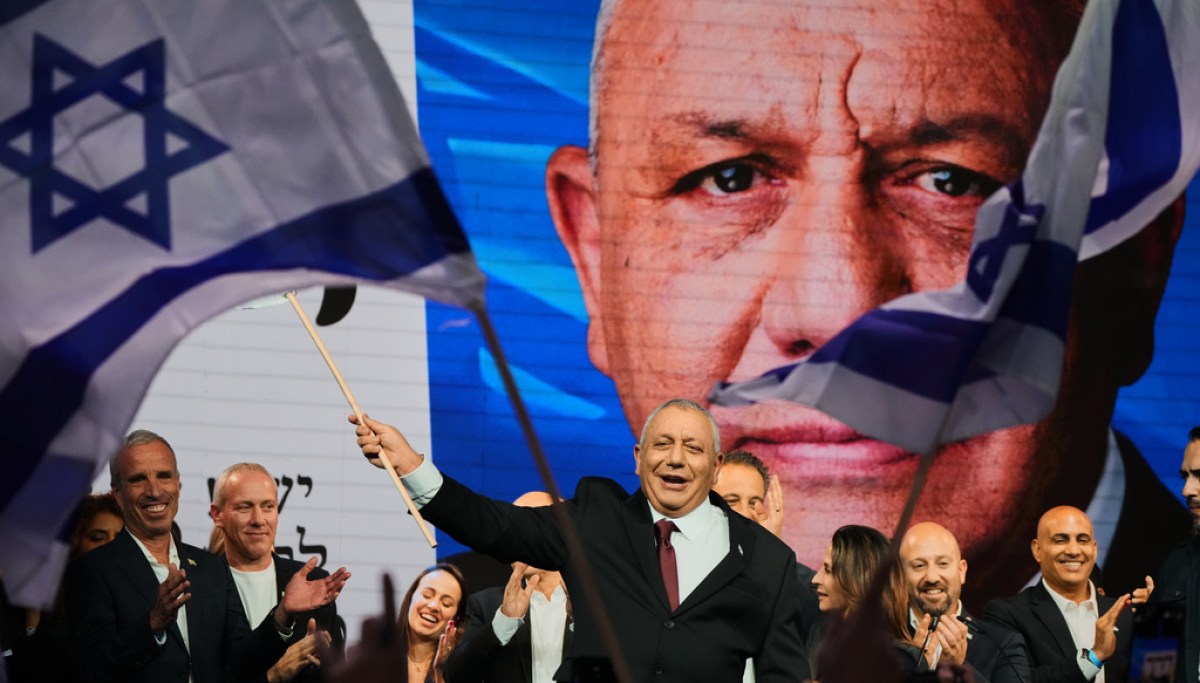
Benjamin Netanyahu’s far-right coalition has lost its mandate while the opposition has a clear majority: but only if the Jewish Israeli opposition bloc, led by retired general Gadi Eisenkot, is prepared to make a governing pact with Palestinian Israeli parties, which have secured a historic result. asserted
which → lose → result
But the country that is desperate for change remains bitterly divided. asserted
that → remain → change
After a campaign mired in racism, during which Israel’s far-right demonised the Palestinian population as the enemy within, Netanyahu has gone further since Tuesday’s vote, claiming that Palestinian-led parties have “stolen the election”, despite Israeli authorities insisting there is no evidence of election fraud. asserted
authorities → mire → fraud
As coalition talks commence, I spoke to our chief Middle East correspondent Emma Graham-Harrison in Tel Aviv, about false narratives and the stark choice facing the country. asserted
I → commence → country
John Healey has backed away from cutting the cost of welfare this parliament, amid dire warnings his first budget could lead to brutal spending cuts because of a £28bn shortfall in public finances. uncertain
budget → back → finances
The acclaimed British stage and screen actor renowned for both Shakespeare and sci-fi, died at his home in Los Angeles after “a brief and poignant journey with Alzheimer’s disease and Lewy body dementia”, his longtime spokesperson said. asserted
spokesperson → renowne → disease
One of the most ambitious nature recovery projects ever undertaken in England can go ahead after campaigners announced they had raised £30m to buy an estate in Northumberland. asserted
they → undertake → Northumberland
- Europe | Spain began three days of mourning on Thursday for at least 69 people who died in a high-speed rail collision, as hospitals continued to treat dozens of injured passengers and train drivers went on strike to urge more investment in railway safety. asserted
drivers → begin → safety
The Trump administration has opened a criminal investigation in California over claims that thousands of noncitizens are registered to vote in the state, and has begun subpoenaing election officials. uncertain
thousands → open → officials
In depth: There is no evidence of election fraud With the final results released early on Friday local time, Netanyahu’s bloc won 53 seats, compared with 48 for the grouping led by rival Eisenkot. asserted
bloc → be → Eisenkot
Palestinian parties won 19 seats, a record high. asserted
parties → win → seats
No single party has ever claimed a majority of 61 seats, so Israel has always been governed by coalitions. asserted
Israel → claim → coalitions
With neither bloc reaching the 61 seats needed for a majority in the Knesset, Israeli president Isaac Herzog is expected to invite the party most likely to be able to form a government to start coalition negotiations, and has already urged politicians to have an “open mind” before talks begin. asserted
talks → reach → mind
The country potentially faces weeks of rancour and uncertainty. asserted
country → face → rancour
Yair Golan, the leader of the centre-left Democrats, a junior partner in the Jewish Israeli opposition bloc, told Israeli media on Thursday that he was meeting Eisenkot and others for initial talks. asserted
he → tell → talks
If the opposition can’t agree some kind of coalition, or even secure Palestinian support for a minority government, Netanyahu may have a lifeline. uncertain
Netanyahu → agree → lifeline
He is already pushing for a right-wing governing coalition, and would probably welcome new elections or a lengthy period of uncertainty during which he will stay on as caretaker prime minister. asserted
he → push → minister
That didn’t mean a shift to the left: young Israelis are more rightwing than older generations, as Emma wrote about here. asserted
Emma → mean → generations
The national conversation ahead of the election was dominated by security at home and abroad. asserted
conversation → dominate → home
Although he was in charge on 7 October 2023, when Hamas attacks resulted in the deaths of about 1,200 people, the majority of them civilians, the prime minister tried to shift blame on to the security services. asserted
minister → result → services
His opponents pledged a state commission of inquiry into the events of 7 October, and spoke to voters’ concerns about the social toll of three years of multi-front wars, and anger about the draft exemption for ultra-orthodox young men when other Israelis are spending hundreds of days on reserve duty. asserted
Israelis → pledge → duty
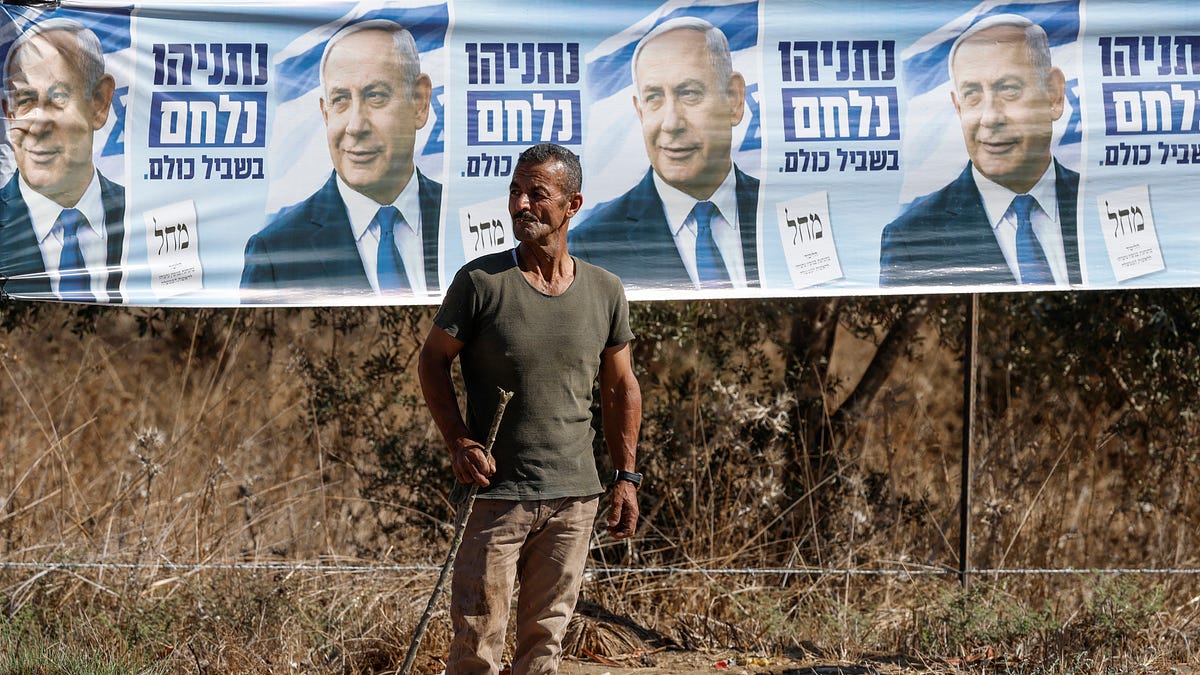
Netanyahu’s false narrative Throughout the campaign, Netanyahu and his far-right allies have framed Palestinian voters – who make up about 20% of the population – as a direct threat to the state, with Netanyahu repeating the slogan “the right or Palestine”, which rhymes in Hebrew. asserted
which → frame → Hebrew
“It’s both tragic and depressing,” Emma tells me, “attempting to paint Palestinians as untrustworthy citizens with dual loyalties, a racist trope that also appears in antisemitic attacks.” asserted
that → ’ → attacks
This tactic extended to election day, when voters received a robocall purporting to come from the prime minister falsely claiming that Palestinian party leaders had been caught with envelopes full of cash. asserted
leaders → extend → cash
Netanyahu and his allies repeatedly made claims about high turnout in Palestinian areas, in a bid to get his own voters out. uncertain
Netanyahu → make → voters
Then on Wednesday night, Netanyahu reacted to the high Palestinian turnout and success of Arab Israeli parties by claiming, again without providing evidence, they had “stolen the election,” calling for the central elections committee and Shin Bet internal security agency to investigate foreign interference in the vote. asserted
committee → react → vote
These claims were amplified by far-right Israeli finance minister, Bezalel Smotrich, who called for the arrest of Arab Israeli leaders. uncertain
who → amplify → leaders
He was swiftly accused of using smear tactics to cling to power. asserted
He → accuse → power
Eisenkot warned that Likud and Netanyahu “have embarked on a coordinated, organised campaign seeking to delegitimise the results of the election”. asserted
Likud → warn → election
President Herzog stepped in with a rebuke to the prime minister and said “we must avoid tarnishing an entire community”. asserted
we → step → community
Meanwhile, Qatar’s foreign ministry spokesperson rejected “ridiculous and dangerous” accusations his country had interfered in Tuesday’s election. asserted
country → reject → election
It bears repeating: Israeli police and the central elections committee have said there is no evidence of election fraud. asserted
police → bear → fraud
The Palestinian-led parties who could be kingmakers There was a surge in support for Arab parties after Palestinian citizens came out in historic numbers to vote. Many had boycotted previous elections “on the grounds that participating endorses a discriminatory system or because they felt their representatives had little leverage”, Emma explains. uncertain
Emma → lead → leverage
But this year, the mood changed: “They’re watching ethnic cleansing in the West Bank, a genocidal war in Gaza, and are under huge pressure inside Israel from an openly racist government, which has allowed organised crime to soar, ramped up home demolitions, and targeted political speech. asserted
crime → change → speech
They felt that, if Netanyahu managed to get another mandate with his far right allies including [extremist security minister] Ben-Gvir, this would only accelerate.” asserted
this → feel → Gvir
The Joint List – which represents a number of mainly leftist Israeli Arab-led parties – is led by Yousef Jabareen. asserted
which → represent → Jabareen
He has previously said the Joint List could not join an Eisenkot-led government because of its support for Israel’s military operation in Gaza and southern Lebanon, but has left open the possibility of bolstering a minority government through confidence votes. uncertain
List → say → votes
The other main Palestinian party, Ra’am, is led by Mansour Abbas, and includes a Jewish former chief of police as number two on their slate, a signal of their commitment to working with Jewish Israelis but also their desire to tackle organised crime, which is a big issue for the Palestinian population. asserted
which → lead → population
…and 39 more, not listed.

💬Give feedback
🕘History 🎫Support