‘Illegitimate’ for courts to declare a right to bike lanes

National Post · collected 2026-08-19 · by Jesse Kline
Read the original at National Post ↗

Summary

A lawyer argues that the Ontario Court of Appeal's decision to reject a Charter right to bike lanes is a victory for common sense and judicial restraint, as policy decisions belong with elected officials rather than judges. According to Ben Woodfinden, Section 7 of the Charter has been interpreted more broadly over time since its drafting four decades ago. The court overturned a lower court decision that had blocked the removal of downtown Toronto bike lanes. This case is now seen as a bigger conversation about public policy and the role of the courts in making decisions.
Written by the local model on 2026-08-19, using this article's own text rather than the other coverage of the same event (that is the story summary below).

Signals How these are calculated →

Claims extracted
4
claim-shaped sentences
Uncertain
0%
0 of 4 hedged
Leaning
not scored
needs a local LLM pass
Publisher trust
95.9
red-flag proxy, not a credibility rating
Outlets on this story
4
Politics
Narrative spread
1
articles carrying this framing
Analyzed 2026-08-19 · how these are computed

AI analysis (generated at analysis time, not now)

Story summary

The Ontario government, led by Premier Doug Ford, has been given permission to remove bike lanes in Toronto after a higher court overturned a lower court's decision that said removal would be unconstitutional. The initial ruling was made in July 2025 by Superior Court Judge Paul Schabas, who determined that removing the bike lanes would put cyclists at a "grossly disproportionate" risk of injury and death, violating their right to life under Canada's Charter of Rights and Freedoms. However, on Friday, the Ontario Court of Appeal reversed this decision, ruling that there is no constitutional right to bike lanes. This means that the city's bike lanes covering 19km** (12 miles) of road can now be removed. The controversy has sparked debate over the role of courts in making policy decisions and the interpretation of the Charter.

Written for “Ontario Bike Lane Lawsuit” on 2026-08-31, grounded in this article and the 3 other(s) covering the same event.
Why this leaning score
The article's own words the score was based on. Each is quoted verbatim and was checked against the article text before being stored, so you can find it in the original.
Score +0.85 Confidence high
Leaning score +0.85 for article 1198 (high confidence, 2 verified quotes) · logged 2026-08-24

Story

📰 Ontario Bike Lane Lawsuit
Politics · 4 article(s) covering the same event.

How this is being covered How these are calculated →

Article leaning vs. publisher reliability
Source leaning vs. consistency

Compared with similar articles

This article reads unscored and hedges 0% of its claims. Each row says how that neighbour differs.
National Post · 0.93 cosine similarity
⚖️ leaning not scored 🔴 2% hedged 1 of 49 📰 publisher trust 96
“Both articles report on the same decision by the Ontario Court of Appeal, dated August 19, which rejected the notion of a Charter right to bike lanes and overturned a lower court decision.”
National Post · 0.89 cosine similarity
⚖️ Leans strongly left 🔴 20% hedged 4 of 20 📰 publisher trust 96
“Both articles refer to the same court case (Cycle Toronto v. Ontario) and decision (the Ontario Court of Appeal overturning a lower court decision) regarding bike lanes in Toronto, with identical outcome dates.”
World news | The Guardian
⚖️ leaning not scored 🔴 8% hedged 2 of 25 📰 publisher trust 95
“Both articles report on the same court ruling (Ontario Court of Appeal decision) made on Friday, which overturned a lower court's decision regarding Toronto's bike lanes.”
www.thestar.com - RSS Results of type article
⚖️ leaning not scored 🔴 6% hedged 3 of 53 📰 publisher trust 97
“Article A discusses a court decision from last week, while Article B appears to be responding to it with an opinion piece about removing bike lanes”

Publisher

National Post · 80 article(s) · 0 correction(s) detected
SignalValueWeight
Correction rate 0.000 0.4
Uncertainty density 0.082 0.25
Assertive mismatch rate 0.000 0.35
No corrections detected for this publisher. That may mean careful reporting, or simply that nothing has been checked.

Who wrote this

Jesse Kline
6 article(s) here · 0 carrying a prediction
🔮 One will find talk of his “very good relationship with Kim Jong Un, of North Korea,” alongside ad hominem attacks against Ford (“the less charismatic, intelligent, and overall unimpressive brother of the late, great, Rob Ford”); photos of him and Kim putting on their best dictator faces with maps showing Lake Ontario renamed “Lake America.”
🔮 Thus Ottawa is spending $11 billion to build six icebreakers to replace the Coast Guard’s aging fleet, the first of which is expected to go into service in 2032, with the remaining vessels delivered by 2038.
🔮 During his now infamous antisemitism speech in June at Holy Blossom Temple in Toronto, Prime Minister Mark Carney announced a new ministerial advisory council that would “reassess” and “measure” antisemitism from “four different directions.”
🔮 It’s all because of the war — it could resume at any moment.” While more than 800,000 displaced Lebanese people have returned to their homes in the south since the June ceasefire, my driver and his family remain among the hundreds of thousands still internally displaced.
🔮 At first blush, splitting an existing vaccine into three doses may not seem like a big deal.
Also by Jesse Kline
Nothing else under this byline is closely related to this article, so these are simply their most recent.
All 6 articles by Jesse Kline →

Topics

Charter National Post Ontario Ontario Court of Appeal Toronto

Subjects

Toronto GPE · 2× Woodfinden PERSON · 2× Ben Woodfinden PERSON · 1× National Post ORG · 1× Ontario GPE · 1× Ontario Court of Appeal ORG · 1× Rob Breakenridge PERSON · 1×

Narrative

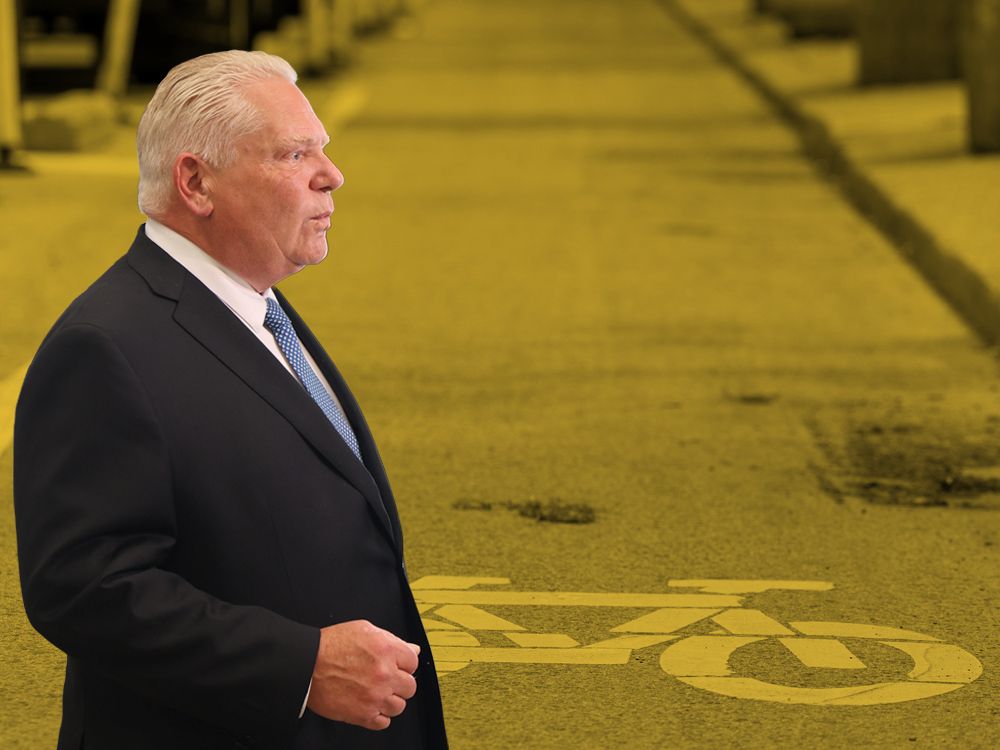
In this interview, National Post contributor Ben Woodfinden joins Rob Breakenridge to discuss last week’s Ontario Court of Appeal decision that rejected the notion of a Charter right to bike lanes and overturned a lower court decision that blocked the Ontario government from removing a number of downtown Toronto bike lanes.
framing: assertive · carried by 1 article(s) · first seen 2026-08-19
2026-08-19 · National Post
‘Illegitimate’ for courts to declare a right to bike lanes · assertive framing

Claims (4 extracted, 0 hedged)

A legal battle over Toronto’s bike lanes has turned into a bigger conversation about public policy and the role of the courts. asserted
battle → turn → courts
In this interview, National Post contributor Ben Woodfinden joins Rob Breakenridge to discuss last week’s Ontario Court of Appeal decision that rejected the notion of a Charter right to bike lanes and overturned a lower court decision that blocked the Ontario government from removing a number of downtown Toronto bike lanes. asserted
that → join → lanes
Woodfinden argues that the decision is a victory for common sense and judicial restraint, helping to remind us all that policy decisions belong to elected officials, not judges. asserted
decisions → argue → officials
He also discusses what this means for the Charter section at the centre of this case: Section 7, which Woodfinden argues has seen a dramatically expanded interpretation since it was drafted over four decades ago. asserted
it → discuss → interpretation
💬 Give feedback
🕘 History 🎫 Support