Photo via TIME

War Is Hell—And The Mosquito Bowl Won’t Let Us Forget It

Read the original at TIME ↗
Cite

Zacharek, S. (2026, October 31). War Is Hell—And The Mosquito Bowl Won’t Let Us Forget It. TIME. https://time.com/article/2026/10/31/the-mosquito-bowl-review/

Dated from the outlet's own feed. Check the original for its byline.

TIME · collected 2026-10-31 · by Stephanie Zacharek

Quick Summary

Director Peter Berg’s film "The Mosquito Bowl" retells a true story from World War II about young football players who became Marines and fought in the Pacific. The movie focuses on four real-life figures: Dave Schreiner, Bob Bauman, Tony Butkovich, and John McLaughry, all of whom were drafted into military service after their college careers. The film highlights a legendary football game played between two Marine regiments at Guadalcanal on Christmas Eve, 1944. Of the 65 men who participated in this game, 15 died during the Battle of Okinawa shortly afterward. Berg’s movie explores how these young athletes’ initial belief that war could be won with strategy and athleticism was shattered by the harsh realities they faced.
Written by AI on 2026-10-31, from this article's own text only (the story summary below draws on all the coverage).

AI analysis

Story summary

The film "The Mosquito Bowl", directed by Peter Berg, retells a true story from World War II about young football players who went to fight in the Pacific. It focuses on four real-life figures: Dave Schreiner and Bob Bauman of the University of Wisconsin; Tony Butkovich of Purdue; and John McLaughry from Brown University. These men believed they could win the war with strategy and athleticism, but were quickly disabused of that notion upon entering combat. The film's title refers to a legendary football game between two Marine regiments at Guadalcanal on Christmas Eve in 1944. A few months later, three out of the four main characters died during the Battle of Okinawa. Of the 65 men who played in the Mosquito Bowl, 15 were killed on Okinawa. The film highlights the stark contrast between their youthful optimism and the harsh realities of war.

Written for “Mosquito Bowl Reminder Of War Horrors” on 2026-11-01, grounded in this article and the 0 other(s) covering the same event.

Story

📰 Mosquito Bowl Reminder Of War Horrors
Entertainment · 1 article(s) covering the same event.

Compared with similar articles

This article reads unscored and hedges 9% of its claims. Each row says how that neighbour differs.
TIME
Hedges 17 of 225 claims Outlet record 59/100
“Article A describes the actual football game played on Guadalcanal during World War II, while Article B discusses a film that retells this true story.”
How this article was measured signals, leaning charts, publisher record, byline, topics and claims

Signals How these are calculated →

Claims extracted
34
sentences that state something as happening or true
Uncertain
9%
3 of 34 hedged ("reportedly", "may", "according to")
Leaning
not political
takes no side on a contested political question
Publisher signals
59/100
TIME's corrections and hedging, across everything collected from it. Not a measure of accuracy.
Outlets on this story
1
Entertainment
Same framing elsewhere
1
articles that frame the event the way this one does
Analyzed 2026-10-31 · how these are computed

How this is being covered How these are calculated →

Article leaning vs. publisher reliability
Source leaning vs. consistency

Publisher

TIME · 783 article(s) · 2 correction(s) detected
Running correction rate · 2 correction(s)

Who wrote this

Stephanie Zacharek
14 article(s) here · 1 carrying a prediction
🔮 As Berg presents it, all four of these men went off believing they could win the war the same way you win a football game, with strategy and athleticism, only to learn how far off the mark they were.
🔮 In 1972, filmmaker William Greaves arranged what we now know was one of the great parties of the 20th century: He commandeered the Harlem apartment of Duke Ellington and arranged for a special group of old friends and colleagues, many of whom had not seen one another in 50 years, to reconnect.
🔮 When news got around that a new movie version of Sense and Sensibility was in the works, cries of dismay rang forth from Bath to Brooklyn.
🔮 Warning: This post contains spoilers for You Can See Everything We might like to believe that documentary filmmakers are adamantly neutral parties, aiming their cameras at people who are just being themselves and, later, turning whatever the camera captures into objective truth.
🔮 But she’s also prickly and unpleasant—she has alienated most of the people who might be able to help her—and a self-destructive streak hinders her further: She’d rather go out for a night of clubbing and coke than stay in and learn her lines for the next day’s important audition.
🔮 Somehow, the runtime slips by faster than you might have expected.
🔮 A fling might be just what she needs.
🔮 Then his wife dies suddenly, making him a single dad with three kids to care for, teenager Fatiha (Adia), her younger brother Qadir (Jahleel Kamara), and an infant, Aziza, who can’t tolerate baby formula; only her mother’s breast milk will do, and supplies are quickly running out.
🔮 In one episode, Wilson walked around a New York neighborhood until he saw an Italian flag, figuring that the person who’d hung it would know enough about Italian food to help him learn to cook risotto, which he wanted to make as a treat for his elderly, babushka’ed landlady.
🔮 If Zach Cregger’s career tells us anything, it’s that starting out as a comedian might be the best training for becoming a horror filmmaker.
Also by Stephanie Zacharek
Nothing else under this byline is closely related to this article, so these are simply their most recent.
All 14 articles by Stephanie Zacharek →

Topics

Okinawa Purdue The Mosquito Bowl World War II the University of Wisconsin

Subjects

Berg PERSON · 4× Bauman PERSON · 2× Okinawa GPE · 2× Purdue ORG · 2× Bill Skarsgård PERSON · 1× Dave Schreiner PERSON · 1× Peter Berg PERSON · 1× Tom Francis PERSON · 1× Tony Butkovich PERSON · 1× the University of Wisconsin ORG · 1×

Narrative

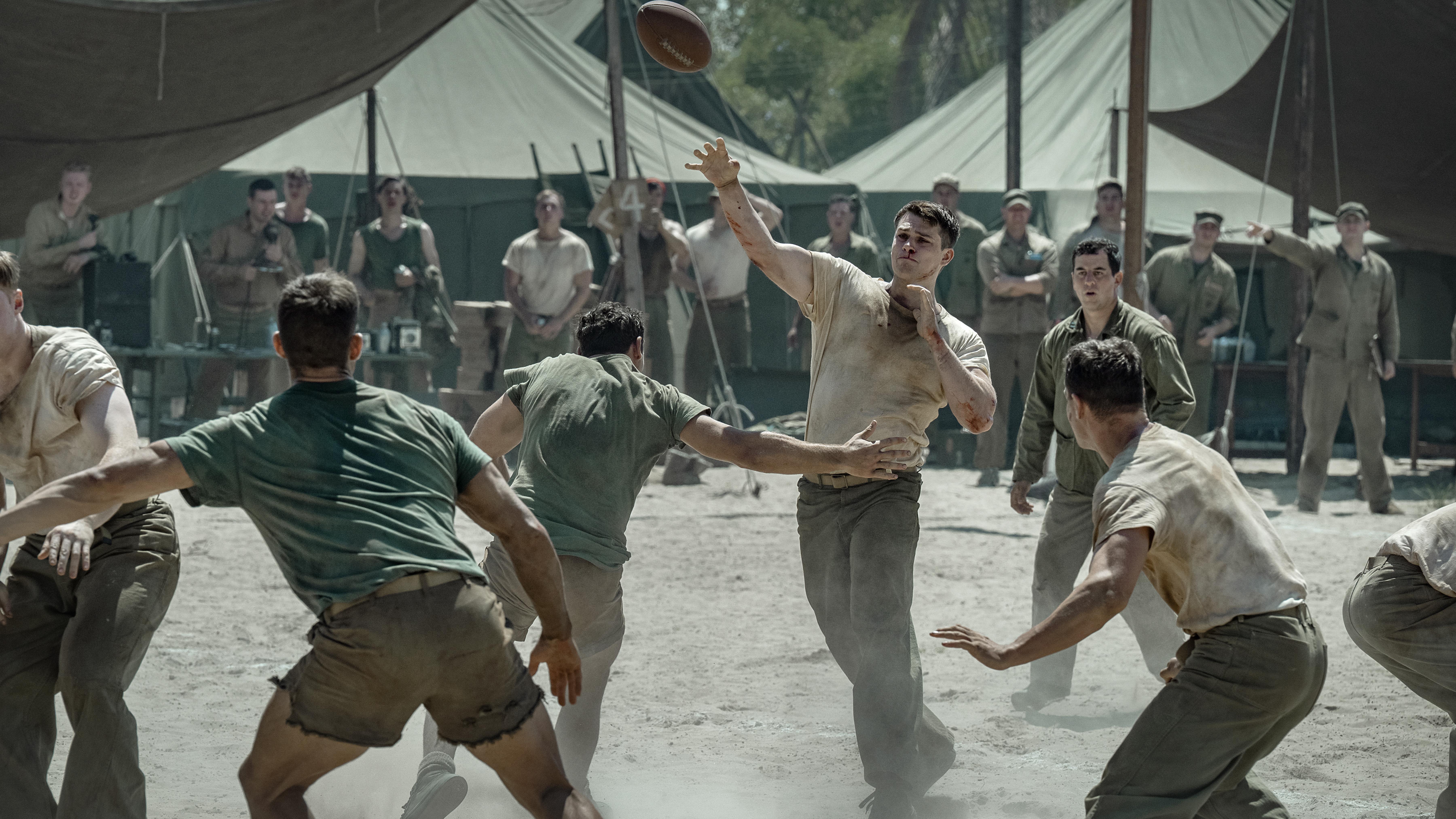
This is director Peter Berg’s retelling of a true story involving young football stars who went off to fight in the Pacific during World War II, focusing on four real-life figures: Dave Schreiner and Bob Bauman (played by Tom Francis and Bill Skarsgård) were teammates and close friends playing for the University of Wisconsin; Tony Butkovich (Ray Nicholson, son of Jack) was a fullback for Purdue; and John McLaughry (Nicholas Galitzine) had graduated from Brown University and been drafted into the NFL by the time the war had started.
framing: assertive · carried by 1 article(s) · first seen 2026-10-31
🔮 As Berg presents it, all four of these men went off believing they could win the war the same way you win a football game, with strategy and athleticism, only to learn how far off the mark they were.
2026-10-31 · TIME
War Is Hell—And The Mosquito Bowl Won’t Let Us Forget It · assertive framing

Claims (34 extracted, 3 hedged)

When you’re a kid, young men going off to war look like men. asserted
men → ’re → men
When you’re a grown-up, you see that they’re really just boys. asserted
they → ’re → ?
If The Mosquito Bowl gets close to any essential truth, it’s that one. asserted
it → get → truth
This is director Peter Berg’s retelling of a true story involving young football stars who went off to fight in the Pacific during World War II, focusing on four real-life figures: Dave Schreiner and Bob Bauman (played by Tom Francis and Bill Skarsgård) were teammates and close friends playing for the University of Wisconsin; Tony Butkovich (Ray Nicholson, son of Jack) was a fullback for Purdue; and John McLaughry (Nicholas Galitzine) had graduated from Brown University and been drafted into the NFL by the time the war had started. asserted
war → involve → time
As Berg presents it, all four of these men went off believing they could win the war the same way you win a football game, with strategy and athleticism, only to learn how far off the mark they were. uncertain
they → present → mark
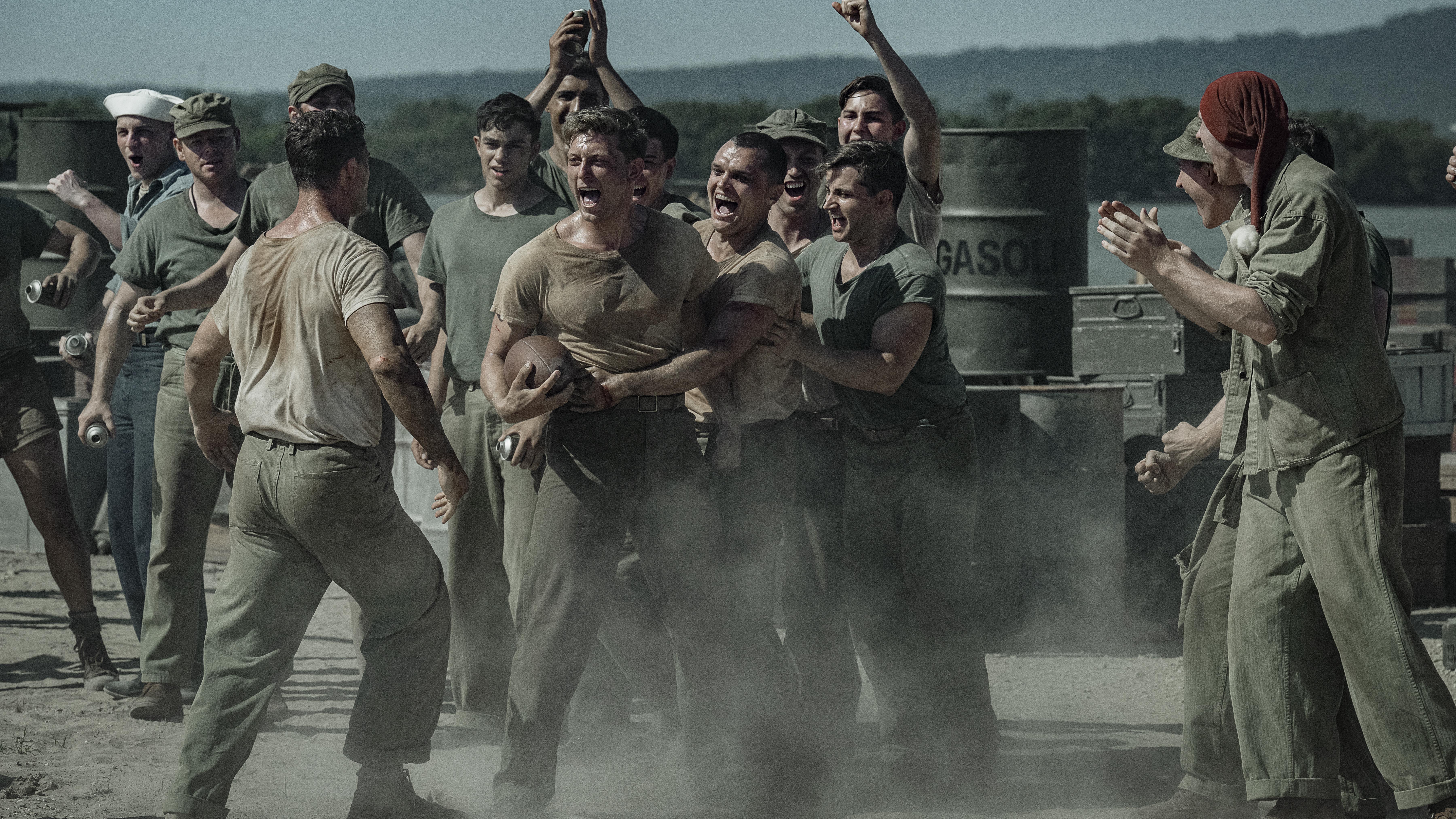
The film’s title refers to a legendary football game between two Marine regiments at Guadalcanal, on Christmas Eve, 1944. asserted
title → refer → Eve
A few months later, three of the four would be dead in Okinawa: Of the 65 men who played in the Mosquito Bowl, 15 were killed on the island. asserted
15 → play → island
There’s a lot of drama inherent in that premise, and Berg—director of films like Hancock, The Kingdom, and Friday Night Lights, progenitor of the hit TV series—takes perhaps too much time drawing it out. asserted
Berg → ’ → it
He introduces the main characters with moderate efficiency: Schreiner is a solid, rather quiet guy who’s given to overthinking everything; as the film opens, his team has just lost to Purdue, and he’s still simmering with resentment toward Butkovich, who appears to be something of a hothead. asserted
who → introduce → hothead
Bauman is the solid Wisconsin country lad, giving his younger brother instructions on holding the family homestead together. asserted
Bauman → give → homestead
And McLaughry is intelligent and grounded, if somewhat undersketched, though he does anchor the movie’s opening scene, which gives us some sense of what these young men left behind when they went to war, things they could never get back. uncertain
they → ground → things
After some characteristically dehumanizing basic training, the men are hauled off to Tarawa. asserted
men → haul → Tarawa
(In real life, the four weren’t in the same regiment, though it’s a forgivable dramatic tweak.) asserted
it → ’ → regiment
This occasions the movie’s first protracted battle sequence, in which these newly minted Marines get a swift education in what war is about. asserted
war → occasion → what
Legs are blown off. asserted
Legs → blow → ?
Pinwheeling men, having been set ablaze with flamethrowers, scream in agony. asserted
men → set → agony
Blood burbles through gaping wounds. asserted
Blood → burble → wounds
After we, and they, have made it through this ordeal, there’s a great deal of talking among the men about the grim circumstances they’ve found themselves in. asserted
they → make → themselves
Then there’s some football—the actual Mosquito Bowl—where they get to have some fun. asserted
they → ’ → fun
It also feels like the shortest. asserted
It → feel → shortest
Because the deadly battle at Okinawa is yet to come, and Berg will spare us no bloody detail. asserted
Berg → come → detail
(The script was adapted from the 2022 book of the same name by Buzz Bissinger, who also wrote the book that the 2004 film Friday Night Lights was based on.) asserted
film → adapt → that
More limbs are blasted off, more bullets end lives instantly or with agonizing slowness, more bayonets pierce tender flesh. asserted
bayonets → blast → flesh
War is hell, and Berg doesn’t want us to forget it. asserted
us → want → it
In my early film-reviewing days, even before the existence of comments sections, I would sometimes get emails from veterans telling me what I had gotten wrong in writing about this or that war film. asserted
I → get → this
Most of those letters had a “Listen here, little lady” tone, but I didn’t mind them. asserted
I → have → them
The experience of watching a war movie is hardly the same as being in combat; it’s not supposed to be. asserted
it → watch → combat
Still, these guys had been to places I hadn’t. asserted
I → have → places
Even if they clearly didn’t understand my job, I’d have to admit to knowing next to nothing about theirs. asserted
I → understand → theirs
But from watching lots of war films—from the time I was a kid, when my World War II veteran dad would bring me along to see movies like the 1976 Midway, because no one else would go with him—I do know that when it comes to depicting the brutality of war, less is more. asserted
less → watch → war
You can dramatize, or allude to, some truly horrific stuff—but choose your details wisely. asserted
You → dramatize → details
One well-placed depiction of a combat atrocity can be enough to haunt a viewer forever. asserted
depiction → place → viewer
With The Mosquito Bowl, Berg throws so much violence at us that it comes to feel like padding, while the depiction of the Mosquito Bowl itself, the core of the movie, is pure joy. asserted
depiction → throw → movie
War doesn’t make a boy a man so much as it knocks the boyhood out of him, fast—which may be why it’s both freeing and poignant to watch these young men escaping, if only briefly, into versions of themselves that no longer exist. uncertain
that → make → themselves

💬Give feedback
🕘History 🎫Support