Warning: This post contains spoilers for You Can See Everything
We might like to believe that documentary filmmakers are adamantly neutral parties, aiming their cameras at people who are just being themselves and, later, turning whatever the camera captures into objective truth.
uncertain
camera → contain → truth
But because documentaries are, for now, made by humans and not robots, pure objectivity is impossible.
asserted
objectivity → make → humans
When Albert and David Maysles captured Little Edie Bouvier Beale’s exuberant flag-twirling dance in Grey Gardens, they weren’t just casually showing us some random American eccentric in an outlandish headscarf; they were both in awe of her and, at least somewhat, laughing at her.
asserted
they → capture → her
The sequence is funny, jaw-dropping, a little sad.
asserted
sequence → drop → ?
It may not tell us what to think, but its job is to lead us there.
uncertain
job → tell → us
Since its surprise debut at the Telluride Film Festival earlier this fall, You Can See Everything, directed by Nathan Fielder and Lance Oppenheim, has been widely praised as a groundbreaking documentary work, one that will change the face of nonfiction filmmaking forever.
asserted
that → see → filmmaking
The first half of Fielder and Oppenheim’s film chronicles the 34 days leading up to the incarceration of Elizabeth Holmes, founder of the blood-testing technology company Theranos.
asserted
half → chronicle → company
Holmes was convicted of fraud in 2018 and sentenced to just over 11 years in federal prison, commencing in May 2023.
uncertain
Holmes → convict → May
To make this documentary, Fielder, Oppenheim, and their crew camped out with Holmes, her partner Billy Evans, and their two small children, observing their lives up-close—or as up-close as possible.
asserted
Fielder → make → lives
The filmmakers had come at Evans’ urging: some time earlier, he and Holmes, who had completely withdrawn from the public eye, had approached A24 to see if the studio might be interested in making a documentary about them.
uncertain
studio → come → them
In a roundabout fashion, Fielder and Oppenheim became the filmmakers charged with the task.
asserted
Fielder → become → task
Early in the film, we hear Evans explaining that he wanted the world to get an accurate picture of the woman he knew, a devoted partner and mother, whom he felt had been unfairly villainized.
asserted
he → hear → woman
The film’s title comes from Holmes’ spoken promise to Fielder: She vowed to keep nothing hidden from the filmmakers—but did she fulfill that promise?
asserted
she → come → promise
Throughout You Can See Everything, Fielder is often on-screen, with Oppenheim working behind the scenes.
asserted
Oppenheim → see → scenes
Over and over again, Holmes assures Fielder she has nothing to hide, and over and over again, his probing—if insistently performative—questions catch her in slippery half-truths.
asserted
questions → assure → truths
Her transparency, to paraphrase the words of Courtney Love, is so real it’s beyond fake.
asserted
it → paraphrase → Love
When Fielder isn’t asking the questions, he’s lurking behind the scenes, listening in on Evans and Holmes’ conversations with a headset; when he hears something he can’t believe, his eyes widen dramatically, or his brow furrows, or his jaw hangs as slack as that of a puppet.
asserted
jaw → ask → puppet
The audience I saw the movie with giggled every time.
asserted
I → see → movie
If this is the future of documentary filmmaking—or at least that of its loopier cousin, creative-nonfiction filmmaking—many of us will come to miss the late Frederick Wiseman even more than we already do.
asserted
we → come → Wiseman
Holmes and her let-it-all-hang-out evasiveness isn’t the problem here.
asserted
it → let → ?
If anything, her whirligig insistence on her inability to lie, or even inadvertently deceive, is at least a kind of self-invented honesty.
asserted
insistence → lie → honesty
She spins out phrases like “All I know is my truth,” before speaking tearfully about her fear of being separated from her family.
asserted
I → spin → family
As the camera rolls, Holmes works overtime to convince the filmmakers, and us, of her innocence, with Evans butting in frequently to add his 3,268 cents—2 would never be enough.
asserted
cents—2 → roll → innocence
(He keeps insisting that the couple have plans to start a new company, though he seems to have more invested in this scheme than his partner does.)
asserted
partner → insist → scheme
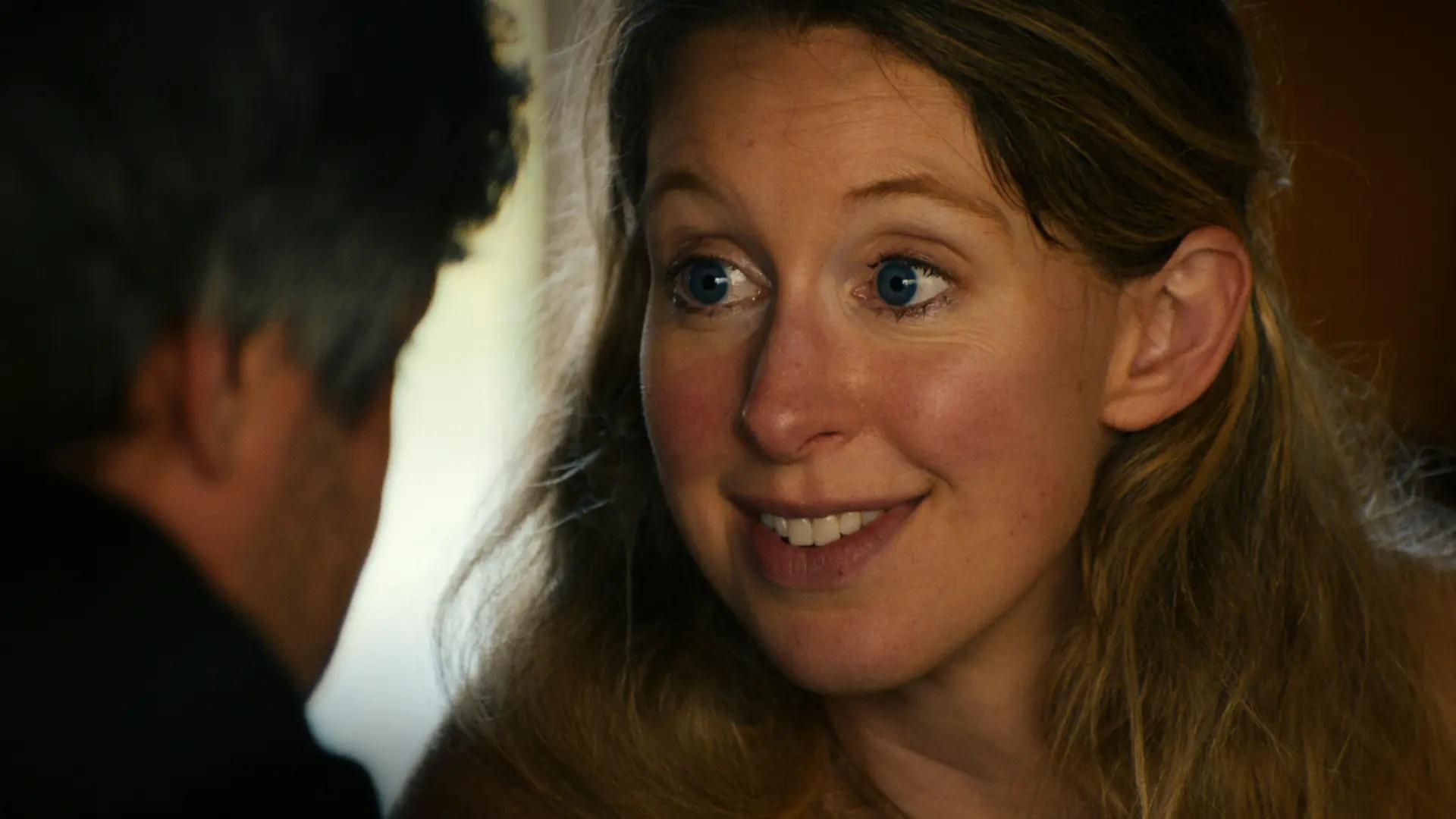
Holmes is one of those smile-talkers—people who grin as words pour out of their mouths.
asserted
words → grin → mouths
One of her tricks is to never break eye contact, and we can see her working this voodoo on Fielder.
asserted
her → break → Fielder
I’ve never seen eyes like this, except on creepy European-made porcelain dolls from the 19th century.
asserted
I → see → century
Are we seriously going to trust this woman?
asserted
we → go → woman
We’re not, and Fielder doesn’t seem to be headed in that direction either, at least at first.
asserted
Fielder → seem → direction
This is a dense picture—there’s almost too much to unpack, if you can be bothered to care about any of it.
asserted
you → ’ → it
But by design, Fielder is as much a player in You Can See Everything as Holmes is, and your feelings about the film overall will depend on how much of him you can take.
asserted
you → see → him
Fielder has made a name for himself with the shows Nathan for You and The Rehearsal, in which he essentially makes himself look foolish, a little, and makes others look foolish, a lot.
asserted
others → make → which
Oppenheim, his friend and filmmaking partner, is the director behind the recent nonfiction feature Primetime, as well as docs like the 2020 Some Kind of Heaven, which turns a sarcastic eye on the Florida retirement community known as The Villages—the ultimate in shooting-fish-in-a-barrel filmmaking.
asserted
which → turn → filmmaking
It’s hard to say who’s more responsible for You Can See Everything’s stultifying smirkiness, at least in the first half; these two are clearly of like mind.
asserted
two → ’ → mind
But there’s a major shift in the film's second half, one that suddenly, and blessedly, makes it at least watchable.
asserted
it → ’ → half
(If you don’t want to know anything about this twist, stop reading here.)
asserted
you → want → twist
The film's second section picks up two years after Holmes has gone off to prison, which means Fielder and Oppenheim have been deprived of their subject.
asserted
Fielder → pick → subject
What little access they might have had is severely curtailed by Evans, who now seems less like a caring husband and more like an evil puppetmaster, eager to use his wife’s words and likeness for his own gain.
uncertain
who → curtail → gain
(His increasing aura of evil is unnerving, especially when you consider that he’s almost fully in charge of raising the couple’s two young children.)
asserted
he → increase → children
Fielder and Oppenheim are at a loss—until it occurs to them to enlist the help of Amanda Seyfried, who played Holmes in the 2022 miniseries The Dropout, both to stand in for the disgraced entrepreneur and to weigh in on her plight.
asserted
who → occur → plight
…and 14 more, not listed.
 The Aporia