As children watching dinosaur movies, we all became fascinated by the huge and mysterious creature.
asserted
we → watch → creature
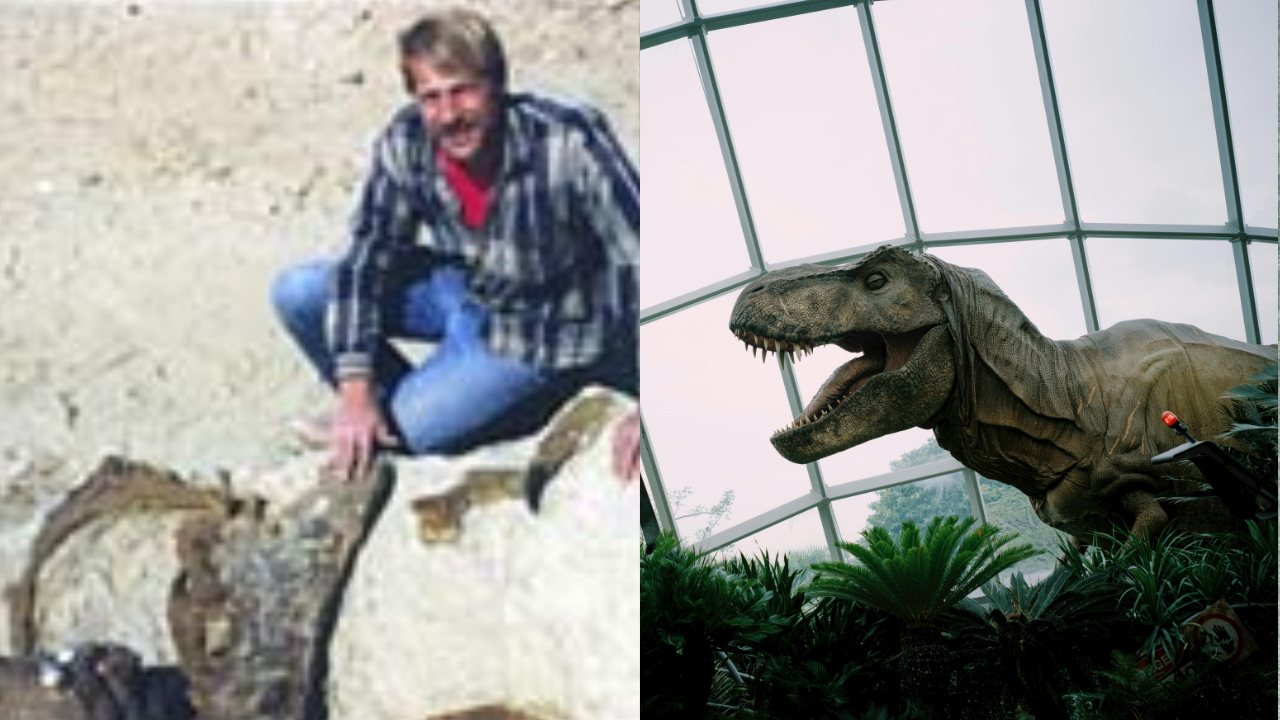
This fascination led the young and amateur fossil hunter Stan Sacrison to uncover one of the most well-preserved specimens of T.Rex ever found.
asserted
fascination → lead → T.Rex
That is more or less what happened to Stan Sacrison in 1987, when he came across bones that would eventually be identified as belonging to a Tyrannosaurus rex, a dinosaur that lived around 67 million years ago.
asserted
that → happen → rex
The skeleton was later named Stan after its discoverer and went on to become one of the most famous T. rex specimens in the world, selling for $31.8 million at an auction in 2020 before finding a new home at the Natural History Museum Abu Dhabi.
asserted
skeleton → name → Museum
How was the T. rex skeleton discovered?
asserted
skeleton → discover → ?
The discovery took place in South Dakota's Hell Creek Formation, a geological area known for its rich deposits of fossils from the Late Cretaceous period.
asserted
discovery → take → period
Sacrison was looking for fossils when he spotted dinosaur bones weathering out of the ground, including what appeared to be part of a dinosaur's hip.
asserted
what → look → hip
However, the remains were initially misidentified as belonging to a Triceratops, and it was not until 1992, when experts from the Black Hills Institute of Geological Research returned to examine the site, that the bones were correctly identified as those of a T. rex.
asserted
bones → misidentifie → rex
What followed was a painstaking excavation, with each bone carefully removed from the surrounding rock, cleaned, preserved and recorded before the skeleton could be assembled.
uncertain
skeleton → follow → rock
The process involved more than 30,000 hours of manual work, eventually bringing together 188 original bones into a remarkably well-preserved specimen.
asserted
process → involve → specimen
Stan is about 11.7 metres long and is considered one of the more complete T. rex skeletons ever discovered, with its skull being particularly important to researchers studying the anatomy of the dinosaur.
asserted
skull → consider → dinosaur
Why did Stan sell for $31.8 million?
asserted
Stan → sell → million
For decades, Stan was kept at the Black Hills Institute in South Dakota, where researchers could study the fossil and visitors could see the enormous predator up close.
uncertain
visitors → keep → predator
Its skeleton was also replicated for display in museums around the world, making Stan a familiar sight to dinosaur enthusiasts even before the original specimen went up for sale.
asserted
specimen → replicate → sale
In October 2020, the original skeleton was auctioned by Christie's in New York and sold for $31.8 million, far exceeding its pre-sale estimate of $6 million to $8 million.
asserted
skeleton → auction → million
The identity of the buyer was not immediately revealed, and the sale raised concerns among palaeontologists, who worried that such an important fossil might disappear into a private collection and become inaccessible to researchers.
uncertain
fossil → reveal → researchers
The price was a record for a dinosaur fossil at the time, although another dinosaur skeleton, a T. rex named Gus, surpassed it in 2026 after selling for approximately $50.1 million.
asserted
skeleton → name → million
Where can visitors see Stan today?
asserted
visitors → see → Stan
The mystery surrounding Stan's new owner was partly resolved in March 2022, when Abu Dhabi announced that the skeleton would become a major attraction at its upcoming Natural History Museum.
asserted
skeleton → surround → Museum
The announcement also revealed that the fossil had been purchased for the museum, bringing an end to speculation about whether the specimen would remain available for public viewing and scientific study.
asserted
specimen → reveal → viewing
The Natural History Museum Abu Dhabi opened in November 2025, giving Stan a permanent home in the Saadiyat Cultural District.
asserted
Museum → open → District
Rather than simply placing the dinosaur in a traditional standing pose, the museum displays Stan in a dramatic scene involving another T. rex, with the two skeletons appearing to clash over a fallen Triceratops.
asserted
skeletons → place → Triceratops
The display draws attention to the fossil's own injuries and bite marks, including evidence of a T. rex bite on Stan's neck, offering visitors a glimpse of the violent encounters that may have taken place during the dinosaur's lifetime.
uncertain
that → draw → lifetime
From the moment Sacrison spotted those bones in South Dakota to its record-breaking auction and eventual arrival in Abu Dhabi, Stan has travelled a remarkable distance through both time and geography.
asserted
Stan → spot → time
The skeleton is a reminder that fossils are not merely remnants of an ancient world; when carefully excavated and made accessible, they can help scientists understand how these animals lived, moved and survived millions of years before humans appeared.
asserted
humans → excavate → years
 The Aporia