Back in the day, watching Harry Potter, we all wanted the invisibility cloak.
asserted
we → watch → cloak
Maybe it sounded impossible then, but now researchers have developed a groundbreaking invisibility cloak that can actually hide complex objects from infrared cameras while protecting them from extreme heat and cold.
asserted
that → sound → heat
This breakthrough might lead to new ways to hide microchips from being detected through their thermal signatures and, at the same time, to cool and safeguard delicate electronics.
uncertain
breakthrough → lead → electronics
The research was conducted by University of Illinois Urbana-Champaign civil and environmental engineering professor Shelly Zhang, postdoctoral researcher Weichen Li, and graduate student Yibo Wang, in collaboration with Professor Ole Sigmund of the Technical University of Denmark.
asserted
research → conduct → Denmark
Their findings were published in
Nature Communications.
asserted
findings → publish → Communications
As Zhang said, "A real thermal cloak should work no matter where the heat comes from; our device can hide a complex 3D object in an infinite number of directions while keeping the temperature inside stable and protected."
asserted
device → say → temperature
Earlier, thermal cloaks were limited to two dimensions or worked only when heat travelled in a particular direction.
asserted
heat → limit → direction
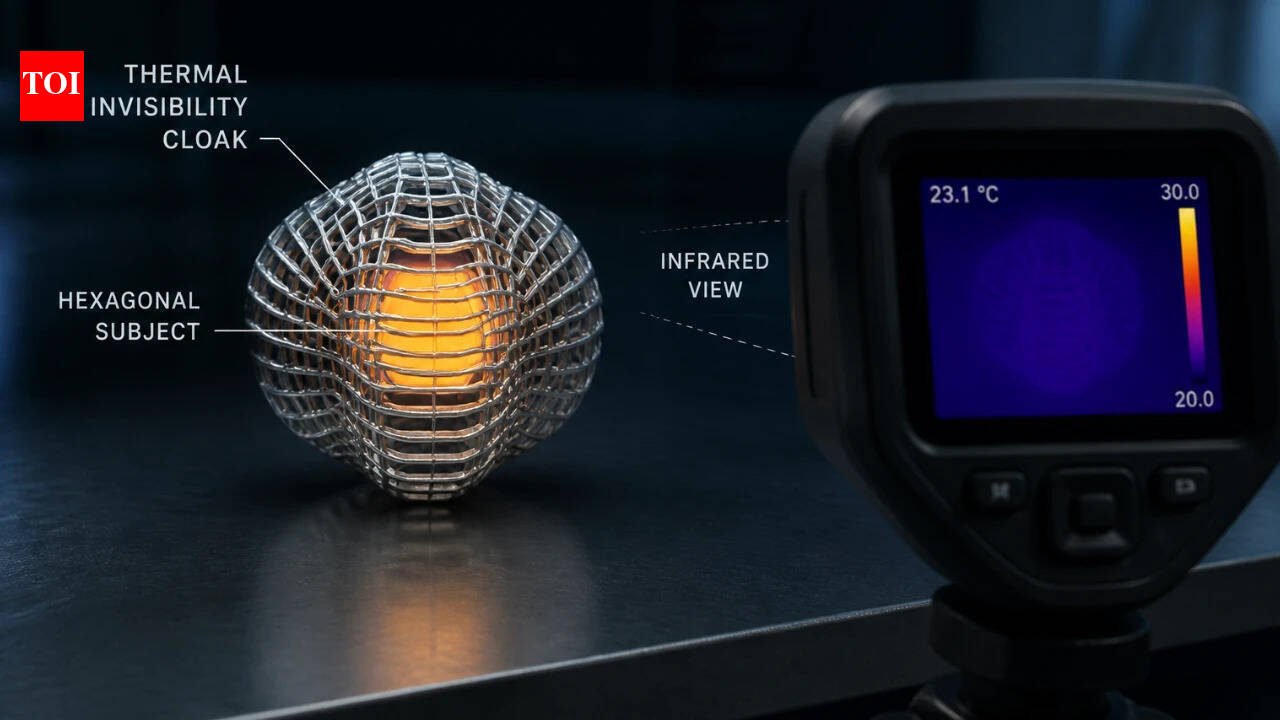
The new design, though, overcomes these issues by directing heat around a hidden object rather than simply blocking it.
asserted
design → overcome → it
As a result, infrared imaging shows a temperature pattern that makes the object appear to be absent.
asserted
object → show → pattern
The new material that made it possible
The meshy lettuce structure of the technology (credit- Shelly zhang/ Mission Lab)
For scientists, creating a thermal invisibility cloak that works in 3D has been a longstanding challenge.
asserted
that → make → 3D
Previous experimental devices could only redirect heat across flat surfaces, leaving them far short of the capabilities needed for a full 3D model.
uncertain
devices → redirect → model
To overcome these challenges, the researchers revisited the foundational principles of transformation thermotics, the study of how heat can be redirected through specially designed materials.
asserted
heat → overcome → materials
The central challenge was to develop a material whose thermal properties could be adjusted sufficiently to achieve the complex heat-flow patterns required for three-dimensional cloaking.
uncertain
properties → develop → cloaking
The solution was a specially engineered lattice-based material in which the structure could be independently adjusted along three directions, giving the researchers a much broader range of thermal conductivities than previously engineered models.
uncertain
structure → engineer → models
The team turned this theoretical design into reality using metal 3D printing.
asserted
team → turn → printing
The working device was produced in the form of an intricately made aluminium lattice, which was then filled with a rubber-like material that acted as an insulator.
asserted
that → work → insulator
Together, these materials created a structure through which heat flow could be controlled.
uncertain
flow → create → which
How did the researchers test the cloak?
asserted
researchers → test → cloak
Building a material that behaves as theory suggests is one thing, and demonstrating it in front of an audience waiting to see the next generation of technology is another.
uncertain
demonstrating → build → technology
To evaluate the device, the team positioned it between hot and cold regions, establishing a temperature difference that caused heat to flow through the surrounding environment.
asserted
heat → evaluate → environment
The demonstration was then monitored using an infrared camera to determine whether the cloak was working as intended.
asserted
cloak → monitor → camera
The experiments showed that the device could guide heat around the hidden region while preserving the surrounding temperature pattern.
uncertain
device → show → pattern
To an infrared camera, the area appeared much as it would if no object were present.
asserted
object → appear → camera
At the same time, temperatures inside the cloak remained uniform, shielding the concealed space from the extreme conditions outside.
asserted
temperatures → remain → conditions
The main challenge facing the device was to prove whether it could conceal a complex 3D figure.
uncertain
it → face → figure
To the surprise of the observers, the team successfully concealed intricate three-dimensional geometries, including shapes resembling human heads.
asserted
team → conceal → heads
According to the team, earlier experiments had not concealed such complex figures and were instead limited to flat surfaces.
uncertain
experiments → accord → surfaces
The potential applications in the electronics industry
AI representation of the invisibility technology's potential use in defense
The newly discovered ability to conceal three-dimensional figures could be used in several industries.
uncertain
ability → discover → industries
In electronics, engineers could redirect heat from intricate components, extending their lifespan and protecting devices that operate under demanding conditions.
The research also has potential applications in defence and security.
uncertain
research → redirect → defence
As the technology develops, it could potentially be used to hide security personnel as well as valuable assets from thermal detection systems.
uncertain
it → develop → systems
As Zhang also explained, "Any field that needs precise control of heat or needs to protect something from being detected thermally could benefit from this work.
uncertain
that → explain → work
But we also see it more broadly: it's about hiding and protecting information that is carried by heat.
asserted
that → see → heat
The next challenge is hiding objects that generate heat
asserted
that → hide → heat
One of the major challenges facing the technology is that it works by redirecting the surrounding heat around the concealed region, making the object harder to detect through infrared imaging.
asserted
object → face → imaging
But what about objects that radiate heat themselves?
asserted
that → radiate → heat
Achieving this would require materials that could conceal the heat generated within the region itself, instead of simply redirecting external heat around it.
uncertain
that → achieve → it
Such capabilities could expand the technology's usefulness in electronics, thermal protection and applications involving infrared detection.
uncertain
capabilities → expand → detection
This remains one of the biggest challenges for the researchers, as objects that generate their own heat could still leave a detectable thermal signature even when the surrounding heat is redirected.
uncertain
heat → remain → signature
Developing a cloak that can also manage heat produced from within could take the technology a step further, allowing it to conceal heat-generating electronics while maintaining stable internal temperatures.
uncertain
it → develop → temperatures
For now, the research marks an important step towards making thermal invisibility work with more complex three-dimensional objects, bringing scientists closer to a future where heat itself can be controlled to protect both objects and the information they reveal.
asserted
they → mark → objects
 The Aporia