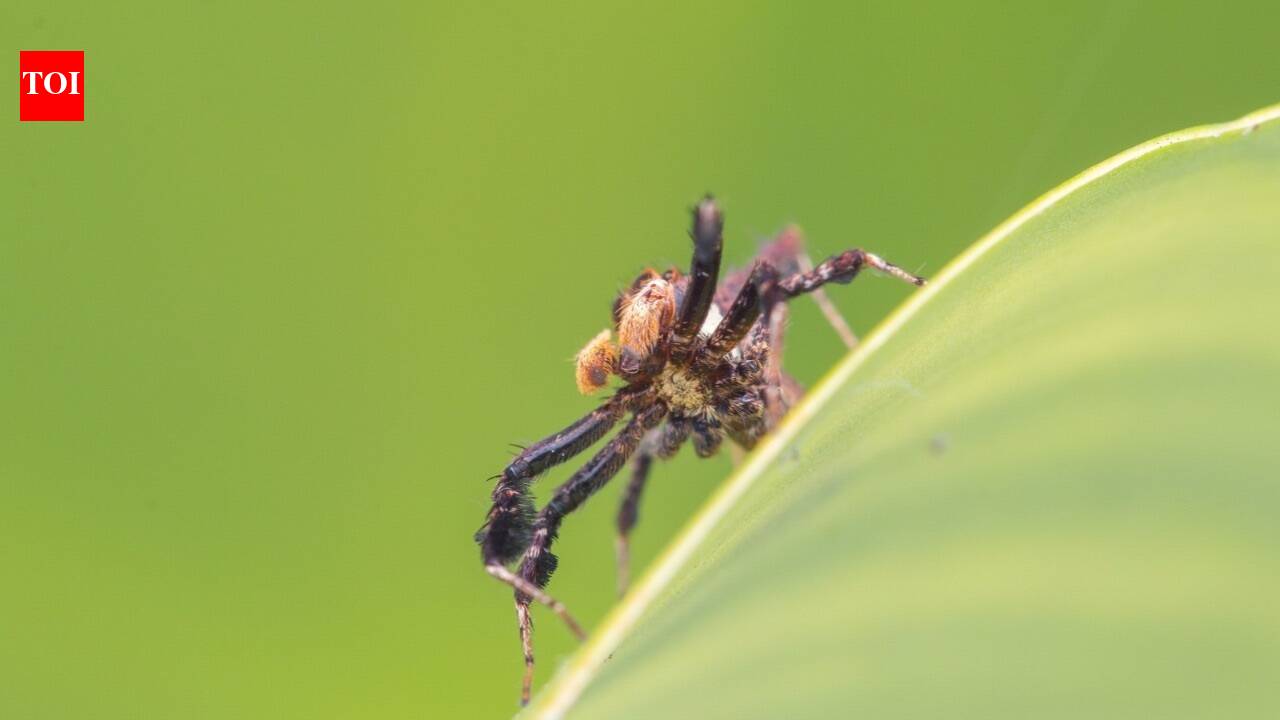
Do spiders dream? Researchers studying spiders have found sleep patterns resembling REM sleep

Read the original at Times of India ↗
Cite

TOI Lifestyle Desk. (2026, October 28). Do spiders dream? Researchers studying spiders have found sleep patterns resembling REM sleep. Times of India. https://timesofindia.indiatimes.com/science/discovery/do-spiders-dream-researchers-studying-australian-jumping-spiders-have-found-sleep-patterns-resembling-rem-sleep-raising-new-questions-about-dream-like-states-in-invertebrates/articleshow/135258133.cms

Dated from the outlet's own feed. Check the original for its byline.

Times of India · collected 2026-10-28 · by TOI Lifestyle Desk

Quick Summary

Researchers at the University of Bonn have observed that Australian jumping spiders (Portia fimbriata) exhibit sleep patterns similar to those found in humans, including periods resembling REM sleep. Published in the journal Proceedings of the National Academy of Sciences on October 27, 2026, the study involved monitoring the spiders' behavior over several days and nights using infrared cameras. The findings indicate that these spiders experience distinct sleeping stages characterized by eye movements and muscle twitches, raising questions about whether non-mammalian creatures might dream.
Written locally by qwen2.5:14b on 2026-10-28, using this article's own text rather than the other coverage of the same event (that is the story summary below).

AI analysis runs on qwen2.5:14b, locally

Story summary

A new study published in the Proceedings of the National Academy of Sciences reveals that Portia fimbriata, an Australian jumping spider species, experiences distinct sleep stages including one similar to REM sleep observed in humans. Researchers at the University of Bonn documented subtle eye flickers and leg curls while monitoring the spiders, indicating a complex sleep architecture previously thought to be unique to vertebrates. The study suggests that these arachnids have structured sleep patterns with clear differences between waking and sleeping states, challenging previous assumptions about the evolution of sleep in animals. While scientists are cautious about whether spiders might dream, the findings open up new avenues for exploring how sleep has evolved across different animal species. The team now plans to investigate spider sleep behavior in natural environments throughout Australia.

Written for “Spiders Show REM Sleep Patterns” on 2026-10-28, grounded in this article and the 1 other(s) covering the same event.

Story

📰 Spiders Show REM Sleep Patterns
Science · 2 article(s) covering the same event. See how they differ ↓

Compared with similar articles

This article reads unscored and hedges 13% of its claims. Each row says how that neighbour differs.
ABC News (AU)
⚖️ leaning not scored 🔴 20% hedged 6 of 30 📰 publisher trust 68
“Both articles report on the same scientific discovery about REM-like sleep in Australian jumping spiders (Portia fimbriata) as of October 27, 2026.”
How this article was measured signals, leaning charts, publisher record, byline, topics and claims

Signals How these are calculated →

Claims extracted
30
sentences that state something as happening or true
Uncertain
13%
4 of 30 hedged ("reportedly", "may", "according to")
Leaning
not political
takes no side on a contested political question
Publisher signals
59/100
Times of India's corrections and hedging, across everything collected from it. Not a measure of accuracy.
Outlets on this story
2
Science
Same framing elsewhere
1
articles that frame the event the way this one does
Analyzed 2026-10-28 · how these are computed

How this is being covered How these are calculated →

Article leaning vs. publisher reliability
Source leaning vs. consistency

Publisher

Times of India · 3546 article(s) · 2 correction(s) detected
Running correction rate · 2 correction(s)

Who wrote this

TOI Lifestyle Desk
52 article(s) here · 1 carrying a prediction
🔮 Scientists have long been curious to ascertain what may happen when other animals fall asleep.
🔮 Maybe it sounded impossible then, but now researchers have developed a groundbreaking invisibility cloak that can actually hide complex objects from infrared cameras while protecting them from extreme heat and cold.
🔮 The waters surrounding Japan have been changing in ways that may not be immediately visible to the people who depend on them.
🔮 When the Michael J. Fox Foundation for Parkinson’s Research launched a major study in 2010, the objective was to help scientists better understand the disease and identify markers that could improve the process of diagnosis and subsequent treatment.
🔮 However, an asking price does not establish what a property will ultimately sell for, and there was no confirmed sale at that figure.
🔮 A used car that has travelled 49,900 miles may seem like a better deal than one showing 50,000 miles on its odometer.
🔮 The authors interpret the renewed expansion as the beginning of the next glaciation, interrupted before a much larger continental ice sheet could develop.
🔮 A playground, public beach and other recreational facilities are expected to follow in later phases.
🔮 What makes this 15th-century Sussex house notable Stonehill House was featured in the architecture pages of Country Life in May 1923, when it was owned by Captain H. P. Dick, who reportedly bred dogs at the property.
🔮 Its next owner will also inherit a house that needs extensive modernisation.
Wire or desk byline, not an individual reporter.
Also by TOI Lifestyle Desk
Nothing else under this byline is closely related to this article, so these are simply their most recent.
All 52 articles by TOI Lifestyle Desk →

Topics

Australian Germany Proceedings of the National Academy of Sciences Science Daily the University of Bonn

Subjects

Australian NORP · 2× the University of Bonn ORG · 2× Canva ORG · 1× Canva AI ORG · 1× Germany GPE · 1× Proceedings of the National Academy of Sciences ORG · 1× Science Daily ORG · 1×

Narrative

Whether spiders can dream or not still remains to be know, but the ongoing inquiry and isnghts into the spiders night time behavouir and responses to external factors has offered a way for understandign how widley different features are distributed across the animal kingdom, with the research time likely to expand the inquiry into how animals sleep in their natural environments.
framing: assertive · carried by 1 article(s) · first seen 2026-10-28
🔮 Scientists have long been curious to ascertain what may happen when other animals fall asleep.

Claims (30 extracted, 4 hedged)

Dreaming is an experience we often associate with humans but is it something that only humans experience? asserted
humans → associate → that
Scientists have long been curious to ascertain what may happen when other animals fall asleep. uncertain
animals → ascertain → ?
While certain sleep behaviours have been observed in mammals and birds, much less is known about how sleep works in creatures with a distinct nervous system. asserted
sleep → observe → system
Researchers at the University of Bonn have studied the Australian jumping spider, Portia fimbriata, known to be a clever hunter. asserted
Researchers → study → spider
As Science Daily reported on the 27th of October 2026, researchers have discovered evidence of distinct sleep stages, including one that resembles the rapid eye movement (REM) sleep seen in humans, opening up new questions about whether spiders could experience something resembling dreams. uncertain
spiders → report → dreams
The study, conducted by researchers at the University of Bonn in Germany, examined the Australian jumping spider Portia fimbriata. asserted
study → conduct → spider
The findings, published in the journal Proceedings of the National Academy of Sciences, by monitoring the spiders on several days and nights found clear evidence that spiders experience regulated sleep, and a REM-like sleep that is “marked by eye movements and muscle twitches” .The observations also suggest that some features of sleep may be shared by animals separated by considerable evolutionary differences. uncertain
features → publish → differences
The choice of spider is particularly interesting because Portia fimbriata is known for its sophisticated hunting behaviour. asserted
fimbriata → know → behaviour
Members of the genus Portia prey on other spiders and use different strategies to approach and capture them which include imitating the vibrations of insects struggling in a webb, that can draw another spider towards what appears to be potential prey. asserted
what → prey → spider
Such behaviour has made these spiders interesting subjects for researchers investigating animal learning and cognition. asserted
spiders → make → learning
Their hunting strategies also raise questions about how their nervous systems support complex behaviour, making their sleep patterns another avenue for scientific investigation. asserted
patterns → raise → investigation
Although scientists have previously reported REM-like movements in jumping spiders, establishing whether these movements occur during genuine sleep required further investigation. asserted
movements → report → investigation
The latest study set out to examine not only the movements themselves but also whether the spiders showed other behavioural signs associated with sleep. asserted
spiders → set → sleep
What happens when spiders fall asleep? asserted
spiders → happen → ?
To observe the spiders, the researchers recorded their behaviour over several days and nights, using infrared cameras to monitor them in darkness. asserted
researchers → observe → darkness
Each individual Portia fimbriata spider was placed in the plastic dishes measuring 12 centimeters in diameter. asserted
spider → place → diameter
The animal was also monitored in different lighting conditions to examine distinguishable sleeping stages. asserted
animal → monitor → stages
The infrared camera helped monitor and reveal their distinct sleeping stages, asserted
camera → help → stages
The recordings revealed two distinguishable sleep stages, including a period of quiet rest followed by a stage marked by eye movements and muscle twitches, however this response does not necessarily mean that these animals experience the same REM sleep like humans. asserted
animals → reveal → humans
These movements are particularly noteworthy because rapid eye movements and changes in muscle activity are associated with REM sleep in humans and other vertebrates. asserted
movements → associate → humans
The similarities prompted researchers to investigate whether the spiders' behaviour represented a distinct stage of sleep rather than ordinary inactivity. asserted
behaviour → prompt → inactivity
However, the resemblance does not establish that spiders dream. asserted
spiders → establish → ?
The researchers relied on behavioural observations rather than direct examination of their brain activity, meaning they could not determine whether the spiders experienced dreams or what might occur in their brains during these periods. uncertain
what → rely → periods
The team also tested how readily the spiders responded to sound to test whether they were asleep or just lay motionless. asserted
they → test → sound
During the observed sleep stages, their responses to disturbances were delayed compared with when they were awake, and some spiders did not respond at all. asserted
spiders → observe → disturbances
Researchers additionally investigated "sleep rebound", a phenomenon in which an animal makes up for disrupted sleep afterwards. asserted
animal → investigate → sleep
Together, these observations provided evidence that the spiders experience regulated sleep with distinct stages, strengthening the case that their nighttime behaviour involves more than simply resting. Can spiders dream then? asserted
spiders → provide → more
Sciene Daily has come to note that while the Bonn University is in the process of expanding its research, what remains to be explored is the relationship between sleep and cognitive abilties. asserted
remains → come → sleep
However, what the research does tell us is that creatures that are seemingly small and jumpy can have complex sleeping systems just like us humans. asserted
that → tell → humans
Whether spiders can dream or not still remains to be know, but the ongoing inquiry and isnghts into the spiders night time behavouir and responses to external factors has offered a way for understandign how widley different features are distributed across the animal kingdom, with the research time likely to expand the inquiry into how animals sleep in their natural environments. asserted
animals → dream → environments

💬Give feedback
🕘History 🎫Support