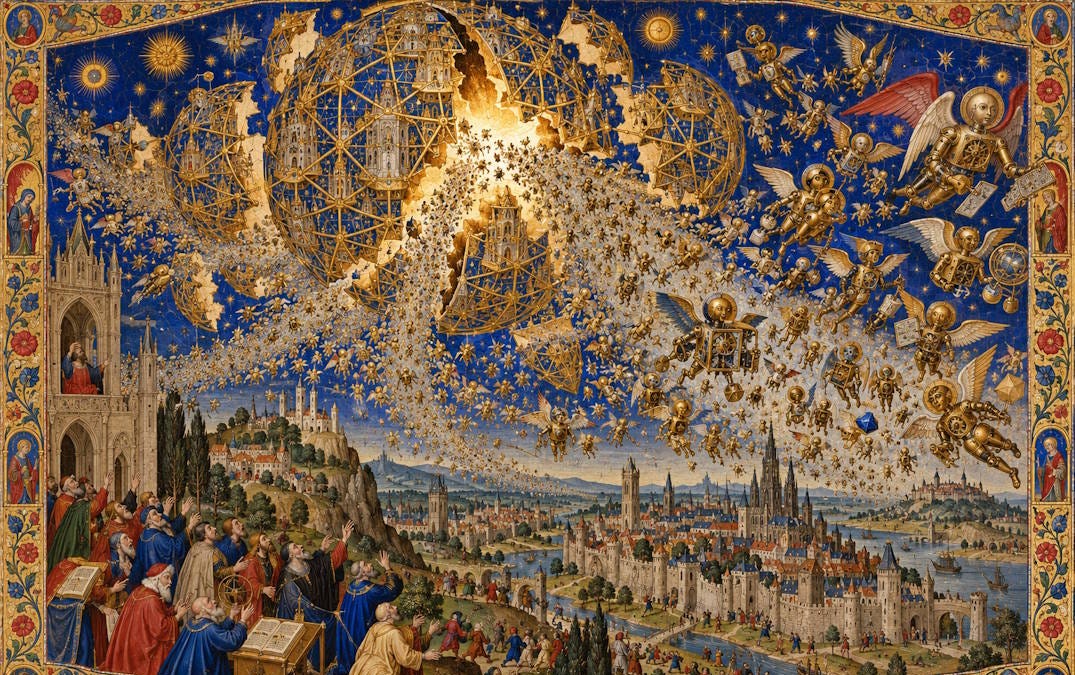
It’s almost hard to remember, but just a few years ago, a lot of very smart people thought that science was in terminal decline.
asserted
science → ’ → decline
Respected researchers were writing papers with titles like “Are Ideas Getting Harder to Find?”, “Papers and patents are becoming less disruptive over time”, and “Slowed canonical progress in large fields of science”.
asserted
Papers → write → science
In 1996, science writer John Horgan even published a book called The End Of Science: Facing The Limits Of Knowledge In The Twilight Of The Scientific Age.
asserted
Horgan → publish → Age
The fundamental idea was that the Universe only has so many insights to discover, and that we’ve picked the low-hanging fruit.
asserted
we → have → fruit
It was the idea that Joseph-Louis Lagrange expressed when he said that “we cannot find more than once a system of the world to establish.”
asserted
we → express → world
As the big ideas and the simple ideas get mined out, we’re forced to throw ever more brains at the mysteries of nature just to keep scientific progress going at a fraction of its old pace:
asserted
we → mine → pace
It looked like science was hitting a wall.
asserted
science → look → wall
Then along came AI.
asserted
AI → come → ?
It’s far too early to tell how much AI will eventually speed up the growth of total factor productivity.
asserted
AI → ’ → productivity
But already we can see signs of a speedup in science.
asserted
we → see → science
Anthropic Founder Jack Clark assembled some of the hopeful data points in a recent lecture:
asserted
Clark → assemble → lecture
Anthropic is accelerating its investment into drug discovery, and is already announcing some impressive preliminary results:
Claude also appears to be enabling rapid progress toward a treatment for food allergies.
asserted
Claude → accelerate → allergies
OpenAI, meanwhile, announced a possible breakthrough treatment for neurodegenerative disease.
asserted
OpenAI → announce → disease
Meanwhile, Google Cloud Chief Scientist Pushmeet Kohli has a list of recent scientific advances that have been enabled by its new Gemini model, including breakthroughs in nuclear fusion reactor design, rare disease research, and quantum computing:
asserted
that → have → design
But as cool as these stories sound, they’re just very minor, preliminary efforts.
asserted
they → sound → ?
There are a number of reasons to think that AI is going to propel us into a golden age of scientific discovery.
asserted
AI → be → discovery
That age might not last forever — AI might still run into diminishing returns eventually.
uncertain
AI → last → returns
But the next few decades are probably going to be an absolutely amazing time for human science.
asserted
decades → go → science
Until this year, that meant human brains — talented, highly trained human brains.
asserted
that → mean → brains
The number of trained human brains could be increased by sending more people to grad school, but only to a point — the smartest people tend to be sent into the hardest research fields first, and if you 10x the number of researchers, the average quality will go down.
uncertain
quality → train → researchers
This constraint was already starting to bite, as Ekerdt and Wu argued in 2024:
asserted
Ekerdt → start → 2024
We argue that a substantial portion of the downward historical trend in U.S. research productivity is a composition effect resulting from self-selection in researcher ability and the dramatic expansion of the research sector…[W]e find that this composition effect has lowered average researcher ability by between 37% and 53%[.]
And of course, low fertility was making the problem worse, because fewer children meant fewer people who were able to become future scientists.
asserted
who → argue → people
AI just blows up this constraint completely.
asserted
AI → blow → constraint
If an AI agent can function as an autonomous researcher, there’s no constraint on the number of researchers in the world — you can just build more of them, by building more computer chips and data centers that enable the running of more AI agents.
asserted
that → function → agents
Whether or not massive hordes of agents can collaborate to solve individual problems much faster, increasing the number of agents allows them to tackle many different research questions in parallel.
asserted
them → collaborate → parallel
What’s more, these AI “researchers” can be trained incredibly quickly compared to human beings.
asserted
researchers → ’ → beings
A human scientist takes decades to train, and more years to reach the frontier of their research field by diligent reading and conversation.
asserted
scientist → take → reading
This is the “burden of knowledge”, and it’s commonly believed to be one reason ideas have been getting harder to find — by the time human scientists can get up to speed, they’re often so old that their ideas are no longer novel.
asserted
ideas → believe → speed
AI just annihilates this constraint — it can assimilate the entire literature and reach the frontier of research extremely quickly, and it can also tell human scientists where the frontier lies without forcing them to discover that for themselves.
asserted
frontier → annihilate → themselves
It can also pivot to new research directions more easily than humans can.
asserted
humans → pivot → directions
Because scientific advances enable higher GDP, they enable more resources to be invested into the creation of yet more electronic “scientists”.
asserted
resources → enable → scientists
Now that doesn’t mean the amount of scientific research goes to infinity — there may still be some essential bottleneck task that human researchers are still needed to perform.
uncertain
researchers → mean → that
There are some indications that AI’s progress on open-ended conceptual research tasks is slower than in other dimensions, and it may be that humans are still needed to provide some of this long-term conceptual thinking.
uncertain
humans → be → thinking
I’d bet against this being true for much longer, but it might be true for a long time.
uncertain
it → bet → time
Even in this most “pessimistic” case, though, the amount of effective capital that scientists can use to leverage their work just went up by a lot.
asserted
scientists → use → lot
AI eliminates the theory bottleneck
Science proceeds by an iterative process of theory and experiment.
asserted
Science → eliminate → theory
The theory part of that cycle is typically short, but non-trivial — it took a couple of years after the blackbody radiation spectrum was observed for Max Planck to come up with the quantum hypothesis to explain it, and decades longer before quantum theory as we now know it was created.
asserted
we → take → it
It took about a year for Watson and Crick to figure out the shape of DNA after the requisite data was gathered.
asserted
data → take → DNA
AI will basically eliminate the theory bottleneck entirely — or at least shorten the turnaround time between experiment and theory by an order of magnitude.
asserted
AI → eliminate → magnitude
Recently, an OpenAI model solved some of the most important open problems in computer science, math, and theoretical physics, and no one even batted an eyebrow because that sort of triumph is becoming increasingly commonplace.
asserted
sort → solve → triumph
…and 47 more, not listed.
 The Aporia