“That is the exploration that awaits you.
asserted
that → await → you
There’s something about the mindset of really hardcore Star Trek fans that’s very difficult to describe to people who don’t share that fandom.
asserted
who → ’ → fandom
I can’t speak for all of us, of course, but for many of us, there is a sense in which the world portrayed in Star Trek is not quite fictional.
asserted
world → speak → Trek
No one regards it as an exact description of the future, of course, but there is a sense in which it represents one possible future that we must achieve — a “Star Trek timeline” that either we’re on or that we need to return to.
asserted
we → regard → that
The United Federation of Planets isn’t some fantastical interstellar alliance, but an organization that we must create, and whose ideals we must instantiate as the governing ethos of humankind.
asserted
we → create → humankind
Our quasi-religious commitment to this utopian future came from watching the Star Trek TV shows, but the different series inspired us in different ways.
asserted
series → come → ways
The original “Kirk and Spock” series, which aired in the 1960s, was more of a technological vision — the idea that one day we would zip around the cosmos getting into adventures, as easily as we’d zip around the world in a boat today.
asserted
we → air → boat
But Star Trek: The Next Generation, which aired in the late 1980s and early 1990s, gave us a different kind of vision.
asserted
which → air → vision
It was a moral future for the human race — a depiction of a better way that we could face the unknown and master our own personal challenges.
uncertain
we → face → challenges
It is the greatest TV show ever made, not by dint of a difference in degree, but because of a difference in kind.
asserted
It → make → kind
Every other show tries to thrill us by showing us how bad or how ridiculous or how exciting someone else’s world could be; Star Trek: TNG thrills us by showing us how beautiful our own world could become.
uncertain
world → try → us
For such a show to be put on the air required an incredible confluence of coincidences.
asserted
put → put → coincidences
For one thing, it was syndicated in its first run, meaning that it was free from constant interference by network executives.
asserted
it → syndicate → executives
The showrunner,1 Michael Piller, also did something highly unusual when he opened the show up to outside script submissions; this allowed in a whole lot of highly innovative episode ideas.
asserted
this → do → ideas
A lot of people — and even a lot of science fiction writers — assume that even as technology makes us more powerful, human nature will remain basically the same, with all its old petty short-sighted hatreds and jealousies and selfishness and so on.
asserted
nature → assume → hatreds
Roddenberry believed otherwise.
asserted
Roddenberry → believe → ?
He famously declared that the people of the future would actually be better people, free from the flaws of his day.
asserted
people → declare → day
And so he mandated that Star Trek: TNG have no internal conflict in its plotlines.
asserted
Trek → mandate → plotlines
Some of the writers chafed at that constraint.
asserted
Some → chafe → constraint
Interpersonal conflict is the bread and butter of drama — and always an easy plot device to fall back on when you need something to go wrong.
asserted
something → fall → drama
But because Roddenberry decreed it, the writers of TNG were forced to envision how the ideal human being would deal with various personal and external obstacles.
asserted
being → decree → obstacles
And so every episode gave us a thoughtful, probing exploration of what the ideal human beings — or at least, people much more morally and emotionally advanced than us — would look like.
asserted
beings → give → us
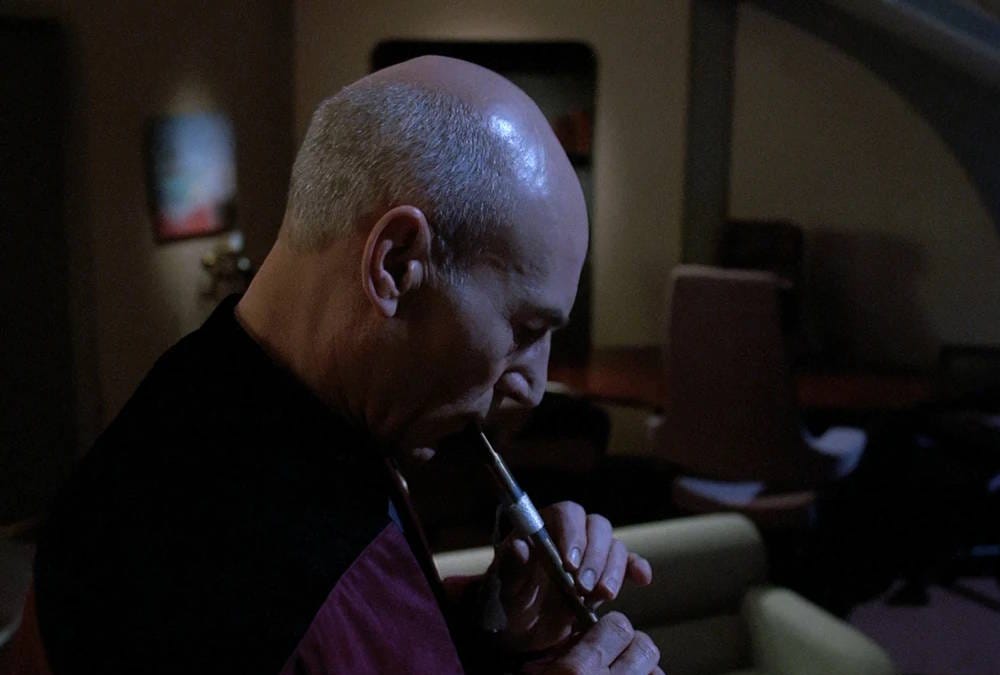
No character embodied that ideal more than Captain Jean-Luc Picard.
asserted
character → embody → Picard
It’s not his personal life that’s ideal — he famously puts career over family, leading to a life full of self-doubt and regret — but his approach to the world.
asserted
he → ’ → world
He will always try to understand the alien before he opens fire.
asserted
he → try → fire
He is a legendary battle commander but would always rather negotiate than fight.
asserted
He → negotiate → ?
He’s not necessarily the kind of man you’d want for a father, but he felt like one anyway.
asserted
he → ’ → one
He values all life, and all uniqueness, intrinsically; he is zipping around the galaxy in a starship in order to discover the Universe, and occasionally to save it, but most of all to understand and respect it.
asserted
he → value → it
He is a brilliant man, with many brilliant people under him, and occasionally he uses his intelligence to defeat an external threat.
asserted
he → use → threat
But he’s no swashbuckling space cowboy — more often than not, he succeeds in understanding the threat, and figures out how to help it achieve its goals without sacrificing his own.
asserted
it → ’ → own
Picard realizes that the highest application of intelligence is not to thwart your enemies, but to design a world in which you and they can live in mutually beneficial coexistence.
asserted
you → realize → coexistence
1990s America was a uniquely hopeful and liberal time in the world, and Star Trek’s greatest captain embodied the spirit of that too-brief moment.
asserted
captain → embody → moment
The character of Captain Picard was brought to life by the peerless acting skills of Patrick Stewart, who died two days ago at the age of 86.
asserted
who → bring → 86
Stewart’s acting career went far beyond Star Trek — he’s widely considered one of the greatest Shakespearean stage actors of his generation, if not of all time, and he played in dozens of films.
asserted
he → go → films
But the tributes that are flying thick and fast around the world today almost all focus on his role as Captain Picard.
asserted
that → fly → Picard
I’m of two minds about this.
asserted
I → ’m → this
As a very slightly famous person, I can tell you that public and private personas are very different things — if you meet me in real life, I won’t quite be the character you’ve imagined from my writings.
asserted
you → tell → writings
That goes triple for actors, whose job is literally to pretend to be someone else.
asserted
job → go → actors
He was, by all reports, a good man, well-loved by those who knew him and worked with him, but his strengths and his flaws were very different from those of the man he played on television.
asserted
he → love → television
To mourn his passing as the passing of Captain Picard is to engage in a parasocial relationship.
asserted
mourn → mourn → relationship
…and 36 more, not listed.
 The Aporia