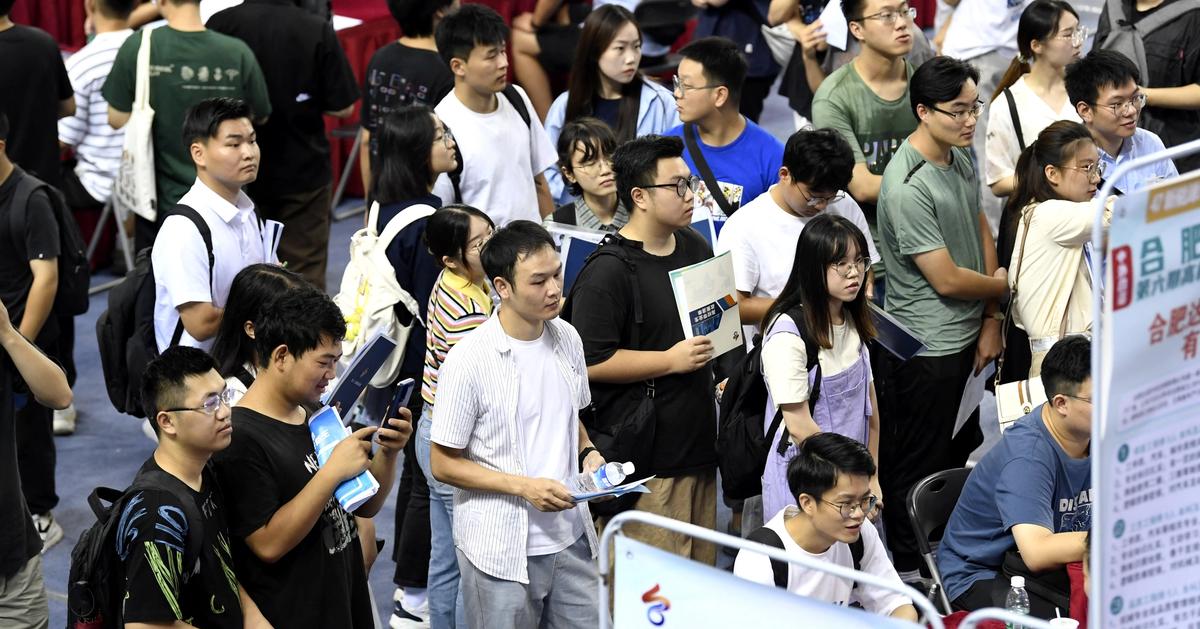
AI upends China’s graduate job market

Semafor · collected 2026-09-15 · by Tom Chivers
Read the original at Semafor ↗

Summary

AI is exacerbating challenges in China's graduate employment market, where an estimated 12.7 million graduates are entering the workforce this year. This surge in graduates coincides with a shortage of suitable jobs, particularly as AI begins to replace white-collar roles traditionally held by recent college graduates. Meanwhile, similar issues are emerging globally; for instance, AI is displacing Kenyan workers who earn money helping Western students complete essays, suggesting broader implications for employment across developing nations.
Written by the local model on 2026-09-15, using this article's own text rather than the other coverage of the same event (that is the story summary below).

Signals How these are calculated →

Claims extracted
5
claim-shaped sentences
Uncertain
20%
1 of 5 hedged
Leaning
Leans left
of the writing, not the subject
Correction & hedging signals
94.9
corrections and hedging in what we collected; not a measure of accuracy
Outlets on this story
1
Technology
Narrative spread
1
articles carrying this framing
Analyzed 2026-09-15 · how these are computed

AI analysis (generated at analysis time, not now)

Story summary

In China, AI is exacerbating the already strained graduate job market, with an estimated 12.7 million graduates expected to enter the workforce this year, marking the largest cohort yet. However, the supply of suitable white-collar jobs has not kept up with the rising number of college attendees, leading to a shortage of traditional roles and causing some graduates to apply for hundreds of positions without success. Similarly, in Kenya, AI is disrupting an industry where educated youth assist Western students in cheating on university papers, making it less lucrative as clients opt for AI tools like ChatGPT, which can perform the same tasks at a lower cost.

Written for “AI Disrupts Job Market” on 2026-09-17, grounded in this article and the 0 other(s) covering the same event.
Why this leaning score
The article's own words the score was based on. Each is quoted verbatim and was checked against the article text before being stored, so you can find it in the original.
Score -0.30 Confidence high 1 quote(s) discarded as not found in the article
Leaning score -0.30 for article 10697 (high confidence, 1 verified quote) · logged 2026-09-15

Story

📰 AI Disrupts Job Market
Technology · 1 article(s) covering the same event. This is the one the site leads with.

How this is being covered How these are calculated →

Article leaning vs. publisher reliability
Source leaning vs. consistency

Compared with similar articles

This article reads leans left and hedges 20% of its claims. Each row says how that neighbour differs.
Toronto Star
⚖️ Leans left 🔴 16% hedged 6 of 37 📰 publisher trust 62
“The articles discuss different aspects of AI's impact on China; one focuses on technological development and competition with the US, while the other discusses the effect on the graduate job market.”

Publisher

Semafor · 356 article(s) · 0 correction(s) detected
No corrections detected for this publisher. That may mean careful reporting, or simply that nothing has been checked.

Who wrote this

Tom Chivers
16 article(s) here · 1 carrying a prediction
🔮 An estimated 12.7 million graduates will join the workforce this year, the largest cohort yet.
2026-09-15 · assertive framing · AI upends China’s graduate job market
🔮 Answering that question would win a $1 million Millennium Prize Problem; OpenAI deployed around 10,000 agents of an as-yet unreleased powerful model on Aug. 28, and solved it within 88 hours, proving that the equations sometimes break down under extreme conditions.
🔮 And an underreported — we felt — story was that the disruption to fossil fuel supplies would drive up fertilizer prices.
2026-09-10 · assertive framing · Fertile ground
🔮 Paul Christiano — author of an influential 2016 paper on AI safety with future Anthropic founder Dario Amodei and a longstanding believer that the technology would take off relatively gradually and be made safe — said he now sees “meaningful risk” of “catastrophic and irreversible loss of control in the very near term.”
🔮 “Things could be out of control” by the end of next year, he argued.
🔮 “All it will take is one screw-up,” an immunologist warned.
2026-09-06 · assertive framing · Experts warn of threats of AI bioterrorism
🔮 The latest strikes were relatively low-key, but the White House is putting pressure on via other angles: The Treasury Secretary is expected to announce new sanctions on countries that deal with Iran.
🔮 LIV Golf, the Saudi-backed challenger to the US PGA Tour, could file for bankruptcy within days, the Financial Times reported, as the kingdom shifts position on several high-profile projects.
More on this subject from Tom Chivers
AI researchers say industry is 'gambling with our lives'
2026-09-09 · Semafor · 56% similar
All 16 articles by Tom Chivers →

Topics

China Kenya The New York Times Times Westerners

Subjects

Kenya GPE · 2× ChatGPT ORG · 1× China GPE · 1× The New York Times ORG · 1× Times ORG · 1× Westerners NORP · 1×

Narrative

AI’s impact, already being felt in manufacturing and food delivery, is now hitting white-collar work: “Listings for traditional roles are dwindling” and some graduates have applied for hundreds of jobs without success.
framing: assertive · carried by 1 article(s) · first seen 2026-09-15
🔮 An estimated 12.7 million graduates will join the workforce this year, the largest cohort yet.
2026-09-15 · Semafor
AI upends China’s graduate job market · assertive framing

Claims (5 extracted, 1 hedged)

AI is hurting China’s already weak graduate job market. asserted
AI → hurt → market
An estimated 12.7 million graduates will join the workforce this year, the largest cohort yet. asserted
graduates → estimate → workforce
But “the supply of… graduate jobs has not kept pace” with ballooning college attendance rates, The New York Times reported. asserted
Times → keep → rates
AI’s impact, already being felt in manufacturing and food delivery, is now hitting white-collar work: “Listings for traditional roles are dwindling” and some graduates have applied for hundreds of jobs without success. asserted
graduates → feel → success
Other countries have more unusual, if structurally similar, problems: AI is eating Kenya’s essay-farm industry, in which well-educated youths help Westerners cheat on university papers, The Times wrote: “Why pay a freelancer in Kenya when ChatGPT could do the job?” uncertain
ChatGPT → have → job
💬 Give feedback
🕘 History 🎫 Support