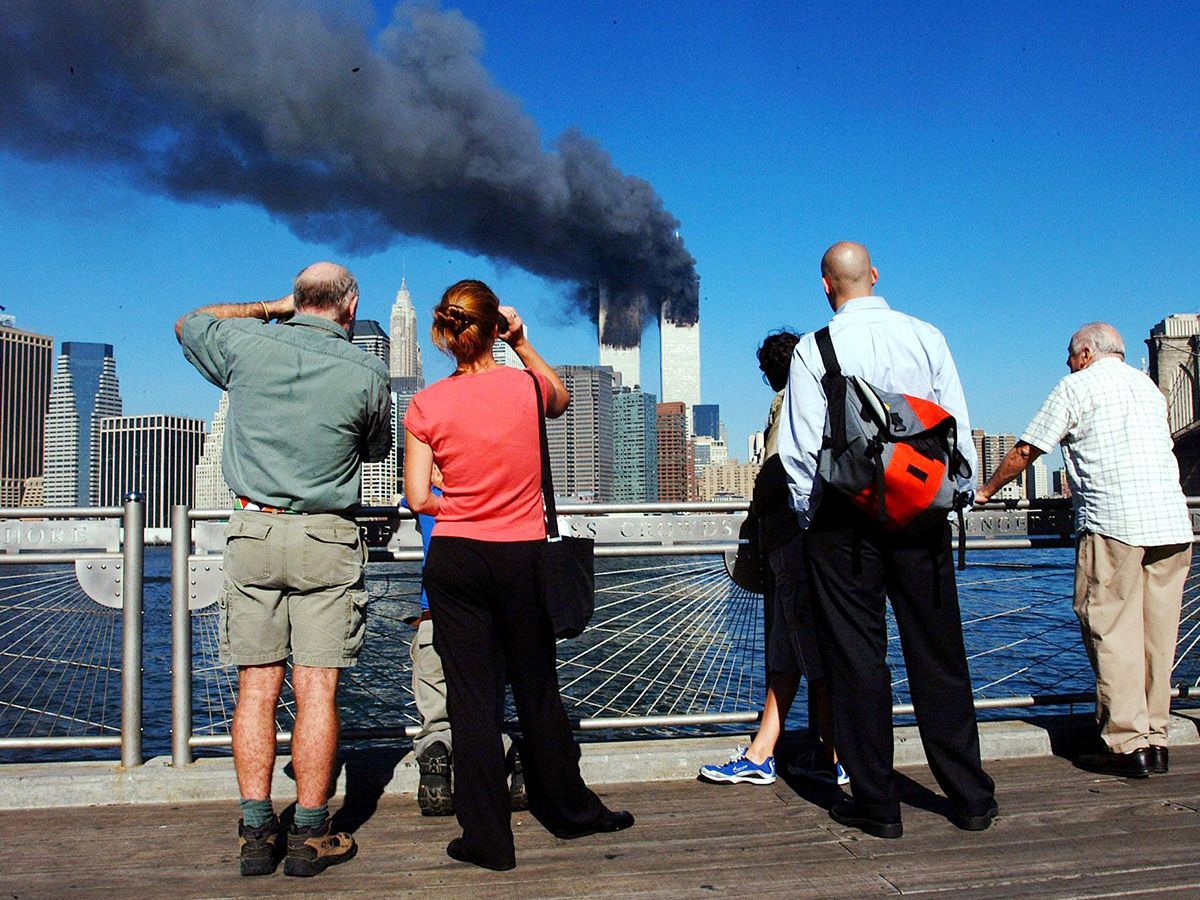
Before the 9/11 terrorist attacks, Steven Backman could usually cross the Canada-U.S. border with a simple wave.
uncertain
Backman → cross → wave
Backman, like many residents of St. Stephen, N.B., would travel frequently to neighbouring Calais, Maine.
asserted
Backman → travel → Calais
“When locals would go through the border, often the U.S. customs or the Canadian customs would just poke their head out, see it was a local person crossing, and just wave you through,” he said.
asserted
he → go → you
Going through the border would become less simple in the years after al-Qaeda operatives crashed passenger planes into the World Trade Center and the Pentagon on Sept. 11, 2001.
asserted
operatives → go → Sept.
Starting on June 1, 2009, U.S. law required Canadians to present a valid passport or another approved, secure document when entering the United States by land or sea.
asserted
law → start → land
Stricter requirements for arriving by air had already kicked in.
asserted
requirements → arrive → air
Canada recommends that U.S. citizens entering Canada carry a valid passport to prove identity and citizenship, regardless of age.
asserted
citizens → recommend → age
Backman, now mayor of St. Stephen, said things have become more relaxed at the border since the tense period immediately following the attacks.
asserted
things → say → attacks
But he routinely pulls out his passport when crossing.
asserted
he → pull → passport
“That’s never gone away.”
asserted
That → go → ?
It’s just one of the many ways the fear of international terrorism helped shape modern life after 9/11.
asserted
fear → ’ → 9/11
Twenty-four Canadians were among the nearly 3,000 people killed in the attacks.
asserted
Canadians → kill → attacks
Three days later, about 80,000 people attended a solemn memorial on Parliament Hill.
asserted
people → attend → Hill
Minutes of a Sept. 13 meeting of key Liberal cabinet members say John Manley, the foreign minister at the time, suggested the gathering be held outdoors as “a ceremony of the people.”
uncertain
gathering → say → people
The collective mood of shock and grief rapidly shifted to one of intense focus and activity as Canada grappled with the implications of 9/11.
asserted
Canada → shift → 9/11
Manley would soon head up the ad hoc cabinet committee on public security and anti-terrorism.
asserted
Manley → head → security
That committee reviewed proposals from departments to keep terrorists out of Canada, protect Canadians from attacks, devise tools to identify, prosecute, convict, and punish extremists, keep the Canada-United States border secure and open to trade, and work with the international community to bring terrorists to justice.
Manley worked closely with Tom Ridge, who stepped down as Pennsylvania governor to become the first director of the U.S. Office of Homeland Security.
asserted
who → review → Security
Manley noted Canada already faced American pressure over border security following the dramatic arrest of Algerian al-Qaeda extremist Ahmed Ressam, who was caught in December, 1999 trying to drive a carload of explosives into Washington state from British Columbia.
asserted
who → note → Columbia
His ultimate goal was to blow up Los Angeles International Airport.
asserted
goal → blow → Airport
“He was on our watch list and we had lost him,” Manley said in a recent interview with The Canadian Press.
asserted
Manley → lose → Press
“This was already a problem, that there was a perception that somehow we were a bit sloppy and that we were the soft underbelly.”
asserted
we → be → ?
Manley recalls seeing a sign of the enduring nature of the Canada-U.S. friendship while visiting Ridge at the White House – all of the photos on the wall outside the Oval Office were of the recent vigil in Ottawa.
asserted
all → recall → Ottawa
Ridge was raised in Erie, Pa., not far from the Canadian border, and told Manley about spending time in Toronto.
“He said he visited places on Yonge Street that he didn’t want his mother ever to know about,” Manley said.
asserted
Manley → raise → that
“And he said to me, the president’s instructions to him were to keep the United States safe, but not interfere with trade.
asserted
instructions → say → trade
He had the right direction from the top, and he and I built a relationship which continues to this day.”
On Dec. 10, 2001, the Chrétien government’s budget allocated $7.7-billion over five years to enhance security. More than $1.2-billion of that sum was aimed at strengthening the border by stopping individuals and shipments that pose a security risk while speeding up legitimate traffic.
asserted
that → have → traffic
Two days later, Manley and Ridge signed the Smart Border Declaration and released a 30-point plan that addressed issues ranging from biometric identifiers and permanent resident cards to aviation security standards and joint border and marine enforcement teams.
asserted
that → sign → standards
On Dec. 18, Canada’s new Anti-Terrorism Act received royal assent.
asserted
Act → receive → assent
The legislation allowed the federal government to brand individuals and organizations as terrorists, and to impose stiff penalties on anyone who participates in their activities or assists members of terrorist groups.
asserted
who → allow → groups
The law also gave police the power to make “preventive arrests” of those suspected of planning a terrorist attack, and required anyone with information relevant to the investigation of a terrorist act to appear before a judge.
asserted
law → give → judge
Many of the measures drew cries of outrage from civil libertarians.
asserted
Many → draw → libertarians
The government created the Canadian Air Transport Security Authority to carry out airport screening previously performed by airlines, an approach the government said would ensure consistency and accountability.
asserted
government → create → consistency
Ottawa also reorganized agencies to create the Public Safety and Emergency Preparedness Department, poured billions of new dollars into security intelligence organizations and assembled a no-fly list.
asserted
Ottawa → reorganize → list
Under a 2011 continental security pact, Canada and the United States agreed to set up co-ordinated systems to track the entry and exit information of travellers.
asserted
Canada → agree → travellers
The effort involves exchanging entry information collected from people at the land border, so that data on entry to one country serves as a record of exit from the other.
asserted
data → involve → other
The data includes the traveller’s name, nationality, date of birth and gender, the country that issued their travel document and the time, date and location of their crossing.
asserted
that → include → crossing
Despite the investment of energy, money and time in remaking the security landscape, Canadian officials often found themselves trying to dispel misconceptions.
asserted
themselves → remake → misconceptions
Manley said one of his assignments was to inform U.S. legislators – including Hillary Clinton – that none of the 9/11 hijackers entered the United States from Canada.
asserted
none → say → Canada
“And when corrected, her reaction was, ’Well, if they didn’t, they could have, and security trumps trade,’” he said.
uncertain
he → correct → trade
A quarter century after 9/11, Canadians are reminded of how their world changed every time they’re asked to remove their belt or discard liquids while going through airport security.
asserted
they → remind → security
Many routinely encounter airport-style scrutiny when attending sporting events, or even visiting city hall.
asserted
Many → encounter → hall
…and 20 more, not listed.
 The Aporia