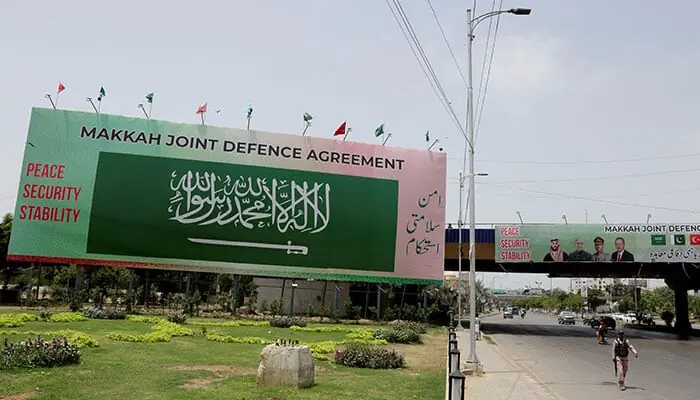
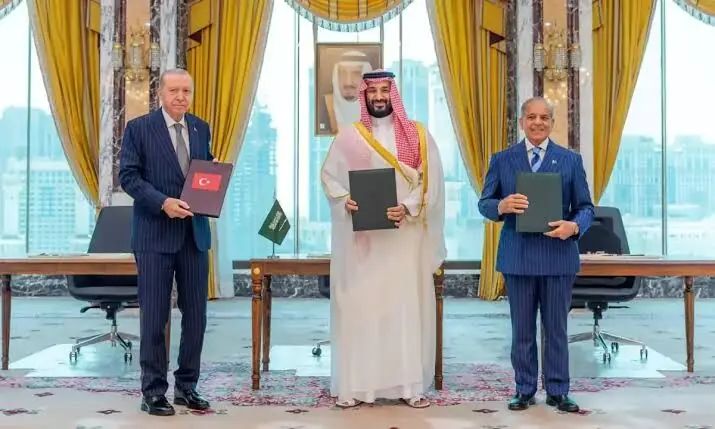
SINCE September 2025, Pakistan has signed multilayered and multi-domain defence agreements with several Arab and Muslim states.
asserted
Pakistan → sign → states
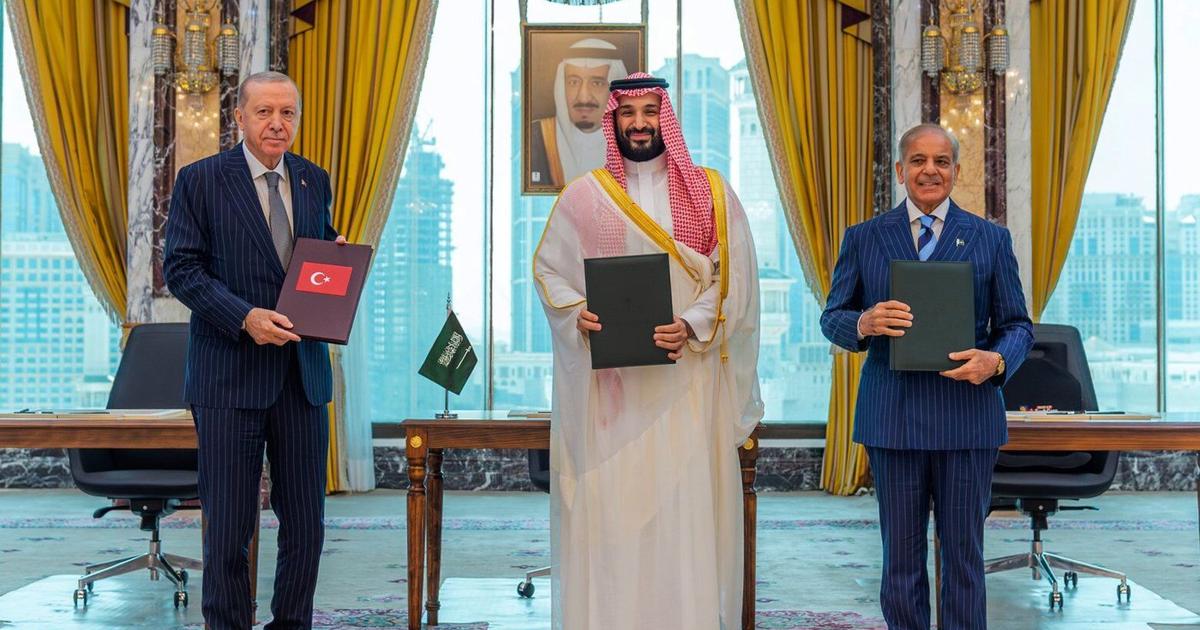
It has signed a Strategic Mutual Defence Agreement (SMDA) with Saudi Arabia, the Makkah Joint Defence Agreement (MJDA) with Turkiye and Saudi Arabia, and a defence pact with Kuwait.
asserted
It → sign → Kuwait
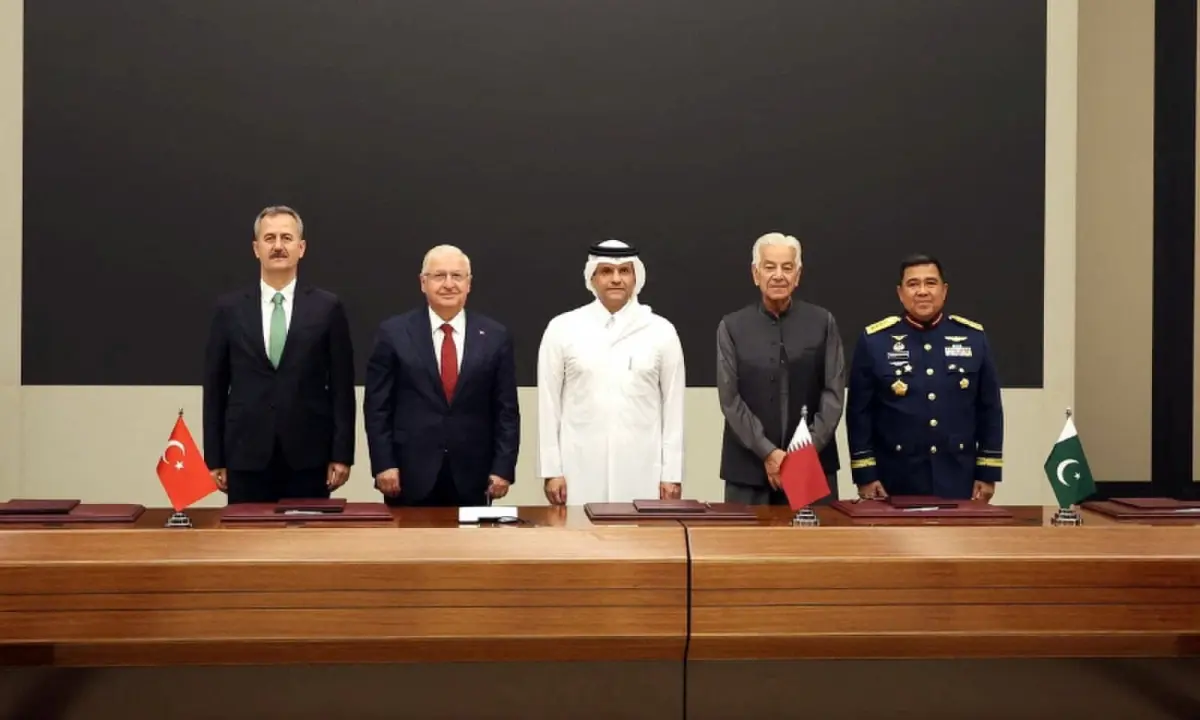
Pakistan has recently signed another defence agreement — the Badr agreement.
asserted
Pakistan → sign → agreement
These defence deals have, in the past year, increased Pakistan’s strategic relevance in the Middle East.
asserted
deals → increase → East
Interestingly, each accord carries the explicit provision for joint defence production and investment in the defence industry.
asserted
accord → carry → industry
This clause in every defence pact reveals Islamabad’s long-term strategic objective of moving from a buyer-seller relationship to a co-production partnership with reliable partners in the region.
asserted
clause → reveal → region
There are four primary strategic factors that have driven Islamabad’s emphasis on the joint defence production clause in each defence pact.
asserted
that → be → pact
The India factor remains the primary driver.
asserted
factor → remain → ?
New Delhi’s defence budget now exceeds $80 billion, and its rapid induction of advanced platforms has widened the qualitative gap.
asserted
induction → exceed → gap
Joint production arrangements with middle powers are likely to allow Pakistan to accelerate defence modernisation without bearing the full research and development cost.
asserted
Pakistan → allow → cost
By manufacturing components and subsystems domestically, Pakistan can sustain a higher operational tempo and maintain credible conventional deterrence.
asserted
Pakistan → manufacture → deterrence
Islamabad believes that strategic parity in South Asia does not require numerical equivalence.
asserted
parity → believe → equivalence
It primarily requires the ability to absorb, adapt, and indigenise technology at a pace that may prevent New Delhi from achieving decisive superiority over Islamabad.
uncertain
that → require → Islamabad
These defence deals, therefore, function as a force-multiplier for Pakistan’s conventional and strategic capabilities.
asserted
deals → function → capabilities
Pakistan’s defence pacts over the past year have increased its strategic relevance.
asserted
pacts → increase → relevance
Islamabad’s second strategic objective is the diversification of defence suppliers and reduced reliance of its defence supply chain on Western weapons.
asserted
objective → reduce → weapons
Historically, Islamabad has relied on Chinese weapons but the extent of dependency has increased significantly in the last two decades.
asserted
extent → rely → decades
The Stockholm International Peace Research Institute has noted that this dependency is nearly 80 per cent.
asserted
dependency → note → ?
Although Pakistan and China enjoy unprecedented trust and depth in their all-weather strategic relationship, in theoretical terms, heavy reliance on any single external source worries Islamabad.
asserted
reliance → enjoy → Islamabad
Similarly, Islamabad is increasingly seeking to decouple its military procurement from Western-reliant supply chains.
asserted
Islamabad → seek → chains
This approach is rooted in Pakistan’s historically bitter experiences with sudden embargoes and sanctions, alongside Islamabad’s broader resistance to the West’s tendency to use defence exports as political leverage over the Global South during geopolitical crises.
asserted
approach → root → crises
Primarily, Islamabad is eager to cultivate robust, non-Western defence partnerships to secure reliable and uninterrupted arms supplies free from the influence of foreign powers.
asserted
Islamabad → cultivate → powers
By integrating affluent Saudi and Qatari capital with the technologically advanced Turkish weapons industry, Pakistan is building an insulated, collaborative defence network with the middle powers to achieve this strategic objective.
asserted
Pakistan → integrate → objective
Islamabad believes that these defence deals, alongside its strategic alliance with China, may allow Islamabad to minimise its conventional vulnerabilities, help modernise its armed forces, and ultimately achieve a much higher degree of long-term strategic autonomy.
uncertain
Islamabad → believe → autonomy
Moreover, Islamabad is acutely aware that the intensifying US-China strategic competition will make it increasingly difficult to maintain a purely China-centric defence supply chain in the long run.
asserted
it → intensify → run
Therefore, by building parallel defence production partnerships with Saudi Arabia, Qatar, Turkiye, and Indonesia, Pakistan is creating a middle-power buffer to avoid unwanted political pressure from the US.
asserted
Pakistan → build → US
Interestingly, these countries are not fully aligned with either Washington or Beijing, and provide Islamabad greater room for manoeuvre.
asserted
countries → align → manoeuvre
Third, the economic factor equally occupies the strategic motivations of Islamabad.
asserted
factor → occupy → Islamabad
Pakistan wants to enhance its ability to modernise the defence production industry and increase defence exports.
asserted
Pakistan → want → exports
Pakistan’s official defence exports stood at approximately $280m in 2024.
asserted
exports → stand → 2024
The recently concluded deals can significantly enhance defence exports to $650-700m by 2027, crossing the $1bn mark by 2030.
asserted
deals → conclude → 2030
The Gulf states, seeking to reduce their own dependence on Western suppliers, constitute the most immediate and lucrative market for Pakistani defence exports.
asserted
states → seek → exports
Joint ventures under the Badr agreement, MJDA and SMDA are designed to produce systems that meet the Gulf’s operational requirements, while carrying Pakistani certification, and, crucially, a lower price tag.
asserted
that → design → certification
Successful penetration of these markets would generate much-needed foreign exchange for Pakistan, create skilled employment, and justify further capital investment in the domestic defence industry.
asserted
penetration → generate → industry
Beyond the Gulf, there is also potential for niche exports to African and Central Asian countries that face similar budgetary constraints and seek cost-effective, reliable platforms.
asserted
that → be → platforms
The fourth objective linked to the third is to attract foreign direct investment to Pakistan’s defence sector.
asserted
objective → link → sector
The joint production clauses are structured to encourage equity participation rather than simple technology licensing.
asserted
clauses → structure → licensing
Early commitments already indicate potential inflows of $1.2-1.5bn over the next five years in manufacturing facilities, testing ranges, and human capital development.
asserted
commitments → indicate → facilities
These investments will upgrade the physical infrastructure of Pakistan’s public-sector defence industry.
asserted
investments → upgrade → industry
These inflows can stimulate related industries, including electronics, metallurgy, and software, while creating thousands of high-skill jobs for individuals who would otherwise migrate overseas.
asserted
who → stimulate → individuals
…and 8 more, not listed.
 The Aporia